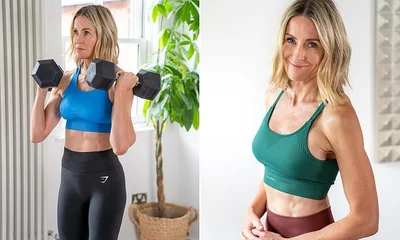
For most of my adult life, I thought I was doing everything right.
Like so many women, I believed cardio was the secret to staying fit. Throughout my twenties and thirties, I was a runner and, whenever I went to the gym, I’d head straight for the treadmill or StairMaster. I never ventured into the weights section because, if I’m honest, I assumed that was for bodybuilders and ’gym bros’.
Then, shortly after my 40th birthday, I spotted a woman in the gym with incredibly toned arms. I asked her how she’d got them, expecting her to tell me she’d found the perfect workout or fitness class. Instead, she smiled and said: ‘I lift weights.’
That conversation completely changed my life.
I started training with her twice a week and, despite years of running, my trainer didn’t even give me any weights for the first few sessions because my technique wasn’t good enough. It was a real eye-opener. I’d spent years improving my fitness, but whilst I was fit from running, I wasn’t actually strong.
Eventually I progressed to 3kg dumbbells, fell in love with strength training, qualified as a personal trainer and even opened my own gym.
Now, at 50, I genuinely feel stronger than I did a decade ago. Yes, I love having toned arms and feeling confident in sleeveless tops, but the biggest benefits have happened beneath the surface. From our mid-thirties onwards we naturally begin losing muscle mass, so strength training has become one of the best investments I can make in my bones, metabolism, energy and long-term health.
These are the habits I swear by...
1. I stopped believing cardio was enough
For nearly 20 years I believed running was all I needed. There’s absolutely nothing wrong with cardio and I still think it’s important, but lifting weights gave me something running never could. While I was fit from running, I wasn’t strong, and I didn’t realise how much difference that would make until I started strength training.
Now I encourage every woman over 40 to build muscle, not just because of how it looks, but because of what it does for your body. As we get older we naturally lose muscle mass, so preserving it becomes incredibly important for our strength, bones and metabolic health.
2. I started with 3kg dumbbells – and I’m proud of that
One of the biggest misconceptions I hear is women apologising because they can ‘only’ lift 2kg or 3kg weights. I always tell them that’s exactly where I started.
As I mentioned, my trainer didn’t even let me hold weights during my first couple of sessions because my form wasn’t good enough. We focused entirely on learning the movements properly, and only then did I graduate to 3kg dumbbells. Today, my home workouts use 12.5-20kg dumbbells for lower-body exercises and 6-12kg for my upper body, but none of that would have happened if I’d rushed through the basics.
I started by lifting ‘just’ 3kg dumbbells... now I use 12.5-20kg dumbbells for lower-body exercises and 6-12kg for my upper body
3. You don’t need to live in the gym
One of the biggest mistakes I see is women setting the bar far too high. They think they need to work out every day or spend hours in the gym and when life inevitably gets busy they end up giving up altogether.
For beginners, I actually recommend just two strength sessions a week. Once you’ve built confidence and consistency, increase that to three 30-minute sessions. My own ideal week is surprisingly simple: two full-body workouts, one upper-body session and between 8,000 and 10,000 steps every day. That’s more than enough to become stronger if you’re consistent.
4. My workouts are repetitive on purpose
Social media can make us think we need a brand-new workout every week, but I couldn’t disagree more. The basics deliver results, and I really believe the magic happens in the repetition.
If your squats are starting to feel easy, don’t abandon them for a complicated exercise you’ve seen online. Simply pick up a slightly heavier pair of dumbbells, slow the movement down or pause at the bottom of the squat. Small progressions like these are what build strength over time.
5. I never skip my ‘golden five’ exercises
One of the questions I’m asked most often is how to get more toned arms. Many women think they need to spend an entire workout doing bicep curls and tricep dips, but whilst those exercises absolutely have their place, they shouldn’t be the main event.
I always build upper-body workouts around what I call my ‘golden five’: chest press, bent-over row, Arnold press, bicep curls and tricep dips. The first three are compound exercises, which recruit several muscle groups at once and allow you to lift heavier weights, before finishing with the isolation exercises that target your arms directly.
I always build upper-body workouts around what I call my ‘golden five’
If you’re a beginner, try performing each exercise for around 45 seconds, followed by 15 seconds of rest, before moving on to the next. Repeat the circuit three times and focus on doing every repetition well.
6. I don’t waste time doing endless crunches
When women tell me they’re worried about their middle, they’re often surprised when I explain I don’t spend hours doing isolated ab exercises. The beauty of a well-balanced strength programme is that your core is already working throughout almost every movement.
Squats, lunges, bent-over rows and shoulder presses all force your core to stabilise your body, so you’re strengthening your abs without even thinking about it. If I do add dedicated core work, I keep it simple with dead bugs, planks and standing marches.
7. Slowing down transformed my results
One of the easiest ways to make strength training more effective is simply to slow down. Every lift should feel controlled and intentional. If you’re flying through your repetitions, the weights probably aren’t heavy enough.
Rather than rushing to finish a set, focus on lowering the weight slowly and maintaining good technique throughout. That’s what helps build muscle while also reducing your risk of injury.
8. I build every meal around protein
If I had to choose just one nutrition habit that’s made the biggest difference as I’ve got older, it would be making protein the starting point of every meal. I aim for around 30g each time, then build the rest of the meal around fibre, healthy fats and complex carbohydrates.
Breakfast is usually a bowl of oats with chia seeds, flaxseed and protein powder, or eggs with added egg whites. Lunch is often a chicken wrap with a high-protein yogurt, while dinner is usually salmon, chicken or sea bass with quinoa, lentils or sweet potato. If I fancy something sweet after dinner, I’ll have a couple of squares of 90 per cent dark chocolate or a protein chocolate pot, before finishing the day with a cold, crisp apple from the fridge and a mint tea. Eating this way keeps me fuller for longer and helps support the muscle I’m working so hard to build.
9. I take the guesswork out of healthy eating
I’ve found healthy eating becomes much easier when you remove as many daily decisions as possible. I often order the same lunch because I know it’s balanced, satisfying and rich in protein, and I batch-cook protein and vegetables so I always have the building blocks of a healthy meal ready to go.
That consistency frees up so much mental space. Instead of constantly wondering what to eat, I already know I’ll be giving my body what it needs.
10. I don’t panic if I only have ten minutes
The biggest mistake I see women make isn’t choosing the wrong exercises – it’s expecting perfection. Life gets busy and some days you simply won’t have half an hour to train.
I’d always rather someone did 10 or 15 minutes than skipped exercise altogether
I’d always rather someone did ten or 15 minutes than skipped exercise altogether because they couldn’t fit in a full workout. Something is always better than nothing, and those shorter sessions are often what keep healthy habits going long term.
11. Recovery is part of the programme too
Rest days don’t have to mean sitting completely still. I love going for walks, doing gentle stretching or spending ten minutes on a simple mobility routine to help my muscles recover.
Child’s pose is one of my favourite stretches, alongside gentle spinal twists and thread-the-needle, because they release tension through my back and shoulders after lifting weights. Recovery is part of training, not separate from it.
12. I stopped obsessing over the scales
My transformation hasn’t been about dramatic weight loss so much as changing my body composition. By the time I reached my mid-forties I’d already spent years building muscle, and I genuinely believe that gave me a strong foundation going into perimenopause.
Like many women, I’ve noticed that if I gain weight now it’s more likely to settle around my middle than it did in my thirties. But having more muscle ‘in the bank’ has helped me maintain my shape, strength and metabolic health during this stage of life.
13. I’m building a body that lets me say yes to life
The biggest surprise about being stronger at 50 isn’t how much I can lift – it’s how capable I feel every single day.
I can carry my own suitcase, move heavy furniture, lift bags of shopping, help my lovely old dog in and out of the car and head off on long walks without worrying whether my body will cope. I don’t ever want to turn down an opportunity or an adventure because I don’t feel strong enough or energetic enough.
I want to expand my horizons, not shrink them. For me, strength training isn’t about chasing the perfect body any more. It’s about building one I can rely on for decades to come.
For more fitness advice from Edwina Jenner, visit edwinajenner.com and follow her on Instagram @edwinajennercoaching.