As the country moves forward to attain its goals of Vikasit Bharat 2047, the armed forces as well as the defence industrial eco-system, buoyed by Aatmanirbharta are now looking at more ambitious goals to achieve during this period dubbed Amrit Kaal. A key area of thrust for the armed forces is to have constant surveillance over the frontiers. This necessity emanates from recent conflict experiences such as the Kargil War in 1999, in which the Pakistani Army captured key positions overlooking the national highway leading from Srinagar to Leh and more recently in Eastern Ladakh. Also, under the Mutual and Holistic Advancement for Security and Growth Across Regions (MAHASAGAR) doctrine, New Delhi is seen as the preferred security provider and first responder in the region. Thereby expanding the area of interest for the navy and the coast guard.
Why India needs an unbroken view from space
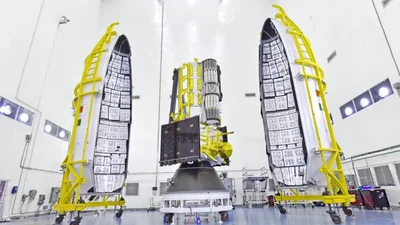
This has increased the need for constant surveillance over a vast and diverse area ranging from the maritime approaches to the highest mountain ranges in the world. The armed forces are now building, what is called the Space Based Surveillance Phase-III (SBS-III) programme. Under this initiative, approved by the prime minister chaired Cabinet Committee on Security in 2024, the armed forces will deploy a constellation of 52 satellites in the low earth and geo-stationary orbits.
These satellites will provide persistent surveillance, secure communications and maritime domain awareness across India's vast areas of interest both on land, as well as on sea.
Indiaâs space programme, long dominated by civilian applications, is now decisively expanding into the military domain. The SBSâIII initiative, approved at a cost of Rs 26,968 crore, will see 21 satellites built by
and 31 by private domestic firms, with deployment scheduled between 2025 and 2029. The constellation is designed to deliver persistent intelligence, surveillance and reconnaissance, secure communications and space situational awareness. Its architecture is based on proliferated lowâEarthâorbit satellites, which will include dozens of smaller, agile platforms rather than a handful of large ones, thus reducing vulnerability to antiâsatellite weapons and electronic warfare, this will ensure a greater level of redundancy and continuity of operations as China has declared anti-satellite capability.
Shortening the battlefield decision loop
The urgency to induct these systems also stems from
, which exposed blind spots in Indiaâs surveillance coverage. During the conflict, India relied on a mix of domestic satellites and foreign commercial assets to track the adversary's movements. Defence planners concluded that India must shorten what is called the Observe, Orient, Decide \& Act (OODA) loop, with the aim of detecting threats not at the border but deep within the adversary's territory, thereby giving additional warning time to the defenders. The SBSâ3 constellation is intended to provide that persistent coverage, with shorter revisit times and higher resolution imagery.
Watching the China-Pakistan military nexus
A parliamentary panel led by Shashi Tharoor has emphasised on the strategic significance of the programme. The panel has asked for a strict timeâbound implementation of the project. The committee linked the programme to Indiaâs broader Indian Ocean strategy, noting that the importance of maritime domain awareness in countering the ChinaâPakistan naval nexus, especially now when Islamabad is procuring greater number of Chinese-origin vessels. The panel's report also highlighted Indiaâs vast coastline, exclusive economic zone and dependence on sea lanes for trade, stressing that SBSâIII must deliver realâtime intelligence and enhanced surveillance to secure this flank.
The private sectorâs role in this project is also critical. Under the revised Space Policy 2026, private firms have been encouraged to take a greater share in the manufacture and maintenance of military constellations, reflecting a global trend where commercial players are an integral part of national security and space programmes. Of the 52 satellites that are to be deployed under this flagship programme, 31 are to be built by private players, while the remaining 21 will be built by the Indian Space Research Organisation (ISRO). The SBSâIII project is seen as a test case for private industryâs active engagement, noting that companies will be responsible not just for building satellites but for sustaining them through lifecycle support. This marks a shift from ISROâs traditional dominance to a more distributed ecosystem where private firms are accountable for operational readiness.
From a handful of satellites to a constellation
India's space-based surveillance project was initiated by late prime minister
. Under the first phase of the project, ISRO developed and launched satellites such as Cartosatâ2A, Cartosatâ2B, RISATâ1 and RISATâ2. The second phase of the project was launched in 2013, by the Manmohan Singh government and the satellites launched were the Cartosatâ2C, Cartosatâ2D, Cartosatâ3A, Cartosatâ3B, MicrosatâTD, MicrosatâR and RISATâ2A. These satelllites improved Indiaâs surveillance architecture, combining optical and radar payloads to provide roundâtheâclock monitoring irrespective of weather or light conditions. This progression from PhaseâI to PhaseâII illustrates how Indiaâs spaceâbased surveillance programme has steadily evolved from a handful of satellites to a more distributed constellation, setting the stage for the much larger PhaseâIII rollout now underway.
Globally, the United States and United Kingdom are also moving toward distributed constellations, a response to antiâsatellite demonstrations that exposed the risks of relying on a few large platforms. Indiaâs adoption of proliferated LEO satellites reflects those lessons. The constellation will carry hybrid payloads combining synthetic aperture radar with highâresolution optical sensors, enabling roundâtheâclock monitoring irrespective of weather or light. Secure communication links will improve commandâandâcontrol redundancies.
India is also developing counterâspace capabilities, including electronic warfare and kinetic options, to protect its assets. The Anti-satellite weapons (ASAT) missile tested by India and announced by PM Modi, was fired on the MicrosatâR satellite, launched as part of SBS-II. To prolong the service of these satellites, the armed forces are also planning On Orbit Maintenance and Refuelling (OOMR) of these satellites as well as other systems to ensure an extended service life.
The strategic context is stark. Chinaâs military space programme has expanded from 36 satellites in 2010 to over a thousand now. More than 500 Chinese satellites are dedicated for Intelligence, Surveillance and Reconnaisance (ISR) missions, according to US Space Force. Pakistan also benefits from Chinese technology transfers as well as the sharing of intelligence between the two countries. Against this backdrop, SBSâ3 is not just a technological project but a strategic necessity, to ensure that India can monitor adversary's deployments against its own borders, secure its maritime approaches and maintain deterrence.
With a 52âsatellite constellation, a joint doctrine integrating space power, cyberâspace frameworks and privateâsector participation, India is building a resilient, multiâlayered military space architecture. The parliamentary panelâs insistence on strict timelines reflects the urgency of the task. As critical parts of warfare on earth extends into orbit, Indiaâs space assets will increasingly shape outcomes, ensuring future conflicts are contested not only on land, sea and air but are also shaped by our very own constellation.