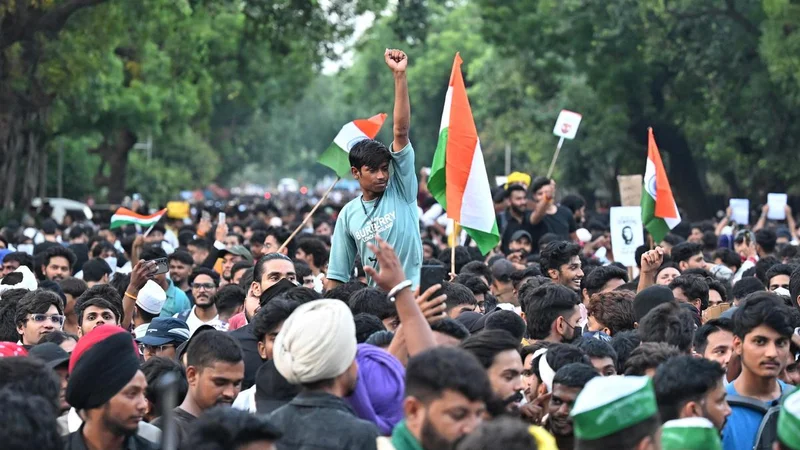
In recent days, numerous protesters declared online that they were leaving their family WhatsApp groups, which had become dens of bigotry and thought control
\| Photo Credit: Shashi Shekhar Kashyap
The WhatsApp generation were Hindutva natives while the Instagram generation is insurrectionary. The BJP has had the toolkit to tame the WhatsApp universe and make it dance to its tune; in the Instagram universe, the BJP is like a deer in the headlights, left with nothing other than brute force in response.
Parents who have sent a message to their kids on WhatsApp and noted that they don’t even see it will recognise a disconnect. Then they discover that their kids these days communicate on Instagram, Snapchat, etc. The parents then set out to find their children on Instagram — but more often than not, they just cannot even find them. That is the disconnect between the WhatsApp generation and the Instagram generation. That is the disconnect that is mirrored in the disconnect between the BJP-controlled Indian state and the country’s youngest generation.
WhatsApp was founded in 2009; Instagram in 2010. WhatsApp has over three billion users compared to Instagram’s 2.35 billion. Social media usage trends are not cleanly mapped, but what can safely be said is that Instagram, Snapchat and TikTok are the preferred platforms of the younger generation, while older users who are on these platforms are playing catch-up.
Boomers on Instagram are more likely to be interlopers who feel it. It is on WhatsApp groups that the 50-plus generation revel, earning for themselves the sobriquet “WhatsApp uncles”. It is a case in which the gender bias in the nomenclature is entirely appropriate.
*Comment \| The cockroach dilemma facing India’s political parties*
The WhatsApp generation prospered in the pre-BJP era, found jobs relatively easily during the growth years, and moved to urban centres. They were Hindutva natives who found in WhatsApp an instrument of empowerment when they were in their thirties. They believed whatever was forwarded to them on WhatsApp and instantly forwarded it further. And they multiplied their prejudices and their half-baked history lessons. Part of this generation left India for the West as temporary workers and waited for the citizenship of a foreign country. They wanted the children of others to restart the battles that their forefathers allegedly lost thousands of years ago.
They could not see what their children were thinking, and they continued to preach. And the state and the WhatsApp Uncle began to sound more and more alike: learn one more language or else; eat this and don’t eat that; marry this way or else; dress this way or else; and, to top it all, “If you can’t find a job, create one.”
In recent days, numerous protesters declared online that they were leaving their family WhatsApp groups, which had become dens of bigotry and thought control.
Two examples of this dramatic generational shift, which is not confined to India but is actually global, are worth noting: one macro and another micro.
In Tamil Nadu, several reporters found during the Assembly election campaign that children in many families rallied behind C. Joseph Vijay and his Tamilaga Vettri Kazhagam, while their parents tried to maintain their bonds with the established Dravidian parties.
In the United States, Republican politician Nikki Haley is a staunch supporter of Israel and American militarism, while her son Nalin Haley, born in 2001, is a strident critic of both. In the U.S., the TikTok-Instagram generation has dismantled the bipartisan consensus over Israel and American militarism.
Instagram is the underground of insurrection, a route of escape and, in some ways, a digital reincarnation of the Underground Railroad. Its users cannot be tamed by the ED or the CBI because they are not entangled in the multi-party establishment of embezzlement and corruption. The only tool that the state has to tame a generation that its parents cannot is brute force. Brute force may succeed in the geographic and social peripheries of the nation, but in the heartland, things are more complicated.
The question, therefore, is how much of it can be used, and for how long. And at what point will the ‘WhatsApp uncles’ realise that these children are, after all, their children?
Published - July 23, 2026 01:08 pm IST