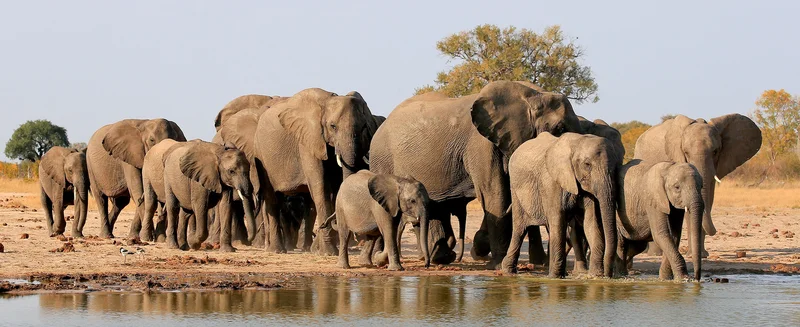
North West clearly doesnât want Parliament to interfere with its controversial elephant management plan, which includes the possibility of mass culling.
The best way appears to be to ensure that, when requested by the parliamentary environment committee, North Westâs MEC for economic development, environment, conservation and tourism Bitsa Lenkopane simply fails to turn up â and her department submits an incomplete report.
On 11 August, Lenkopane was again absent when North West appeared before Parliamentâs committee on forestry, fisheries and the environment to explain its plans for managing elephants in Madikwe and Pilanesberg. Her apology said she was attending a sitting of the North West legislature and would join the virtual meeting if she finished in time. She didnât appear.
Sheâs done this before.
Parliamentary committee chairperson Nqabisa Gantsho was furious: âSeveral undertakings were made at the conclusion of the previous meeting, including written responses, details on concession agreements and land claims, information on employee ownership and transformation statistics, and submission of the final PETT (Provincial Elephant Task Team) report.
âMost of these reports from the department have still not been submitted to Parliament, which cripples and undermines the work of Parliament.â
DA MP Andrew de Blocq reminded the committee that the MEC had failed to attend a previous meeting on the issue. âItâs the second week in a row that weâve been pushed out by the MEC,â he said âShe has already forced a postponement of this agenda item.â
Culling worry
The MECâs absence left officials and North West Parks representatives to gloss over a strategy that could lead to nearly 1,000 elephants being removed from Madikwe over five years. The options include translocation, contraception and lethal removal. Hunting has also been retained as a possible intervention.
The scale and controversy of the plan might have suggested a need for maximum disclosure. Instead, MPs were given a presentation based on a provincial task team report they had not received. Notably, the conclusion of the report was not detailed.
De Blocq described that presentation as âfairly scantâ and asked when the complete report would be released for public comment.
âThere were 34 different scenarios that the team evaluated,â he said. âWhat other 33 scenarios or management interventions were considered by the task team? That would be very useful for us and the general public at large to be able to interrogate this in proper detail.â
North West officials confirmed that the report existed, but could not tell committee chair Gantsho when it would be made public.
âYes, we do have it,â a North West Parks official responded, âbut we are still making sure that we work on everything that has to be worked on⦠The next step is for it to go to the public, and definitely weâll make sure that it reaches the public in due course.â
âIâm not convinced by your response,â Gantsho responded, â because I do not understand: if youâre saying the report is readyâ¦â
Wider breakdown
The failure to produce the task team report was part of a wider breakdown in accountability. During an October 2025 oversight visit to Madikwe and Pilanesberg by parliamentarians, North West officials undertook to provide reports on concession agreements, land claims, transformation, community benefits and the final elephant task-team findings.
Nine months later, none of those reports had been submitted.
In her opening remarks, Gantsho said this âcripples and undermines the work of Parliamentâ. She said the committee expected evidence of progress, firm timelines and accountability, all of which were missing from the provinceâs submission.
âWhat we are doing today is what we were doing during oversight nine months ago,â said MK Party MP Siyabonga Mkhize. âWhat I just realised is that we are just back to square oneâ, where it had been during the oversight visit.
âThis presentation cannot simply become another collection of scientific recommendations,â he said. âImplementation requires names, budgets, deadlines and measurable benefits to communities. Otherwise there is no accountability.â
Mkhize noted that the province still had no costed implementation plan, clearly identified funding or time-bound accountability structure.
Another committee member, MKâs Tshepo Themba, said MPs had expected the MEC and her team to submit the outstanding report. âSo far, nothing has been done, so we are disappointed on that matter,â he said. Even the customary list identifying the North West delegation had not been sent to the committee before the meeting.
Reading the tone of questioning, it appeared that, taken together, the absent MEC, missing reports, incomplete submission and refusal to provide publication dates suggested more than simple administrative disorganisation. It showed a provincial authority treating oversight by the countryâs highest legislative body as an inconvenience.
NSPCA exclusion
The most confrontational exchange concerned the exclusion of the NSPCA from the Provincial Elephant Task Team. A directive from the committee chair, said de Blocq, issued more than a year earlier, that the statutory animal-welfare body be included, had been ignored. The NSPCA had also not been given the task teamâs minutes.
âThe Madikwe-Pilanesberg concessionaires have been consistently excluded from this process,â de Blocq said. âThe Madikwe-Pilanesberg communities have been excluded from this process. They also donât have representation on the Provincial Task Team.â
This was particularly serious, he said, because communities were significant landowners and the task team was making recommendations affecting tourism, cultural sites and community businesses.
North West Parks chairperson Dr Mathews Mogopa defended the NSPCAâs exclusion by arguing that, because its statutory focus was animal welfare and because elephants in Madikwe and Pilanesberg were not hand-fed animals, but animals that fended for themselves, âthere shouldnât be an impression that it is obligatory and mandatory by law for the MEC to then include themâ.
He said it was up to the MEC to determine when to involve the NSPCA on issues relating to its welfare mandate.
Gantsho rejected that position. âWe are not happy,â she said. âIt is unacceptable â the exclusion of the communities and NSPCA and also the concessionaires from the issues that directly affect them.â The provinceâs claim that the MEC could decide whom to invite, she said, was âreally unacceptable [to] us. We canât allow that to happen.â
Gantsho said the committee would raise the matter with the national minister and deputy ministers.
While the Animal Protection Act does not automatically give the NSPCA a seat on every governmental task team, it does permit it jurisdiction and investigative rights to prevent animal ill-treatment and wide investigative powers into the treatment of animals within human control, as at Madikwe.
Crisis created through delay
MPs also challenged North West Parks over its failure to introduce elephant contraception when it was offered at no cost years ago.
An agreement with Humane World for Animals was concluded in 2022, but the programme was never implemented. The NGO remains on standby to implement this.
Earlier evidence to Parliament indicated that the delay had resulted in at least 400 avoidable elephant births, with many adult females now pregnant.
âWhy wasnât contraception implemented five or 10 years ago?â de Blocq asked. âThere have been offers of free contraceptive services. There are MOUs in place.â
A North West technical representative conceded that contraception had been a âmissed opportunityâ and said he could not explain why it had not been implemented.
That failure now sees North West claiming Madikwe requires urgent intervention, with more than 1,600 elephants in the fenced reserve.
The province and parks board had âcompletely failed to be proactiveâ, said de Blocq, creating the crisis they now claimed to be managing. It was a situation intensified by years of official inaction.
He also refuted hunting being presented as a population-management tool, calling it an economic tool that could be âdangerous and recklessâ in reserves dependent on international photographic tourism.
MPs asked who would benefit financially from elephant removals, whether hunting would damage tourism and whether the logistical and financial feasibility of killing or moving hundreds of elephants had been assessed. Clear answers were not provided.
What is North West hiding?
While North West did not expressly tell Parliament that it lacked the power to summon the MEC, its conduct sent a similar message: the committee may request attendance, reports and stakeholder participation, while the province decides whether to comply.
MP questioning revealed that the complete task-team report remains hidden, the alternative scenarios remain hidden, the costs remain unknown, the implementation dates remain vague and the communities, concessionaires and NSPCA remain outside the body making the crucial recommendations.
Until the province releases the complete report, explains its failure to implement contraception and allows all affected parties into the process, an inevitable question will continue to hang over Madikweâs elephants: What are North West Parks and MEC Lenkopane trying to hide? DM