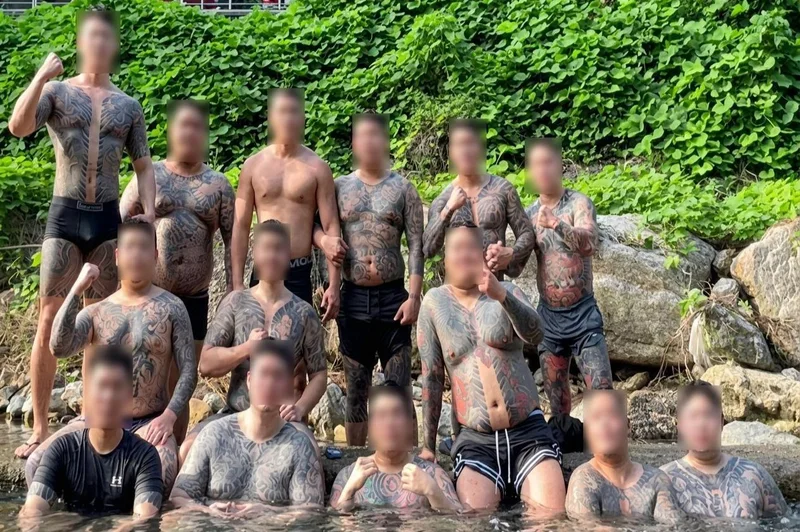
Members of the Dongdaemun gang pose during a retreat in Yangju, Gyeonggi Province, in July 2024. Courtesy of Seoul Metropolitan Police Agency
Police recently apprehended a new generation of organized crime members who maintained traditional gang rituals — such as communal living, forced chest tattoos and rigid codes of conduct — while expanding into emerging financial cybercrimes, including voice phishing and online investment scams.
The Seoul Metropolitan Police Agency's Metropolitan Crime Investigation Division said Thursday that it arrested 40 members of the Seoul-based Dongdaemun gang and three affiliated syndicates on charges of forming and participating in a criminal organization under organized crime statutes. With the exception of the boss and senior advisers, all gang members are in their 20s and 30s.
Police placed 14 individuals in pretrial detention, including a 33-year-old gang enforcer. Investigators established the organization's structure for the first time by analyzing criminal records, seized evidence, communication logs and surveillance video.
Police launched the investigation in February after obtaining surveillance footage of a group assault committed by Dongdaemun gang members in Gangnam District in September. Investigators tracked the gang's recruitment activities, arresting 14 members and raiding 16 locations in March. Seven more Dongdaemun members and 19 affiliated gang members were subsequently arrested, bringing the total number of suspects to 40.
Local youths formed the Dongdaemun gang in 1996 in northeastern Seoul. It actively recruited new members from 2017 through February. The arrested gang enforcer and other operatives targeted local youths from middle and high schools, persuading 16 individuals to join by boasting that their syndicate had deep roots dating back to crime boss Lee Jung-jae, a notorious postwar mobster with political ties, as seen in the 2002 period drama "Rustic Period."
Lee Jung-jae, left, a notorious postwar political gangster, stands trial in court for disrupting a Democratic Party rally at Jangchungdan Park in Seoul. Korea Times file
New recruits lived in shared housing across Seoul and Incheon, where they were indoctrinated into gang hierarchy and strict codes of conduct before committing violent crimes. Subordinates bowed 90 degrees to seniors, addressed them as "hyeongnim," or older brother, and were forced to get chest tattoos of the gang's name in Chinese characters.
The gang enforced loyalty by threatening defectors with mutilation by sashimi knives — weapons commonly used by Korean gangs — while providing commissary money and legal fees to detained members.
Gang members attended affiliated syndicate events in large groups to provide an intimidating show of force, and they routinely mobilized for mass brawls during territorial disputes.
Members fought a rival gang in Suwon, Gyeonggi Province, in 2020, and engaged in a standoff involving roughly 50 affiliated gang members at a Gangnam restaurant following a dispute in February. Police also found that gang members chased down and assaulted a rival gang member in Gangnam District in September 2023 because he brushed past a high-ranking member during a dinner gathering.
Investigators suspect the Dongdaemun gang was also actively involved in emerging financial scams. Since 2013, members operated a voice phishing call center in Qingdao, China, managing domestic cash couriers and mule accounts in Korea.
Police uncovered evidence that the gang traded personal information databases and ran fraudulent online investment chat rooms. The syndicate formed partnerships with peer-group gangs in central and southwestern Seoul to jointly conduct illegal financial operations.
Police filed organized crime charges against the suspects, which carry severe statutory penalties. Gang leaders face a minimum of seven years in prison, while rank-and-file members face at least two years of imprisonment. Police obtained arrest warrants for two members currently residing abroad and are seeking their arrest through international law enforcement cooperation.
Members of the Dongdaemun gang bow at a 90-degree angle during an event hosted by an allied syndicate in Jungnang District, eastern Seoul, in March 2022. Courtesy of Seoul Metropolitan Police Agency
Bae Eun-cheol, head of Metropolitan Crime Investigation Unit 2 at the Seoul Metropolitan Police Agency, said the key outcome of the investigation was establishing that the group operated as an organized crime syndicate with a hierarchy and continuity.
"Organized crime groups are not merely posturing," he said, "They reap criminal proceeds through illegal businesses that ultimately harm the public and must face strict punishment."
This article from the Hankook Ilbo, the sister publication of The Korea Times, is translated by a generative AI system and edited by The Korea Times.