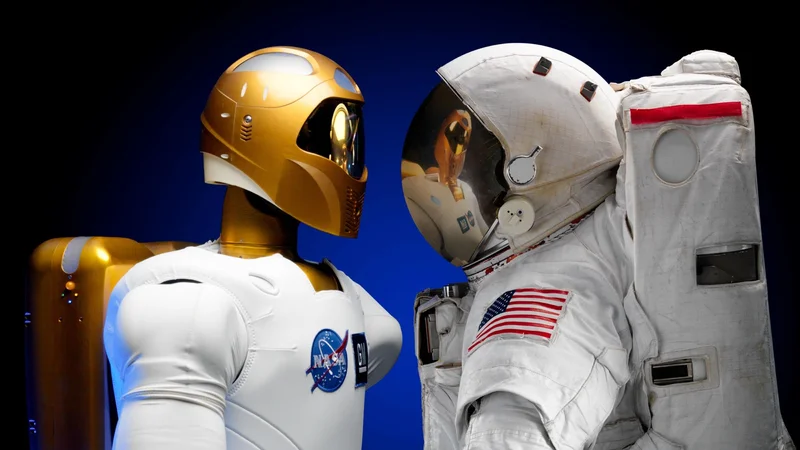
The most useful robots on Earth look nothing like us — they're rolling boxes, laser-armed gantries, and robot dogs, not the humanoids we were promised. Here's why function is quietly beating form in the design of machines. And, in the background, why the race to build them has become a defining rivalry between the United States and China — with Japan playing a shrewd third hand.
On the night of June 2, 2026, a Chinese robot dance troupe upstaged every human act on the season premiere of America's Got Talent.
Eight humanoid machines took the stage alongside a 26-year-old dancer from Sichuan named Yufei Wu, and moved — to Lady Gaga's "Abracadabra" — with a fluid, unnerving rhythm. Three of them dropped into somersaults and popped back up without a wobble. Simon Cowell called it "nuts, but brilliant." Sofía Vergara, visibly rattled, said what everyone was thinking: "Usually robots are very weird. These ones have rhythm. It was like watching people dance." The clip cleared a million views within a day.
See it for yourself: the Unitree robots' synchronized flip on the official America's Got Talent Season 21 premiere video, and NBC's write-up of the audition. Performance stills are © Trae Patton/NBC and are not reproduced here.
This is the robot we've been promised for a hundred years. It is the shape our imagination reaches for by default — Westworld's Dolores waking behind a human face, the android that walks among us and passes for one of us. On a Tuesday-night talent show, the fantasy finally seemed to be strutting around in the flesh.
Two things about that moment are worth sitting with. The first is that the robots were not American. They were G1 units built by Unitree, a company out of Hangzhou, China — and even as the studio audience whooped, committees in Washington were drafting language to ban Unitree's machines from U.S. government use on security grounds. The dancing robots were a soft-power flex dressed up as light entertainment.
The second is the uncomfortable secret underneath the whole spectacle: the most useful robots on Earth right now look nothing like those dancers.
They look like low-slung boxes on wheels tearing through warehouses at 20 miles per hour. Like 9,500-pound steel gantries dragging arrays of lasers across lettuce fields. Like squat discs mapping your living room floor, and four-legged machines patrolling air bases with rifles bolted to their backs. The real revolution in physical AI is not arriving on two legs. It is arriving on wheels, tracks, and purpose-built chassis — driven by a new class of AI "brains" that care nothing for looking human.
This is a story about that gap — between the humanoid we keep being sold and the strange, efficient machines actually getting the work done — and about why, again and again, the useful robot turns out to be the one that abandoned the human shape. Running underneath it is a second story, quieter but impossible to ignore: a hardening rivalry between the United States and China for control of the whole field, with Japan — the country that dominated robotics for forty years — playing a very different game from either. We'll come to the superpowers. But first, the machines.
The Humanoid Hype Cycle
To be clear, the humanoids are real, and some are on factory floors right now. 2026 is a genuine inflection point — just not the one the demo videos imply.
The automotive industry has become the great proving ground. BMW's plant in Spartanburg, South Carolina runs a commercial-scale deployment of Figure's Figure 03 robots. Mercedes-Benz is piloting Apptronik's Apollo. Hyundai has folded Boston Dynamics' electric Atlas into its operations.
It sounds like the future has arrived. But the deployments are heavily sanitized for the cameras. According to Forrester's 2026 State of Humanoid Robots report, 69% of automation decision-makers say they plan to adopt humanoid systems — yet today's real-world units are confined to narrow, highly structured, endlessly repetitive tasks. When CNN reporters rented time on China's much-hyped humanoids in mid-2026, they found the same gap: dazzling on stage, hesitant and error-prone the moment the task drifted from the script. Buy a humanoid in 2026, in Shenzhen or in San Francisco, and you are not buying a worker. You are buying a research platform and a data-collection tool that happens to be shaped like a person.
Tesla's Optimus humanoid on display. Impressive on a pedestal; still largely a research platform on the floor.
Tesla's Optimus on display. The current fleet of humanoids are best understood as data-collection platforms, not autonomous workers. (Photo: Benjamin Ceci, public domain)
Why two legs are so hard
The trouble with building a robot in our image is that our image is a nightmare to engineer.
Start with energy. Today's humanoids run for just one to two hours of active use before they need a battery swap. A huge share of that power isn't spent doing anything useful — it's spent not falling over. Standing upright means constantly solving what roboticists call the zero-moment-point problem: a ceaseless flurry of tiny corrections in heavy actuators, just to keep the machine balanced. The robot burns energy to stand still.
Then there's the coupling problem, which is subtler and arguably worse. A wheeled robot can break a job into tidy, independent pieces — the wheels handle moving, the arm handles lifting, and neither much bothers the other. A humanoid can't. The moment it pushes a cart or lifts a heavy box, the load shifts its center of mass and instantly changes what its legs must do to stay upright. Everything is connected to everything else. Misjudge a payload and the machine doesn't just fumble the task — it topples. The operating envelope is narrow, and the failure mode is a very expensive crash.
The months-long reality check
Nothing punctures the hype quite like watching what actually happens when a lab takes delivery of one.
The default research humanoid is the Unitree G1, popular largely because it's stunningly cheap by robotics standards — around $16,000 for the base model, climbing into the $50,000s once you add the research-grade EDU package with its dexterous, touch-sensitive hands, and to roughly $73,900 for the top-tier EDU Ultimate. But the sticker price is the easy part. Getting one to do real work is a months-long slog.
By the accounts of the labs that buy them, the first couple of weeks go not to robotics but to safety: padding, barriers, emergency stops — because rushing this is how you break a five-figure machine on day one. The next stretch is basic locomotion on flat ground, tuning the gait and logging data from the inertial sensors. Only after that does the upper body come into play, mostly for teleoperation — a human puppeteering the robot through a VR headset to harvest training data. Reaching the first genuine policy-training experiments typically takes months, not days.
And the acrobatics are real, not camera trickery — the G1 genuinely can side-flip and somersault, exactly as it did live on that America's Got Talent stage. But a backflip is a meticulously choreographed, pre-programmed stunt: tuned for months, triggered on cue, and no evidence whatsoever that the robot can decide anything for itself. Hand the same machine an unscripted task and it moves like someone crossing an icy parking lot — slow, conservative, hoping not to fall.
The Unitree G1, the default research humanoid, priced low enough that university labs can actually afford one.
The Unitree G1 has become the field's default research platform — not because it works out of the box, but because it's cheap enough to experiment on. (Photo: Sayanesy, CC0)
The current field
For all that, the hardware is improving fast. The market has sorted itself into three tiers: cheap data-collection platforms, heavy-duty locomotion research rigs, and the automotive pilot units. Read the "Maker" column closely — it's the whole geopolitical story in miniature. The cheap, ubiquitous platforms that labs everywhere actually buy are Chinese; the premium pilot units courting Western automakers are American.
| Platform | Maker | Starting Price | Size | Max Payload | Battery | 2026 Role |
| --- | --- | --- | --- | --- | --- | --- |
| G1 | Unitree (China) | \~$16,000 base; EDU $44K+ | 127 cm / 35 kg | 2–3 kg (arm) | \~2 hrs | Data collection, university research |
| H1 | Unitree (China) | \~$90,000 | 180 cm / 47 kg | >5 kg | \~3.5 hrs | High-speed locomotion research |
| Figure 03 | Figure AI (USA) | $25/hr (rental) | 168 cm / 61 kg | 25 kg | \~5 hrs | Automotive pilots (BMW) |
| Apollo | Apptronik (USA) | Pilot only | 172 cm / 72 kg | 25 kg | \~4 hrs | Intra-logistics (Mercedes) |
| Optimus | Tesla (USA) | \~$20K–30K (est.) | 173 cm / 57 kg | 9 kg | \~8 hrs | Pre-commercial factory trials |
At BMW Spartanburg, Figure's robots are rented out under a "Robot-as-a-Service" model at roughly $25 per operating hour. They've hit 99% placement accuracy on tasks like parts handling, holding an 84-second cycle time. Genuinely impressive — with an asterisk. These are "brownfield" jobs in which the factory was extensively remodeled to accommodate the robot, not the other way around. The machine isn't adapting to a human world. The human world is being rebuilt around the machine.
The Brains: Foundation Models for the Physical World
Here's the twist that makes 2026 different from every previous robotics boom. The most important breakthroughs aren't happening in the hardware at all. They're happening in the software — and specifically, in a new kind of AI brain that can be poured into almost any body.
For decades, programming a robot meant hand-writing thousands of lines of brittle, deterministic code for one specific setup. A robot taught to pick up a blue block on a white table would fail utterly if you nudged the block two inches to the left, or dimmed the lights. It had no understanding of what a block was. It only knew coordinates.
The new approach is to build something closer to a ChatGPT for physical movement — a generalist robot policy, or foundation model for physical AI. Instead of scripting every motion, you train one large model on an enormous variety of physical experience and let it learn the underlying common sense of the material world: how objects behave, how to grasp, how a task decomposes into motions. The technical term of art is a vision-language-action model, or VLA: feed it camera images plus a plain-English instruction, and it outputs motor commands directly.
This has become the hottest race in technology, and nearly every heavyweight has entered it — Google DeepMind, NVIDIA, Tesla, and Figure on one side of the Pacific, a fast-rising cohort of Chinese labs on the other. We'll survey that whole field in a moment. But the purest expression of the idea comes from two startups that sell the brain and nothing else, unbolted from any particular body: Physical Intelligence and Skild AI. Start with them, because they make the concept legible.
Physical Intelligence and the π₀ architecture
Physical Intelligence's flagship model, called π₀ ("pi-zero"), is a clever piece of engineering, and its core idea is worth understanding because it explains why these systems suddenly work.
The model splits a robot's brain into two cooperating halves. The first is a vision-language backbone — a 3-billion-parameter version of Google's PaliGemma — that looks through the robot's cameras and reads plain-English commands. This is the part that can answer "what object is this?" It handles meaning. The second half is a dedicated "action expert" that translates that understanding into actual motor movements.
The action expert uses a technique called flow matching, and the intuition behind it is elegant. Imagine you want to turn a cloud of random static into a smooth, precise arm motion. Older "diffusion" methods do this in discrete, jerky steps, which is why some robots move like stop-motion puppets. Flow matching instead charts a straight, continuous path from noise to finished motion — like drawing a clean line instead of a dotted one. The result is fluid movement generated 50 times per second.
Trained on more than 10,000 hours of physical data across seven different robot types and 68 tasks, π₀ pulls off what researchers call zero-shot generalization. Drop it onto a robot it has never controlled, show it an object it has never seen — an air fryer, say — give it a sentence, and it can reason out how to handle the thing from physical common sense alone. The newer π₀.₇ release has, in demos, matched expert human teleoperators on the first try with an unfamiliar industrial arm, guided by nothing more than step-by-step verbal coaching. Its creators have called it a "GPT-3 moment" for robotics, and the comparison isn't entirely hype.
Skild AI and "omni-bodied" intelligence
Skild AI pushes the idea to its logical extreme. The company came out of stealth with a jaw-dropping $1.4 billion Series C led by SoftBank, landing a $14 billion valuation and a pitch to become "the operating system for physical AI."
Its thesis is omni-bodied intelligence: a single hierarchical model, the "Skild Brain," designed to drive any machine that moves — quadruped, wheeled cart, industrial arm, humanoid, doesn't matter. One brain, many bodies.
The obstacle every robotics company hits is data starvation. There simply aren't enough hours of real robot footage on the internet to train a giant model the way you'd train a chatbot on text. Skild's workaround is twofold: it ran trillions of synthetic experiences inside NVIDIA's simulated worlds (Isaac Lab and Omniverse), then layered on billions of ordinary internet videos of humans doing tasks. The model watches people and extracts the physics — then converts that intuition into joint torques and motor commands for a machine with a completely different body.
The economics are the punchline. Automating a task the old way might mean spending $250,000 on a bespoke system. Skild's bet is that you buy $4,000 to $15,000 of off-the-shelf hardware, install the Brain, and get strong performance within hours — with the robot able to handle payloads up to 1.5 times its own body weight. Every deployed robot feeds its real-world experience back into the shared model, so the whole fleet gets smarter together. That flywheel already generated $30 million in early revenue in a matter of months.
Everyone else in the race
Physical Intelligence and Skild are the clearest illustration, but they are far from alone — and the roster of their rivals is a map of where power in tech is concentrating.
NVIDIA is playing the shrewdest hand of all: it doesn't particularly want to build the winning robot, it wants to sell everyone else the tools to try. Its Isaac GR00T N1, released as the world's first open humanoid foundation model under a permissive license, is paired with Cosmos, a family of "world models" that generate endless synthetic training footage, and with Jetson Thor chips to run the results on-robot. Analysts have taken to calling it the bid to become "the Android of robotics" — the default operating layer under everyone's hardware. (It was NVIDIA's simulated worlds that Skild used to raise its brain.)
Google DeepMind brought the full weight of its frontier lab to bear with Gemini Robotics, which extends the same multimodal Gemini that answers your questions into a robot controller, split into an action model and a spatial "embodied-reasoning" model. A stripped-down on-device version can pick up a genuinely new task from as few as 50 to 100 demonstrations.
Then there are the vertically integrated players who build the brain and the body. Figure trains its own VLA, called Helix, on a learn-by-watching approach and runs it on the same robots it's piloting at BMW. Tesla's Optimus reuses the neural networks Tesla built for Full Self-Driving, with xAI's Grok bolted on to handle language. One clarification, since people often ask: among Elon Musk's companies, it's Tesla and xAI in this race — not SpaceX, which builds rockets, not robot minds.
And crucially, this is not a one-country race. China's foundation-model push is real and accelerating. AgiBot (also called Zhiyuan), co-founded by the celebrity engineer Peng Zhihui, released its GO-1 generalist model in March 2025 and a successor, GO-2, a year later — both trained on AgiBot World, a homegrown dataset of more than a million real robot demonstrations. Beijing's Galbot is chasing the same prize for retail, industrial, and healthcare work, and the Chinese internet giants — Alibaba, Tencent, ByteDance, Baidu — are all pouring money into physical AI. China still trails the American labs on raw model quality, but it holds a data card no one else can match: the world's largest fleet of actually-deployed robots, each one generating exactly the real-world experience these models are starving for. This, more than any single demo, is what keeps American executives up at night.
For all the jostling, notice the one thing every entrant agrees on. NVIDIA, Google, Figure, Tesla, AgiBot — none of them is building a brain for a humanoid. They are all building a brain for any body. The intelligence is being deliberately designed to outlive whatever it's poured into.
This is the quiet revolution underneath the loud one. Once intelligence is decoupled from the body, the body becomes a design choice. And when the body is a free choice, almost nobody rationally chooses two legs.
Interlude: The Two Superpowers of the Robot Age
If the foundation model is the crown jewel, the obvious question is who ends up wearing the crown. Step back from the individual machines and the field resolves into a two-power contest — the same one now shadowing every frontier technology — between the United States and China. They are not running the same race so much as running two different races and each claiming to lead.
The United States owns the imagination and, for now, the software. American startups have absorbed the lion's share of humanoid capital — investors riding the generative-AI wave have poured more than $6 billion into the sector since 2023 — and the marquee names are American: Figure, Tesla's Optimus, Boston Dynamics, Apptronik. The most advanced robot brains — the VLA models we just met, from Physical Intelligence and Skild to Google DeepMind and NVIDIA — are overwhelmingly American. What America does not have is volume. In 2025, its leading humanoid makers each shipped on the order of 150 robots. Tesla set a target of 5,000 Optimus units for the year and missed it.
China owns the factory. Where America has hype, China has output: Chinese firms now account for an estimated 90% of the humanoid robots produced by unit, and the country's robotics market hit roughly $14.2 billion in 2026, up 47% year over year. In 2025 it shipped some 17,000 humanoids from more than 140 companies; its Ministry of Industry and Information Technology has set a target of 100,000 units in 2026 alone. Two Chinese firms — Unitree (those AGT dancers) and Agibot — each sold more robots last year than Tesla's entire missed production goal.
This isn't magic; it's manufacturing. The Yangtze River Delta hosts the most vertically integrated robot supply chain on Earth: Unitree machines its own motors, gearboxes, and sensors, and nearly every other component sits within a two-hour drive. China also installed 295,000 new industrial robots in 2024 — more than the rest of the world combined — and controls the rare-earth minerals and EV-grade actuators every humanoid depends on. It is, quite deliberately, running the same playbook that won it the electric-vehicle market: let a hundred companies bloom, crush each other on price, and drive the cost of the hardware toward zero. American firms, increasingly nervous, are now scrambling to source components away from the very supply chain they hope to outrun.
Notice, though, what this rivalry does not change. Whether the winning robot is stamped in Hangzhou or coded in San Francisco, the machines that survive contact with real work are still the wheeled, the tracked, and the purpose-built. The superpowers are fighting over who supplies the world's robots — not over whether those robots need to look like us. On that deeper question, both have quietly answered no. Which brings us to the one major power that answered no first, and built an empire on it.
The Japanese Bet: Own the Body That Already Works
While America chases the brain and China chases the volume, the country that ruled robotics for forty years is making a third, quieter wager — and it happens to be the one that best fits the shape of reality.
Japan does not lead the humanoid headlines, and by choice. What it leads is everything underneath them. It has the highest robot density of any major economy — the most robots per human worker on Earth — and its manufacturers supply an estimated 60% of the world's robots. FANUC, the secretive company whose fluorescent-yellow arms populate car plants worldwide, pulls in roughly $4.8 billion a year and controls about 65% of the global market for the CNC controllers that machine tools run on. Yaskawa's Motoman arms weld and assemble on production lines from Nagoya to Tennessee. Kawasaki and DENSO round out a "Big Five" that, together, account for more than 40% of all industrial robots shipped anywhere. Five of the ten largest robot makers on the planet are Japanese.
A Yaskawa Motoman dual-arm robot precisely assembling parts beneath the company's logo. Japan's bet is on dexterous, task-built machines, not humanoid showpieces.
A Yaskawa Motoman dual-arm robot at work. Japan dominates the market for the industrial arms that quietly run the world's factories — and is now racing to pour modern AI into them. (Photo: Hetarllen Mumriken, CC BY-SA 2.0)
Here's the thing to understand about Tokyo's strategy: it is a deliberate refusal of the humanoid fantasy. Japan largely tried that already. Honda's ASIMO — the friendly, backpack-wearing biped that jogged and climbed stairs for cameras through the 2000s — was quietly retired in 2022 after decades of research produced a wonderful ambassador and almost no economic return. The lesson Japanese industry drew was the opposite of Silicon Valley's. The future of a robot isn't a better imitation of a person; it's a better arm, a better sensor, a better controller — bodies purpose-built for the task, made smarter by AI rather than reshaped to look like us.
And Japan is now moving fast to graft modern AI onto that installed base. In March 2026, NVIDIA announced a sweeping "physical AI" partnership with FANUC, Yaskawa, Fujitsu, and Kawasaki Heavy Industries — the goal being to give the world's most-deployed industrial arms the kind of perceive-reason-act intelligence we met in the last section, without changing their proven shapes. The government is behind it with real money: a national strategy to capture 30% of the global physical-AI market by 2040, backed by ¥387.3 billion earmarked in the 2026 fiscal year for physical-AI models and data infrastructure.
The urgency is demographic, and it is stark. By 2030, roughly 30% of Japan's population will be over 65, and the country already has on the order of 1.2 million unfilled jobs. Japan cannot import enough workers to close that gap, so it is building them — as elder-care assistants, hospital porters, convenience-store shelf-stockers, and farm hands. These machines are overwhelmingly non-humanoid: arms on rails, wheeled carts, single-purpose helpers. Japan's aging society is, in effect, a national experiment in whether robots can hold up a shrinking workforce — and the robots it's betting on look nothing like the dancers on America's Got Talent.
If this whole feature has a patron saint, it's Japan: the country that got rich on robots precisely by never insisting they resemble us.
The Warehouse: Choreography at 20 MPH
To see what physical AI looks like when it's actually allowed to optimize for the job — rather than for a photogenic silhouette — walk into a modern distribution center. Or rather, don't, because you probably couldn't keep up.
Amazon now operates over one million robots worldwide, including the "Sparrow" picking arm and the "Cardinal" vision-based sorter. But the most extreme example belongs to Symbotic, which runs a fleet of more than 22,200 autonomous mobile robots.
Autonomous grid robots in a highly structured warehouse. This is what winning looks like when form is allowed to follow function.
Grid-based warehouse robots operate in dense, coordinated swarms — a form factor that emerged because it works, not because it looks familiar. (Photo: Techwords, CC BY-SA 4.0)
The physics of the SymBot
The SymBot is the anti-humanoid, and proudly so. It's a low, wheeled slab built to rip through high-density storage racks at over 20 miles per hour. In 2025, Symbotic's fleet covered more than 200 million miles — one workhorse unit, Bot #9806, logged 52,000 miles by itself — and handled 2.23 billion cases of product.
Its advantages come precisely from refusing to imitate biology. The latest generation borrows from car design: a wishbone suspension and power casters that spread torque across all four wheels, holding wheel-slip under one degree even when it hits a spill of water or coffee grounds. That lets it corner 10% faster than the previous model while quadrupling wheel life.
Because it rolls, it dodges the entire energy tax of balance. A 20% cut in energy use let engineers shrink the bot's weight and capacitors, while new high-density Nyobolt batteries — with six times the capacity of the old packs — keep it running with almost no charging downtime. And it lifts while moving: raising and lowering its payload as it drives, cutting pick-and-place times in half. Picture the alternative. A humanoid ambling down an aisle to pick up a single box is comically inefficient next to a 20-mph platform hoisting a 60-pound load on the fly.
When the bottleneck becomes traffic
The deepest lesson from the warehouse isn't about any single robot. It's that once you have enough of them, the individual specs stop mattering. When 1,500-plus SymBots swarm a single floor, the constraint is no longer mechanical speed. It's traffic control.
That realization is remaking the industry. Symbotic's 2026 acquisition of the UK's ARMS Innovations signaled a pivot from selling robots to selling "warehouse operations optimization" — software that behaves like a nervous system, matching tasks, prioritizing inventory, and untangling robot traffic jams in real time, adjusting on the fly to order spikes without any pre-scripted plan.
And when something does go wrong — a crushed box wedged in a payload bay — humans step in remotely. Over ultra-wideband radio, an operator taps into the bot's cameras and walks it through a 10-axis recovery. This human-in-the-loop safety net resolves nearly 90% of physical errors without anyone setting foot in the grid.
The cobot's quieter takeover
Not every business can build a multimillion-dollar automated grid. For everyone else, a humbler form factor is winning: the collaborative robot, or cobot.
Standard Bots aims squarely at the small machine shop — 20 to 150 employees — with a six-axis arm called "Core." It's dramatically cheaper than legacy giants like FANUC, carries an 18 kg payload, and repeats a motion to within ±0.025 mm. Its real trick is a no-code interface that lets a shop-floor worker teach it a new routine in an afternoon, which is what finally makes automation pencil out for a single-shift operation.
Locus Robotics takes a different tack: its autonomous mobile robots work alongside human pickers rather than replacing them, ferrying picked goods across the warehouse so people don't have to walk miles a day. Across 350 sites, these LiDAR-guided carts have quietly proven that human-robot collaboration often beats outright human replacement — a theme the humanoid dream tends to ignore.
The Field: Killing Weeds With Light
If the warehouse is the conquest of the structured indoor world, agriculture is the assault on the messy, unpredictable outdoors — mud, glare, wind, and endless biological variety. And the most economically disruptive robot in farming today is a machine that kills weeds with lasers.
The Carbon Robotics LaserWeeder weighs 9,500 pounds, stretches 20 feet wide, and gets towed behind a tractor — a tractor that can itself be automated with Carbon's bolt-on Autonomous Tractor Kit, which clamps onto a John Deere without permanent modification. As it crawls over the rows, 42 high-resolution cameras feed a bank of onboard NVIDIA GPUs running the company's "Large Plant Model."
An autonomous weeding robot working rows of leafy greens at night, its floodlights illuminating the crop.
An autonomous weeding robot — here FarmWise's Titan — works a row-crop field after dark. Machines like this and the Carbon Robotics LaserWeeder run day or night, using onboard cameras and AI to tell crop from weed in milliseconds. (Photo: PaulineCant, CC BY-SA 4.0)
A foundation model for plants
The Large Plant Model is exactly what it sounds like: a foundation model, but for botany. It was trained on more than 150 million labeled plants spanning crops, weeds, soils, climates, and growth stages. That's what lets the machine tell a valuable seedling from an invasive weed in milliseconds. Through a feature called "Plant Profiles," a farmer can snap two or three photos of their specific field on an iPad and have the model adapt on the spot — no weeks of retraining.
Once a weed is identified, one of thirty 150-watt CO₂ lasers fires a precise burst of heat, cooking the weed's growth tissue without disturbing the soil or the crop beside it. The throughput borders on absurd: over 5,000 weeds per minute, up to 1.5 acres per hour, day or night, at a 99% kill rate. One machine does the work of a hand-weeding crew of 75.
This isn't marketing bluster, either. Peer-reviewed trials at Rutgers and Cornell found laser weeding matched or beat conventional herbicides on beets, spinach, and peas — cutting weed cover by more than 45% and slashing weed biomass by 97% by season's end.
Why the shape of the machine is the whole point
The money tells the story. At Braga Fresh, a commercial farm in California's Salinas Valley, a $1.2 million LaserWeeder deployed across 2,350 acres rewrote the operation's economics. Hand-weeding time collapsed from 90 minutes per acre to 12–15 minutes. Crews shrank from three teams of 25 to three teams of 18. The result: $822,500 in annual savings, a 39% cut in weeding costs, and a payback period under two years.
There are compounding gains, too. Because the lasers never touch the soil, the underground seedbank shrinks year over year, the crop takes no chemical damage, and yields climb anywhere from 5% to 50%. The technology has already spread to 15 countries. Now imagine a humanoid assigned the same job: slogging through mud, bending to pluck weeds by hand, one at a time, breaking down constantly. It's not a competition. Form follows function, and in a field the function demands a rolling gantry bristling with lasers — not something with a face.
The Sidewalk and the Living Room
The non-humanoid also wins where the stakes are lowest and the price sensitivity highest: the consumer world, where a single failure can end a company and nobody will pay a premium for a robot with a face.
In last-mile delivery, Starship Technologies has built a quiet empire. Founded by two Skype co-founders, Ahti Heinla and Janus Friis, the company spent a decade perfecting a humble six-wheeled cooler-on-wheels. By 2026 its fleet has completed over 10 million autonomous deliveries across 23 million kilometers and 300 locations — mostly college campuses and dense city centers.
A six-wheeled Starship delivery robot navigating a sidewalk in winter. Boring by design, and wildly successful because of it.
Starship's six-wheeled delivery rover: deliberately slow, stable, and unglamorous — and profitable at $1–2 per delivery. (Photo: Mbrickn, CC BY-SA 4.0)
Running at Level 4 autonomy — fully automated, with humans watching remotely — Starship's rovers cross 125,000 roads a day, fusing radar, cameras, and machine learning to map the world to the inch. By skipping the nightmare of bipedal balance and settling for a slow, stable, wheeled box, the company has driven the cost of a delivery down to as little as $1 to $2, cheap enough to be a real business for partners like Grubhub and the Co-op grocery chain. Rivals like Serve Robotics are scaling fast on Uber Eats. And the robots have been so thoroughly absorbed into daily life that a survey of 7,000 college students found 30% felt safer on campus because of them — and 37% admitted to affectionately petting the machines.
The vacuum: the robot that already won
The most successful home robot in history has no arms, no legs, and no face. It's a disc a few inches tall, and it's probably running in a home near you right now.
Global shipments of household cleaning robots hit 32.72 million units in 2025, with Roborock alone taking a 24.1% share. And the engineering crammed into these low discs is genuinely impressive. The Roborock Saros 20 boasts a staggering 36,000 pascals of suction and an "AdaptiLift" chassis with a climbing-arm module that hauls it over thresholds up to 3.46 inches high. Dreame's X60 uses "bionic QuadTrack" treads to climb stairs — long considered one of the last unsolved problems in home cleaning.
A robotic vacuum at work. No arms, no legs, no face — and the best-selling autonomous machine ever built.
The robot vacuum is embodied AI's quiet triumph: tens of millions sold, mapping the interiors of homes worldwide. (Photo: Mamirobothk, CC BY-SA 3.0)
These machines navigate with cameras, LiDAR, and 3D time-of-flight sensors, dodging charging cables, laundry, and — the industry's proudest benchmark — pet waste. Unsexy, low, and utterly unlike us, they are nonetheless mapping the insides of tens of millions of human homes every single day, hoovering up spatial data without a single articulated finger. If you're looking for the true face of consumer robotics, this is it. It doesn't have one.
It's worth noting who makes them. Roborock, Dreame, Ecovacs, Eufy — the brands that own the robot-vacuum category are, almost without exception, Chinese. The pioneer that invented the entire category, America's iRobot — maker of the original Roomba — didn't merely lose its lead; it lost the company. After years of being undercut by cheaper, faster-innovating Chinese rivals, and gut-punched by a collapsed $1.7 billion Amazon buyout and steep new tariffs, iRobot filed for Chapter 11 bankruptcy in December 2025 and agreed to be swallowed by one of its own Chinese manufacturers. While American headlines fixate on the humanoid, China has already quietly won the one home robot that tens of millions of families actually buy. The disc under your couch is the same industrial story as the dancers on the talent show: designed in Shenzhen, built on a supply chain no one else can match, sold at a price no one else can beat.
Why the Wheel Keeps Winning
Step back, and the through-line is clear. The rise of omni-bodied foundation models means a robot's intelligence is now permanently divorced from its body. And once the brain can drive anything, the market ruthlessly optimizes the body for the task. In the overwhelming majority of commercial jobs, that body has wheels.
The reason is physics, not fashion. Study after study finds wheeled robots slash the energy cost of moving by up to 83% versus purely legged machines. Wheels pair beautifully with efficient brushless DC motors and field-oriented control algorithms, which minimize wasted heat and friction — meaning longer battery life and more uptime.
Legged robots, by contrast, are locked in a permanent fight with gravity. Animals cheat that fight with muscles and tendons that store and release energy on every stride, like springs. Most robots can't: their rigid feet slam into the ground and throw that impact energy away. Researchers are chasing the difference — adding compliant springs to quadruped feet can cut energy use by around 17%, mimicking a tendon — but legs remain fundamentally thirstier than wheels.
The likeliest endgame isn't one body plan defeating the others. It's hybrids: wheeled-legged machines that roll efficiently across flat concrete, then switch to a careful stepping gait to clamber over debris, using predictive, energy-aware software to pick the cheapest mode for the terrain ahead. The best of both — efficiency when possible, legs when necessary.
Boston Dynamics' Spot, a quadruped built for terrain wheels can't handle. The future is likely hybrid, not humanoid.
Boston Dynamics' Spot. Legs earn their keep on terrain wheels can't cross — but the efficient future is a hybrid of wheel and limb, not an imitation of the human body. (Photo: Jonte, CC BY-SA 4.0)
The Next Fifteen Years
Forecasting robotics is a humbling exercise — the field has a long history of promising the household android "in five years," every five years, for six decades. So take what follows as the shape of the curve, not the date on the calendar. That said, the analysts, labs, and money are converging on a surprisingly coherent picture of 2030 to 2040, and it splits cleanly along the two tracks this story has traced.
The utility robots scale first, because their math already works. This is the high-confidence half of the forecast. The combined industrial-and-service robot market is projected to nearly double from about $68 billion in 2025 to $150 billion by 2035, and agricultural robots — LaserWeeder and kin — are among the fastest-growing niches anywhere, expanding at a 16-to-25% annual clip toward somewhere between $18 billion and well over $100 billion by 2035, depending on whose model you believe. The wide range is itself the point: nobody doubts the direction, only the slope. Over the next five to ten years, expect warehouse automation to become standard in mid-sized facilities, autonomous forklifts and goods-to-person systems to go mainstream, and precision-farming robots to spread from specialty crops into commodity acreage. These machines don't need a breakthrough. They need a lower price and a bigger sales force.
The humanoids are the wild card — real, but on a longer fuse. Here the estimates fan out dramatically, which tells you how speculative the bet still is. Goldman Sachs, after revising its own numbers up sixfold in early 2025 (citing AI gains and a 40% drop in manufacturing costs), now pegs the humanoid market at roughly $38 billion by 2035, with around 1.4 million units shipped. Morgan Stanley is bolder, projecting some 13 million humanoids in service by 2035 — overwhelmingly in factories and warehouses — on the way to a $5 trillion market by 2050. Notice what even the bulls concede: by mid-century, roughly 90% of humanoids will do repetitive, structured, industrial work. The android that folds your laundry and minds your parents is real in these forecasts, but it arrives late — a phenomenon of the late 2030s and beyond, after the machines have paid their dues on the factory floor.
Underneath both tracks, the same engine is compounding: physical AI. The market for it is projected to blow past $430 billion by 2030 and approach $1.6 trillion by 2040. The technical throughline is the one from this story's middle chapters — foundation models fed by "world models" and synthetic data, breaking the data bottleneck that has strangled robotics for decades. The milestone researchers now openly forecast for the mid-2030s is task-agnostic robots: machines that pick up an unfamiliar job within hours simply by watching a human do it once, no reprogramming required. If that lands on schedule, robots become as reconfigurable — and eventually as ordinary — as software. The remaining hard problems are honest ones: dexterous hands and fine touch, battery endurance, and the unglamorous reliability and safety engineering that separates a viral demo from a machine you'd trust around a toddler.
And the geopolitical arc bends the way the earlier chapters suggested. Morgan Stanley's 2050 map has China operating the largest installed base of humanoids on Earth — over 300 million units — to America's roughly 78 million. Whoever writes the best foundation model, the country that stamps out the bodies at scale is on track to field the most robots, just as it now dominates EVs, drones, and the disc under your couch.
Put the two tracks together and the fifteen-year story writes itself. Humanoids will finally cross from spectacle into genuine utility — in warehouses and factories first, homes much later. But in sheer numbers, economic value, and everyday ubiquity, the wheeled, the rolling, and the purpose-built will still dwarf them. The future is more robots of every shape — and the vast majority of them, still, shaped like anything but us.
Function Dictates Form
The robotics industry is living a strange double life. In public — in the demo reels, the keynote stages, the venture pitches — the story is still the humanoid, the romantic, culturally hardwired project of building a machine in our own image. In private, on the factory floor and in the field, the reality is coldly pragmatic.
The machines actually changing the world are hyper-specialized to the physics of their environments. They are the SymBots choreographing themselves by the thousand at 20 miles an hour, holding up the global supply chain. They are the LaserWeeders fusing neural networks with beams of light to rewrite the economics of a farm. They are the delivery rovers on your sidewalk and the disc under your couch.
Empowered by a new generation of foundation models — Physical Intelligence's π₀, Skild's omni-bodied Brain — these machines now carry an unprecedented grasp of the physical world. They learned it, in part, by watching us. But that's the final irony of the robotic future: the machines studied humans closely enough to understand the world — and concluded they had no reason to look like us at all.
The geopolitics point the same way. The three powers racing for the field have each, in their own accent, arrived at the same lesson. Japan — the original robotics superpower — got rich for forty years by never insisting its machines resemble people, and is now betting its aging society on more of the same. China is winning the present by out-manufacturing everyone on exactly these unglamorous forms: the arm, the cart, the disc, the dog. America still leads on the brain and still spends the most chasing the biped — but even its most valuable robots are the wheeled and the winged. Whoever ultimately "wins" robotics will win it, in all likelihood, with machines that don't have faces.
Which brings us back to those eight dancers on the America's Got Talent stage, somersaulting to Lady Gaga while a nation gasped. They were a magnificent piece of theater — and, like all the best theater, a distraction. The real performance was happening offstage the whole time: in the warehouse aisle, the lettuce field, and the living room, where the machines that will actually reorganize the human economy were already quietly at work. They don't dance. They don't need to.
The future of robotics isn't humanoid. It's relentlessly, efficiently, and unimaginably diverse — and it is being contested by three nations that have all, at last, stopped trying to build a mirror.
Notes \& Sources
This feature is adapted from an in-depth research review of the 2026 non-humanoid robotics landscape. Key sources include:
- The AGT cold open \& humanoid culture: NBC Insider and Interesting Engineering (Unitree G1 dance crew, June 2 premiere); Global Times (robots confirmed as G1 models); SCMP ("US public cheers dancing Unitree robots while Congress looks to ban them").
- The US–China–Japan race: Rest of World (China is winning the humanoid robot race while Tesla's Optimus lags); TechCrunch (Why China's humanoid robot industry is winning the early market); SCMP and Digitimes (Chinese supply chain, price war); Rare Earth Exchanges (MIIT 100,000-unit 2026 target); Forbes (US makers reducing China dependence); CNN Business (Chinese humanoid rental market exposing limits).
- Japan: SVRC Japan Robotics Market 2026 (robot density, FANUC/Yaskawa figures, \~60% of global supply); NVIDIA–FANUC/Yaskawa/Fujitsu/Kawasaki physical-AI partnership (CryptoBriefing, EconoTimes); Japan's ¥387.3B FY2026 physical-AI budget and 2040 target; Honda ASIMO retirement (2022).
- Humanoid market \& deployments: SVRC Humanoid Robot Buyer's Guide 2026; RINDAX Trends; iFactory AI (Figure 03 / Apollo deployments); Forrester, State of Humanoid Robots (2026); RoboZaps (Unitree G1 review).
- Foundation models (pure-plays): Physical Intelligence, π₀: A Vision-Language-Action Flow Model for General Robot Control (pi.website); AI Business Review (π₀.₇); Skild AI, Announcing Series C and Building the General-Purpose Robotic Brain; TSG Invest.
- Foundation models (the wider field): NVIDIA Newsroom and Developer Blog (Isaac GR00T N1 / N1.7, Cosmos world models, Jetson Thor); TechCrunch (Nvidia wants to be the Android of generalist robotics); Google DeepMind (Gemini Robotics, Gemini Robotics-ER and On-Device; arXiv 2503.20020); Figure AI (Helix VLA); Tesla / xAI (Optimus, FSD-derived nets, Grok integration); SCMP and Interesting Engineering (AgiBot GO-1 / GO-2, AgiBot World dataset); Forbes (top Chinese robotics startups); Humanoid.guide (Galbot).
- Warehouse robotics: Symbotic 2025 milestones \& SymBot technical blogs; Symbotic/ARMS Innovations acquisition (Logistics Viewpoints, Business Insider); Standard Bots (warehouse robotics companies); Amazon Robotics.
- Agriculture: Carbon Robotics (LaserWeeder, Large Plant Model, ATK); Western Growers Braga Fresh case study; Rutgers \& Cornell peer-reviewed trials (PMC); Lidar News; Business Wire.
- Consumer: Starship Technologies (delivery stats, college-student study); Serve Robotics; Roborock/IDC market share; The Smart Home Hookup and JUGLANA (2026 robot vacuum comparisons); iRobot Chapter 11 bankruptcy and Shenzhen Picea acquisition (NPR, CNBC, Manufacturing Dive, WBUR Here \& Now).
- Locomotion \& energy: Marko Bjelonic research; CubeMars (legged vs. wheeled motor guide); arXiv papers on compliant quadruped feet and energy-aware wheeled-quadruped gait selection.
- 15-year forecasts: Goldman Sachs (humanoid market \~$38B and \~1.4M units by 2035; 6x upward revision); Morgan Stanley (\~13M humanoids in service by 2035, $5T by 2050, China vs. U.S. installed-base projections); Market Research Future (industrial \& service robots $68B→$150B by 2035; agriculture robots CAGR); GlobeNewswire / market reports (physical AI >$430B by 2030, \~$1.6T by 2040); McKinsey, BCG, and Deloitte 2026 physical-AI outlooks (task-agnostic robotics by \~2040).
Images sourced from Wikimedia Commons for editorial use. Credits appear in each caption; licenses include public domain, CC0, CC BY-SA 3.0, and CC BY-SA 4.0.