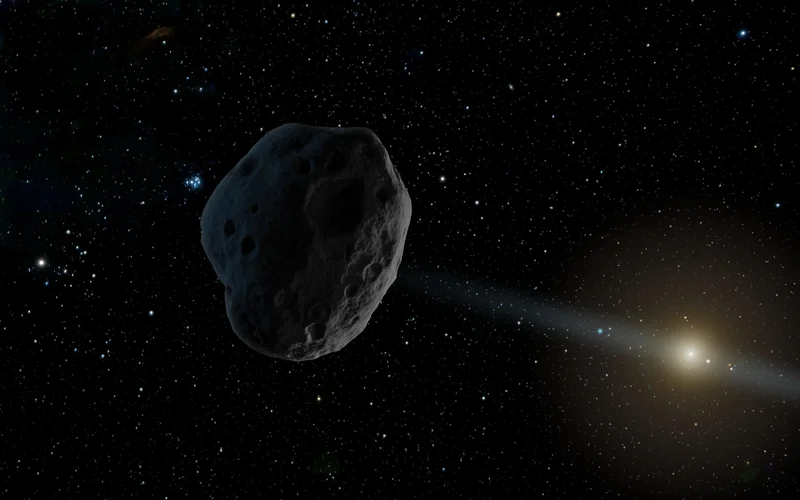
For nearly three decades, astronomers tracked a 1,250-foot-wide object relatively close to Earth that they thought was an asteroid.
It looked like one. It followed the expected path. Telescopes saw no glowing cloud of gas or dust tail sweeping behind it. Then, the space rock, called 1998 SH2, drifted from its usual orbit that gravity alone predicted.
Something was giving it a tiny push. Astronomers eventually realized that the culprit was likely gas escaping from its surface — a faint version of the same process that powers a comet.
When NASA-led researchers pointed some of the world's most powerful telescopes at 1998 SH2, they finally found the evidence: a barely visible cloud and a wispy tail. The object that astronomers had cataloged as an asteroid for years had finally given up its secret. It was a "dark comet" — a weakly active snowball — in disguise.
The discovery doesn't just correct the label for one object. It suggests astronomers may need to rethink the definitions for asteroids and comets. For generations, scientists have separated these two groups by what they see: asteroids look like bare, rocky bodies, while comets reveal themselves through glowing tails that form when their ice turns into gas near the sun. But 1998 SH2 shows that some comets may be so faint that they masquerade as asteroids. That could mean the solar system is teeming with many more hidden comets than astronomers ever realized.
Because of this, some astronomers are arguing that it may be time for the community to shift from trying to classify space rocks based on what they look like to what they do.
"Asteroids and comets are classically differentiated based on their orbits, composition, and observed cometary tails and activity levels," the authors wrote in their Nature Astronomy paper. "However, in recent years, a continuum of hybrid objects [has] become more apparent, eroding the traditional boundaries between these two classes."
Comets native to the solar system, such as NEOWISE seen here over Jean, Nevada, in 2020, are identified typically by their glowing heads and long, bright tails of vaporized ice.
Credit: David Becker / AFP / Getty Images
Their study subject, now to be designated as Comet P/1998 SH2, is the first whose motion — as opposed to visual evidence — initially predicted its comet-like activity.
The object made its "close" approach — still about 2 million miles away — in Aug. 2025. As gas escaped from the surface, it acted like a tiny thruster, propelling the small body and gently nudging its trajectory. That subtle change gave astronomers a clue that something unusual was happening, said Davide Farnocchia, a navigation engineer who led the study from NASA's Center for Near-Earth Object Studies, in a statement.
The researchers then used targeted observations from telescopes in Hawaii and Chile to confirm their suspicion. The barely-there clues were easy to miss, which helps explain why the object spent years misidentified.
The distinction matters because comets and asteroids would likely respond differently to attempts to redirect them if they ever posed a threat to Earth. Understanding what these objects really are is crucial for planetary defense.
The discovery also offers a possible clue about other mysterious objects that have puzzled astronomers, including the 2017 interstellar visitor, 1I/'Oumuamua.
Credit: European Southern Observatory / M. Kornmesser illustration
Since 2016, scientists have only designated about a dozen or so objects as "dark comets."
"The possibility that a number of potentially hazardous objects currently classified as asteroids could turn out to be comets could increase the relative Earth impact risk from comets," the authors wrote.
The discovery also offers a possible clue about other mysterious objects that have puzzled astronomers, including the interstellar visitor 1I/'Oumuamua, which accelerated slightly as it passed through the solar system in 2017, without revealing an obvious tail. Local Comet 1998 SH2 demonstrates that an object can release enough gas to affect its motion while remaining nearly invisible to telescopes.
"This work shows the importance of continuously tracking near-Earth objects," Farnocchia said.