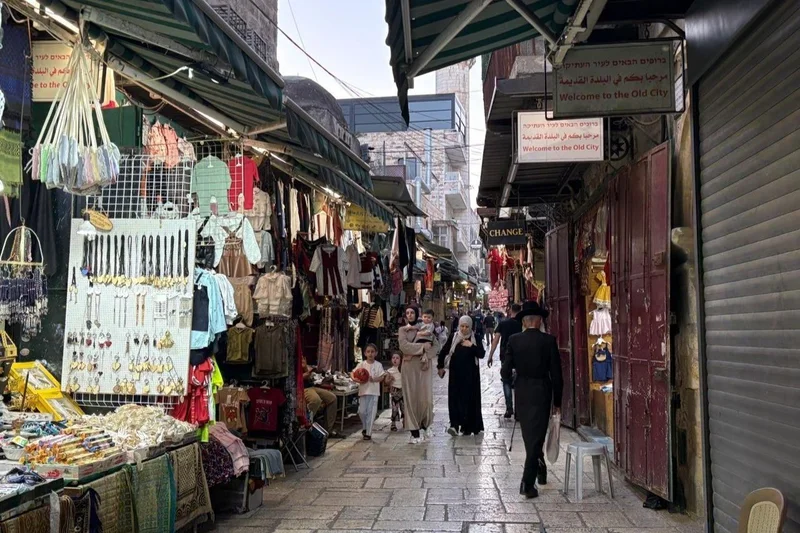
Jerusalem's Old City, home to sacred sites of Judaism, Christianity and Islam, is increasingly being marred by religious tensions.
The three religions have historically maintained a delicate balance through their respective quarters, but expressions of hostility toward other communities are reaching dangerous levels as Jewish extremist groups gain influence amid what critics say is tacit acceptance and encouragement from the Israeli government of Prime Minister Benjamin Netanyahu, which includes far-right parties.
Extremism threatens holy sites of three religions
The Christian Quarter is one of the places where interreligious tensions are most visible.
According to the Israeli civic group Religious Freedom Data Center, or RFDC, 83 cases of harassment targeting Christians were reported from April through June this year. Spitting accounted for the largest number, with 47 cases, followed by eight cases of verbal abuse.
While Hankook Ilbo reporter accompanied nuns on their way home through the Old City on Aug. 4, a Jewish teenager spat toward them.
"After a French nun was assaulted in April, everyone became anxious, so volunteers began accompanying us," an African nun said. "We can only hope the situation improves."
Such harassment is seen as an overt expression of hostility toward Christianity. Jewish extremists who have learned about the historical persecution of Jews without receiving adequate education about Christianity, along with teenagers who imitate them, are among the main perpetrators.
Five of six Jewish males who threw stones at Russian nuns inside a monastery building in the Armenian Quarter on Aug. 2 were minors.
Churches, worried about becoming targets of extremists, have even sought to minimize the visibility of crosses and have become highly reluctant to draw outside attention.
Al-Aqsa Mosque, one of Islam's holiest sites, is facing similar pressure.
Israeli National Security Minister Itamar Ben-Gvir, a prominent far-right politician, entered the mosque compound last month with hundreds of Jews and participated in Jewish prayer.
The site is administered by the Islamic religious trust, or Waqf, under Jordanian custodianship, and non-Muslim prayer there is prohibited under the longstanding status quo. Ben-Gvir has nevertheless made repeated visits to the compound since taking office in 2023, prompting accusations of religious provocation.
Muslims interviewed in the Arab Quarter of the Old City shook their heads at the mention of Ben-Gvir's name, saying far-right politicians were creating unnecessary unrest at a sacred Muslim site.
"There will be no peace unless the far-right politicians who stir up even Muslim holy sites change," said Jadallah, a 40-year-old taxi driver.
"These days, you never know when something might happen, so even entering predominantly Jewish areas feels dangerous," said Sahad, a 44-year-old tour guide.
The exclusion and attacks associated with Jewish extremists have also targeted secular Israelis.
A cafe in central Jerusalem became a target of ultra-Orthodox protesters after opening on Shabbat, the Jewish Sabbath, when businesses in Israel traditionally close. Protesters threw waste at the cafe entrance and attempted to enter the establishment on Aug. 8, leading to a physical confrontation.
"This isn't a provocation. It's simply a place for residents who have nowhere to go on Shabbat," cafe manager Yoel Ben Daiv said in an interview with local media.
Experts are concerned that tensions fueled by the far-right government could spread more broadly across Israeli society.
"Like settler violence in the West Bank, the conflict in Jerusalem stems from an extremist mindset that says, 'We will completely control this land,'" RFDC founder Yisca Harani said in an interview with the Hankook Ilbo.
"We need to restore the rule of law and order before moderate Jews also become victims of further violence," Harani said.
This article from the Hankook Ilbo, the sister publication of The Korea Times, is translated by a generative AI system and edited by The Korea Times.