Your support helps us to tell the story
From reproductive rights to climate change to Big Tech, The Independent is on the ground when the story is developing. Whether it's investigating the financials of Elon Musk's pro-Trump PAC or producing our latest documentary, 'The A Word', which shines a light on the American women fighting for reproductive rights, we know how important it is to parse out the facts from the messaging.
At such a critical moment in US history, we need reporters on the ground. Your donation allows us to keep sending journalists to speak to both sides of the story.
The Independent is trusted by Americans across the entire political spectrum. And unlike many other quality news outlets, we choose not to lock Americans out of our reporting and analysis with paywalls. We believe quality journalism should be available to everyone, paid for by those who can afford it.
Your support makes all the difference.
Read more
A year after Elon Musk predicted Tesla's robotaxi service would spread across half the United States by the end of 2025, the company's self-driving revolution is moving far more slowly than promised.
During Tesla's latest earnings call, Musk and his executives faced tough questions from analysts over a rollout that has fallen well short of the company's ambitious projections.
Since launching a small robotaxi pilot in Austin in June 2025, Tesla has expanded only to a handful of cities in Texas and Florida, with service largely confined to quieter neighborhoods on the outskirts rather than busy downtown areas.
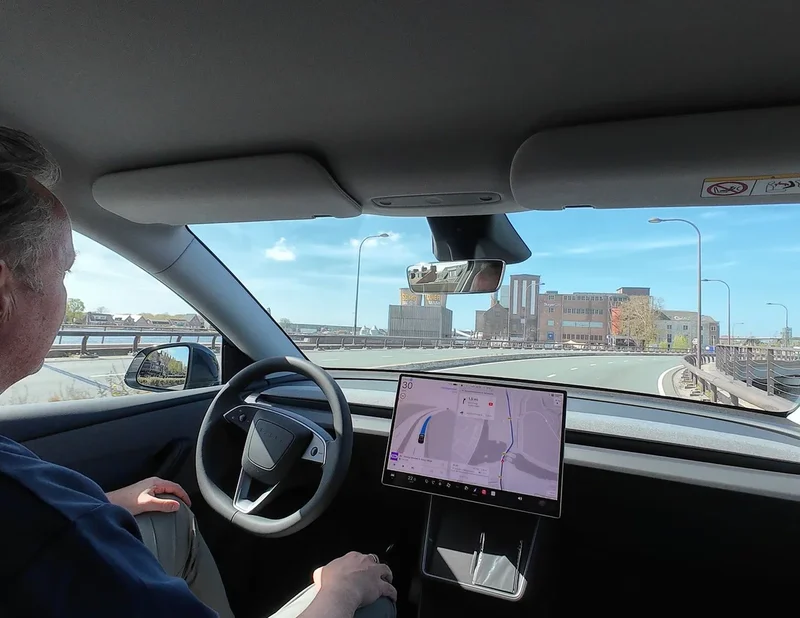
On Wednesday's earnings call, Musk and his executive team struck a more guarded tone about AI (Steve Fowler)
Tesla said paying customers have logged 2.5 million miles in its robotaxis, including 380,000 miles without an in-vehicle safety monitor.
But that remains a fraction of rival Waymo's more than 220 million autonomous miles through March, a gap Forrester analyst Paul Miller said highlights Alphabet's commanding lead in commercial self-driving technology.
Barclays analysts also noted that Tesla's supposed edge—its ability to scale quickly—has instead become a source of frustration for many investors, who increasingly view the rollout as slow.
Elon Musk’s SpaceX recently struck a deal to buy AI coding agent Cursor for $60 billion (PA Archive)
Much of Tesla's sky-high valuation is built on expectations that robotaxis and its Optimus humanoid robots will one day become the company's biggest money-makers. Even after a nearly 17% drop this year, Tesla shares still trade at more than 166 times forward earnings estimates, far above most automakers and major technology companies.
The slower rollout marks a noticeable shift from Musk's earlier confidence. He had previously described Tesla's technology as "a general solution that works anywhere," contrasting it with Waymo's methodical city-by-city expansion.
Now, Tesla executives say reality has proved more complicated.
Vice President of Vehicle Engineering Lars Moravy said regulations vary from city to city, requiring the company to tackle each market individually.
"Regulatory situations are different city by city," Moravy said. "The reason we're expanding city by city is to make sure that we're meeting all of those one at a time."
Chief Financial Officer Vaibhav Taneja said Tesla is still working through operational and software "kinks" and wants to iron them out with a small, controlled fleet before dramatically expanding.
Since launching a small robotaxi pilot in Austin in June 2025, Tesla has expanded to only a handful of other cities, in Texas and Florida, with service often limited to outlying areas (AFP/Getty)
Analysts pressed executives on why the fleet still numbers only in the dozens rather than the hundreds. Tesla's vice president of AI, Ashok Elluswamy, argued the company is seeing "literally exponential" growth in robotaxi miles but said it is still in the very early stages.
Musk insisted Tesla is determined to expand as quickly as possible without compromising safety.
"We want to grow as fast as possible with robotaxi, without harm to anyone," he said.
In January, Tesla projected its robotaxi service would be operating in seven metro areas by the end of June, including Dallas, Houston, Phoenix, Miami, Orlando, Tampa and Las Vegas.
By this week, the company had launched only in Dallas, Houston, Miami, Tampa and Orlando, with service areas in each city remaining limited to less-trafficked neighborhoods.
Reuters also found long wait times and, at times, no vehicles available during tests of the service in Dallas and Houston, underscoring the challenges Tesla still faces as it tries to turn Musk's robotaxi vision into reality.