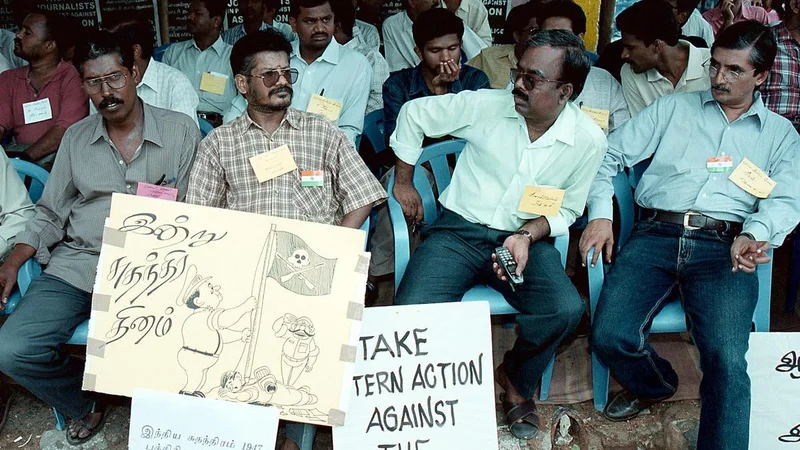
On the morning of August 15, 2001, as Tamil Nadu Chief Minister J. Jayalalithaa hoisted the national flag at Fort St. George, about 3.5 km away, scores of journalists sat on a fast outside the M.A. Chidambaram Cricket Stadium, near the State Guest House in Chennai.
About 48 hours earlier, several journalists, particularly photographers and camerapersons, had been subjected to a savage attack by the police just outside the office of the Director General of Police on Dr. Radhakrishnan Salai. On the night of August 12, the journalists were covering a DMK rally which was being undertaken to condemn alleged police excesses during the arrest of former Chief Minister M. Karunanidhi on June 29 that year. The rally had turned violent near the DGP’s office and the journalists were filming it when the police attacked them.
“The police refuse to acknowledge that journalists were prevented from getting out of the DGP’s office as pitched battles broke out between a well-armed police and unruly elements during Sunday’s DMK rally in the city. But the version of journalists trapped inside the DGP’s office tells a different story. While at least five journalists were held inside the DGP control room for ‘their own safety’, nearly 15 journalists who were covering the pitched battle were attacked by the police,” said a report in The Hindu Archives.
“One official even tried to protect one journalist. The journalist, a crime beat reporter, who hid behind the official, was pulled away from the officer before being attacked,” the report quoted a journalist, who witnessed the scene, as saying. Several of the journalists sustained bleeding injuries and the camera equipment of a TV journalist and some photographers were damaged by the police. Late that night when journalists confronted the Chennai Police Commissioner Muthukaruppan, he extended an apology “if such incidents had taken place.”
Jayalalithaa’s response
Jayalalithaa, who said she was distressed that journalists were attacked, claimed it happened because they were caught between unruly persons and the police. She said she had asked the police to evolve procedures to see that such incidents did not recur.
However, the journalists were not convinced with her explanation. Just a month earlier, some journalists were allegedly attacked when they were covering the arrest of Karunanidhi. Before that, a Sun TV correspondent, who was among the journalists who covered a visit by former Minister K. Ponmudi to a civil supplies godown, was arrested.
Day-long fast
Protesting the frequent attacks, the journalists decided to observe a day-long fast near the State Guest House on Independence Day. The fasting journalists demanded a CBI inquiry into the attack on members of their fraternity.
“The journalist organisations - the Chennai Press Club, the Madras Union Of Journalists and the Madras Reporters Guild - decided that scribes would wear black badges while covering the coming budget session of the State Assembly. A meeting of the press organisations after the hunger protest, however, decided to drop its earlier call for total boycott of all police functions as it was ‘not feasible’,” The Hindu reported on August 16, 2001.
Senior editors of various media publications expressed their solidarity with the fasting journalists.
Days later, nine members of the Journalists Action Group, a voluntary group formed after the attack, filed a petition before the Madras High Court praying for a CBI inquiry and a direction to the Government of Tamil Nadu and the DGP to provide compensation to journalists, who were injured, and whose camera equipment were damaged by the police. Former Union Minister and senior advocate P. Chidambaram represented the journalists, pro bono, and argued their case before the court.
The Chennai Press Club, Madras Union of Journalists, and Madras Reporters Guild filed impleading petitions in support of the same prayers.
The journalists also decided to boycott the Justice Bhaktavatsalam Commission, which Jayalalithaa constituted to probe the police firing at the rally in which five DMK cadres died as well as the attack on the journalists. The journalists argued that the Commission of Inquiry can hardly do any justice to the affected parties as it cannot enforce the Constitution or the Laws of the land or punish those guilty.
The government and the police, in their counter-affidavits, denied journalists were attacked “in order to force them to abandon the coverage in front of the office of the Director General of Police.”
Passing orders on the petitions in October 2002, Justice V. Kanagaraj held that though parties may differ on the manner in which the incident took place, it was a fact that the journalists sustained injuries and their cameras were damaged and “therefore no doubt need be entertained that the petitioners must be compensated adequately.”
The judge underlined, “...it should be borne in mind that the compensation should not be meant ‘some or mere compensation’ for the name sake but ‘adequate compensation’ to the extent the injury or damage has been caused to the person or the property of the petitioners in full consideration of the claims made by the individual petitioners based on such evidence placed before the first respondent Government.” However, he rejected the prayer to order a CBI probe.
(Disclosure of interest: The author was one of the nine petitioners representing the Journalists Action Group)
Published - August 15, 2026 09:00 am IST