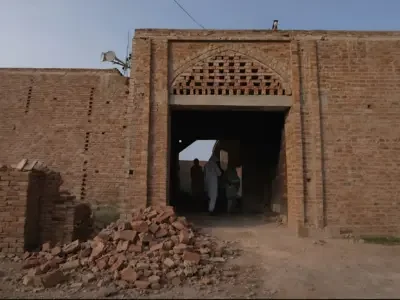
When 46-year-old Rajab Ali, a transgender man, spent his life savings to build a mosque for his local community in Okara district of the Punjab province in Pakistan, he hoped it would bring goodwill and allow people to pray there without gender discrimination. Now that it is complete, however, his neighbors are harassing him for praying in it because he is transgender, known in Pakistan as Khawaja Sira (third gender), a community that has come under renewed attack in Pakistan.
A legal grey zone
In 2018, Pakistan’s parliament passed the Transgender Persons Act. The law grants transgender people equal rights and access to public spaces, including places of worship.
The new protections have drawn conservative backlash. In 2023, a federal court struck down certain provisions of the 2018 law, arguing that self-perceived gender identity is contrary to Islamic principles. Pakistan’s trans community has since faced a wave of violent attacks. Transgender people now face an uncertain future, with some of their hard-earned rights occupying a legal grey zone.
Daunting challenges
When Ali began constructing his mosque in December 2022, the pushback started almost immediately.
“Hatred started spreading in the community,” said Ali during an in-person interview with Global Voices at the mosque in December 2025. “People started saying they would not pray in a mosque built by a transgender person.”
As Ali pushed forward, neighbors stole items from the mosque and sent women to harass him. Motor parts, water taps and fans disappeared, forcing him to repeatedly replace them. “I’m not so wealthy,” Ali said. “So how can I keep replacing these things every day?” When he sought local help to manage the mosque, no one came forward. He put the project on hold for a year and a half, resuming construction in November 2025. Although the mosque is now complete, Ali fears further harassment from his neighbors.
Some residents, including Bilal, refused to pray in what he called a “transgender mosque.” Community member Javed Iqbal, however, said everyone should pray there, adding that those who refused should return Rajab’s savings so he could build a mosque where he would be respected and accepted.
Recently, as he’s tried to lead prayers, he finds some mosque-goers questioning his presence. According to Ali, they say things like “Where did this transgender come from?”
“I fear they could harm me,” he said.
Ali is not the first person to attempt to build a trans-friendly mosque in Pakistan. In 2016, transgender activists in Islamabad constructed one on the outskirts of the city, so they could worship freely. Like Ali, they faced constant harassment: When boys from the neighborhood tried to collect donations for the mosque, they were arrested, and the project appears to have stalled out. Pakistan’s first transgender Islamic school opened in 2021.
Facing exclusion
Pakistan’s official transgender population figures remain uncertain. The 2017 census recorded 21,774 transgender people, a figure the Pakistan Bureau of Statistics called a “gross undercount.” The 2023 census recorded 20,331, but stigma and discrimination may discourage many from officially identifying, suggesting the true number is likely higher.
Education is another area where transgender people face exclusion. The 2023 census puts the transgender literacy rate at 40.15 percent, compared with 60 percent nationally. Experts attribute the gap to stigma, schoolroom harassment and parents’ reluctance to send transgender children to school.
“In our country, most transgender people are illiterate, so they often don’t know about their legal rights,” said Lahore High Court lawyer Muhammad Azam Chaudhary during an in-person interview with Global Voices in December 2025. “The 2018 Act provides significant rights to transgender people, but it will take time because, without education and social acceptance, legal protections remain fragile.”
Spiritual awakening
Realizing he was different at age six, Ali lived for decades presenting as a woman and earning a living as a dancer within the transgender community. In 2021, at age 42, a spiritual awakening led him to begin presenting as male and teaching Islam. Ultimately, he chose to invest his entire life savings of 6 million Pakistani rupees (USD 21,000) to build a mosque for his community.
Ali’s religious critics and some neighbors have argued that it’s inappropriate for income earned from dancing to be used to build a sacred space like a mosque.
Resistance from conservatives
Asif Riaz, a religious scholar, disagrees. Being transgender is neither a sin nor a basis to question someone’s moral character, he argues, during a telephone interview with Global Voices in January 2026.
Riaz argued that while society overlooks mosques built with corrupt or illegitimate money, Ali faces unfair scrutiny. Once a mosque is established as a sacred space open for worship, the focus should remain on its purpose, rather than the donor’s identity or personal life.
Not all religious scholars share Riaz’s interpretation. Another Islamic scholar, interviewed by telephone in January 2026, whose name is withheld for anonymity, argues that money earned through dancing is religiously prohibited and should not fund a mosque. This perspective shifts the debate beyond Ali’s transgender identity, questioning whether impermissible income can be used for a sacred purpose. Together, these views highlight a conflict over whether the objections stem from Ali’s identity, his livelihood, or both.
For Zanaya Chaudhry, a transgender rights activist with the Khawaja Sira Society in Lahore, the community’s attack on Ali’s mosque is a classic example of the heightened scrutiny faced by the trans community. During an in-person interview with the author in December 2025, Chaudhry said: “Society judges transgender people based on how they earn, questions their morality, even when their intentions are sincere.”
Chaudhary elaborated, “I believe earning from dance and art is not wrong. What matters is society’s role, how it provides opportunities and allows them to earn. After acceptance, one of the biggest issues for trans people in Pakistan is earning a livelihood.”
Widespread discrimination and harassment
Pakistan does not have comprehensive national data on unemployment among transgender people. A 2026 Islamabad study found that 34 percent of its 91 Khawaja Sira participants were unemployed, but the figure cannot be treated as a national rate.
While the 2018 law was supposed to end harassment at places of worship, a 2025 study done by researchers from the University of Central Punjab and the University of Malaysia showed that little, if anything, has changed. The researchers documented cases of exclusion and harassment faced by transgender people at mosques, churches, and other holy sites.
“I went to the mosque during Ramadan just to pray quietly, but the imam told me to leave because people were uncomfortable,” one of the study’s participants said. “Allah made everyone equal, but in the mosque, they act like we don’t exist,” said another.
Ramesh, a transgender person from Faisalabad, said during a telephone interview with Global Voices in December 2025 that transgender people often face harassment when visiting mosques. He recalled being stared at and made uncomfortable, including an incident in which children outside a mosque clapped, called him “hijra,” and mocked him as he arrived for prayer.
Healthcare is another area where transgender people face discrimination. Nayyab, a transgender person interviewed by the author in person in August 2026, recalled being harassed at a government hospital after joining the women’s queue to obtain a medical slip. A staff member told her she should stand in the men’s queue instead. She also recalled a female doctor making derogatory remarks about transgender people during a consultation.
From healthcare facilities and places of worship to employment opportunities, transgender people continue to face discrimination throughout daily life in Pakistan. For Ali, the country’s progress on transgender rights has been a whirlwind.
“I just have one wish,” said Ali, “that after my death, people will remember me and pray for me.”