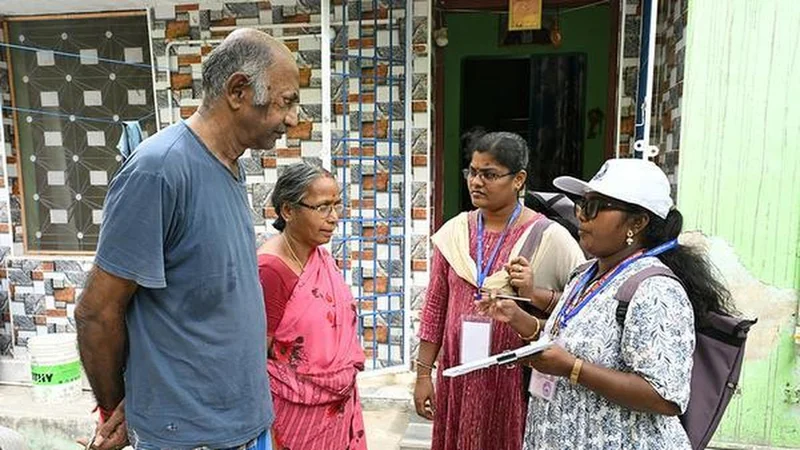
The story so far: The Registrar General and Census Commissioner of India (RG&CCI) on August 14, 2026, notified a set of 40 questions for Population Enumeration — the second phase of Census 2027.
The Population Census exercise is done in two phases: the Housing and House Listing Operations (HLO), and Population Enumeration, spanning over 11 months. The HLO phase is to be concluded by September 30 across the country. Barring few States such as West Bengal, Assam, Manipur, Tripura and Tamil Nadu, the HLO phase has been concluded elsewhere.
The Population Enumeration will be done in whole Union Territory of Ladakh and snow-bound areas of Jammu and Kashmir, Himachal Pradesh and Uttarakhand from August 17-September 30, ahead of the rest of the country where the exercise will be conducted in February 2027.
Why is the second phase significant?
The 40 questions notified by the RG&CCI, among others asks will ask the respondents to record their “caste”. This is the first time caste will be enumerated in Independent India, other than that of Scheduled Tribes and Scheduled Caste.
The Census 2027 schedule will include 13 new questions or data fields that were not part of the Census 2011 questionnaire. Census 2011 had 29 questions.
How will caste be recorded?
Question number 10 of the Census schedule reads: “Scheduled Caste (SC)/ Scheduled Tribe (ST)/ Caste.” Officials said that enumerators will record the caste as declared by respondents in an open field rather than selecting from a pre-prepared list. Similar methodology was used during Census pre-tests conducted in 16 States and Union Territories in July.
This approach has drawn criticism from the Congress, which argues that an open-ended format may create data-quality challenges.
The concern stems from the experience of the 2011 Socio Economic and Caste Census (SECC), which generated more than 46 lakh caste names because of variations in how people identified and described their caste. The Union government has previously cited these inconsistencies as a reason for not releasing SECC caste data.
What are the new questions being added?
The 2027 Census will introduce 13 new data fields not present in the 2011 exercise. Among them are:
- Spouse’s name
- Father’s particulars
- Mother’s particulars
- Nationality
- Digital literacy status
- Permanent residential address
- Place of COVID-19 vaccination
- Number of bank accounts
- Passport number
- Driving licence availability
- Mobile number
- Aadhaar number
- Voter ID number
Are some questions similar to the proposed National Population Register (NPR) ?
Some of these questions such as particulars of mother and father, Aadhaar, mobile, voter ID and driving license details also featured in the rehearsal form of National Population Register (NPR) in 2019.
NPR, initially proposed to be done with he first phase of Census has been put on a back-burner due to stiff opposition by political parties and civil society members as the data can be used to create a countrywide National Register of Citizens (NRC).
Why is there an opposition to NPR?
As per Citizenship Rules, 2003 under Citizenship Act, 1955 the NPR is the first step for the creation of a National Register of Citizens (NRC). The NPR was first created in 2010 and the data was collected simultaneously during the first phase- the House Listing and Housing (HLO) schedule. It was updated in 2015-16.
The NPR has details of family wise database of 119 crore usual residents of the country and the data can be shared with government agencies and States, unlike the Census data.
Thousands of people had taken to the streets across the country in 2019-2020 protesting the Centre’s decision to update the NPR, which is considered the basis for preparation of NRC that could potentially exclude millions of people born in India through a document based process.
Why are questions on Aadhaar, bank accounts and vaccination under the scanner?
The inclusion of personal identifiers and administrative details has renewed a broader debate about privacy and the relationship between the Census and other government databases.
On March 30, RG&CCI Mritunjay Kumar Narayan, while addressing a press conference said that as per the Census Act 1948, the Census data is confidential and the respondents are to answer to the best of their knowledge. “Only aggregate data is released, an individual’s data cannot be shared with States or even the judiciary and do not also come under the purview of the Right to Information Act (RTI). Census data cannot be used to provide reservation benefits to any individual,” Mr. Narayan said, adding that Census data is beyond “scope of investigation.”
What are the concerns regarding caste enumeration methodolgy?
Officials said that the SECC threw up lakhs of caste names as it was kept open ended. Respondents were asked to name their castes. For example: people wrote Gupta, Agarwal etc. for Baniya caste, which increased the numbers exponentially.
According to the latest government data, there are about 2650 Other Backwards Classes (OBC) in the Central list, 1170 in the Scheduled Caste category and 890 communities in the Scheduled Tribe (ST) list. The State governments maintain their own OBCs list.
The Opposition parties had demanded wider consultation with all stakeholders before caste census is undertaken but the questions were notified on August 14. Throughout 2025, the government repeatedly stated that the final caste questionnaire had not been settled. Parliament was informed in February 2026 that questions relating to caste would be notified before the commencement of the second phase of Census operations.
The Ministry of Home Affairs said representations had been received from various organisations and State governments regarding caste enumeration, and that the final questionnaire would be prepared according to established procedures.
What other data will the Census collect?
Apart from caste and identity-related information, the questionnaire will gather data on: Education and skills; literacy and digital literacy; school or college attendance; highest educational qualification; mother tongue and other languages known; employment; work status during the previous year; occupation and industry; employment category; and whether the person is seeking work.
Further, the questionnaire will seek details on — Travel to workplace; migration; place of birth; previous residence; reasons for migration; duration of stay after migration; permanent residential address; women’s demographic data; number of children surviving; children ever born alive, births during the previous year in relevant cases.
Published - August 15, 2026 02:14 pm IST