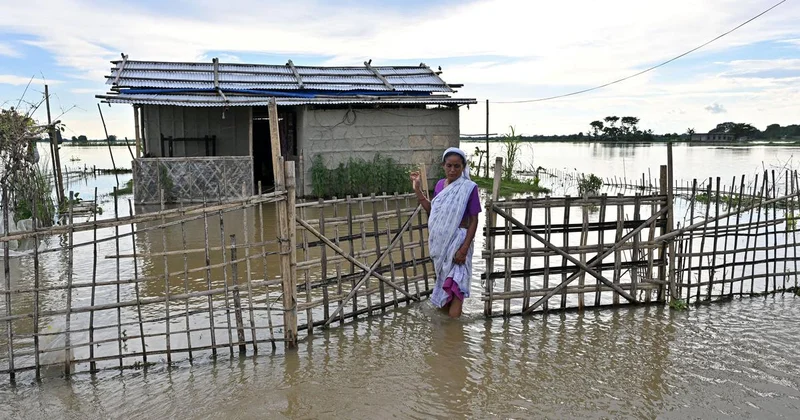
Since July 19, an artificial flood has wreaked havoc in four Upper Assam districts. So catastrophic has this flood been that nearly 800 villages and an area of around 1,19,000 hectares of cropland have been submerged, sheets of mud have been deposited in fields and inside people’s homes and large areas in the countryside have been turned into lakes.
More than 100 people have died and roughly seven lakh have been affected. Countless cattle have died.
The worst part of this disaster is that these are places not on the map of Assam’s annual flooding. But now, they seem to be doomed, as if a malignant wound has been created that will only spread and not heal.
For a land that is shaped and reshaped by the Brahmaputra river system and its unique fluvial dynamics, floods are not new in Assam – nor unwanted. Every monsoon, floodwaters bring alive all that was parched and dormant, replenishing the wetlands and the paddy fields, and reassuring fecundity in all living beings.
Assamese society has been traditionally a flood-dependent society, not a flood-fearing or flood-resisting one.
To make sense of the current catastrophe in Upper Assam, a historical understanding of how a natural phenomenon has become disastrous in the Brahmaputra Valley is necessary.
I grew up in Majuli – an island often associated with flood and riverbank erosion. One of my earliest memories of floods was waking up one morning to find that water was barely a few inches below my bed, with small fish and tadpoles all around me. We spent several days on a raised platform, next to our cattle, cooking and eating there.
That was in the 1980s, but in Majuli, flooding of this kind remained an annual ritual until a few decades ago.
The relationship between the Majuli ecologies and monsoonal flooding is that of co-evolution. Both change and adapt. It is rhythmic. Of course, there were damages and inconveniences, but floods were rarely catastrophic. Residents accepted those inconveniences as trade-offs for the bounty of the fertile floodplains of the Brahmaputra.
Gradually, the island got enclosed with embankments – infrastructure built for flood control, with a specific colonial legacy – resulting in a drastic transformation in the nature of flood events. Although embankments on the island dated back to the 1950s, they were patchy, leaving enough channels open for the river to flow in through during the monsoons.
Now, with a near-complete enclosure of the island, vast tracts are deprived of monsoonal floodwater, as the embankments have cut off the umbilical cord between the river and the floodplains. This has resulted in a series of ecological breakdowns.
On the other hand, riverside areas – areas outside of embankments – are now flooded for months, as the water cannot flow into the island’s interior, so much so that in a delusional turn of events, many communities in these areas have started demanding embankments. An ecological disharmony has been created, with the future quite uncertain for these fragile landscapes.
The Majuli story exemplifies processes occurring in the Brahmaputra Valley as a whole. There is no denying of the ecological volatility of the valley, shaped by, among others, a highly potent monsoonal regime with a massive network of Himalayan rivers, the huge volume of sediment load deposited by the Brahmaputra every year, resulting in the formation of transitory islands that interfere with the course of the river.
In addition, an earthquake in 1950 with a magnitude of 8.7 on the Richter scale imbalanced the ecological foundation of the region. This earthquake significantly altered the courses and configurations of the river system in Assam – through colossal landslides and debris deposition, raising the Brahmaputra riverbed by meters in some places, creating new channels, and diverting old ones.
The dominant flood-control measure – embankments – has made matters far worse, exacerbating ecological volatilities. As a consequence, catastrophic flood events have now become part of the landscape in Assam.
However, the state seems to be stuck in a time warp and cannot think beyond embankments. It lacks both the imagination and the will to try to redress the crisis. I have discussed some of these issues in greater detail in my book, Slow Disaster.
In 2024, I wrote an article in The Telegraph calling attention to more holistic flood-management measures: watershed planning at the basin level, restoring old channels and wetlands, cooperation among riparian states for river governance, among them. I suggested that the authorities should also emphasise flood forecasting and warning, and strengthen capacity building of local communities and institutions.
All this, however, is a generic explanation for Assam’s recurring flood woes. It does not adequately capture the current catastrophe in Upper Assam, which is a case of river and mountain grabbing – organised loot that has shaken the very core of the fragile ecologies of the region.
The major southern-bank tributaries of the Brahmaputra – Dikhow, Dhansiri, and Jhanji, all originating in hills of Nagaland, and Disang, with its source in Nagaland and Arunachal – have become key sources of the extractive industry. Illegal mining of sand and stone has ravaged their riverbeds.
Rampant coal mining and deforestation in the hills of next-door Nagaland have added to the fragility of these geographies. The mountains are thus denuded on the top and emptied out at the bottom.
So when the mighty monsoon descended, these weak and bare hills could not withstand its force, let alone absorb the rainwater. Hills and valleys were all shattered at a speed that was previously unseen.
The case of willful, unrestrained pillage of the riverbeds and the mountains in Assam and Nagaland is a textbook case of the effects of neoliberalism. The commodification of nature here is total and rapid, driven by private profit, enabled by the state.
The list of actors in this cruel theatre of loot may never be revealed, but there is a nefarious network at play here – a network of state and non-state elites, from the uplands and the plains alike.
Heartwarming solidarity
Meanwhile, the outpouring of support from the ordinary citizens for their neighbours has been heartwarming. Enormous solidarity is on display: residents have organised themselves into all kinds of collectives and made their way to the flood-affected districts with relief materials – both for humans as well as the cattle.
Many relief vehicles carried the banner of “Zubeen’s Country”, a reminder of the late singer-songwriter Zubeen Garg’s love for the land and its people.
The state’s culpability in the Upper Assam cataclysm, is glaring. It has either looked away for far too long or failed to prevent the devastating plunder of the rivers and the mountains. And as far as flood-relief and rehabilitation measures go, the state’s role has not been reassuring either. Will the state learn from this disaster and stop building the dams upstream? Will it be able to put a full stop to illegal mining in the riverbeds? Will it stop the so-called development activities in our mountains, near our forests?
Mitul Baruah is an Associate Professor of Sociology/Anthropology and Environmental Studies at Ashoka University. Views are personal.
We welcome your comments at letters@scroll.in.