In a game with no winner there were two victors and a clear loser.
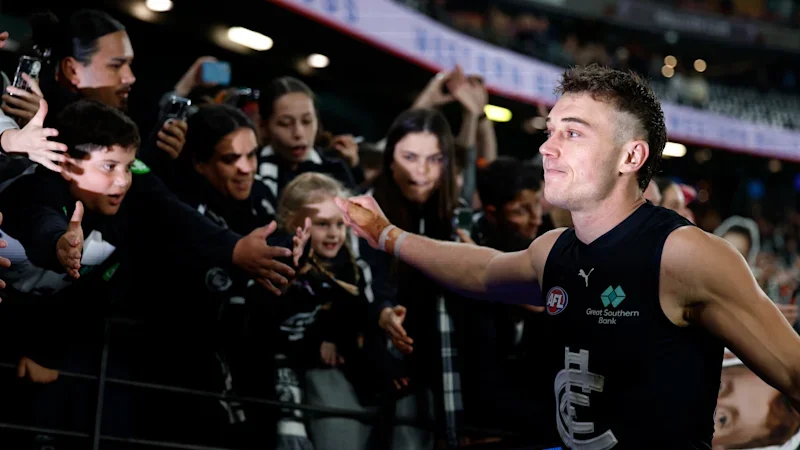
Josh Fraser’s Carlton won. The AFL’s contentious wildcard round won. St Kilda lost.
Josh Fraser’s Carlton will play “finals”, or at least a quasi-final round. St Kilda will not.
Carlton lost the biggest name of the off-season to St Kilda as well as the son of a scion of the club, and are now certain to finish ahead of the Saints.
Carlton lost their coach in round nine and surely found their new one in the next 13 rounds.
Fraser should not have needed the draw, which affirms the Blues of a place in the pre-elimination final elimination final that is the wildcard round, to convince those who matter of his bona fides as a senior coach, but it can’t have hurt.
Appropriately for the wildcard round concept, the final team to qualify is the very definition of a joker in the pack.
To take a rabble of a team and turn them around in season is a major achievement. For Carlton to have the wherewithal to know in the last minute that a draw was enough for them to make the wildcard round, and then to have the composure to just hold possession, betrayed a maturity not long seen at Princes Park.
I’ve been a cynic of the whole wildcard round on the basis of it rewarding the mediocre – 10th in a field of 18 making the finals has shades of ribbons and lollipops for everyone. But it is difficult to argue with the merit of it after this game.
Does it mean the ninth and 10nth sides are serious chances of going anywhere in September? Maybe not, but in a competition of small margins and a season in which one of those teams under their caretaker coach has been one of the best performed in the league over 13 rounds, anything is possible.
It now feels implausible that the person that inherited the team that had won one game in the first nine matches could not then be appointed senior coach for next year. Josh Fraser has now won 10 and a half games from 13 matches.
Put differently, consider an alternative world in which Fraser was not appointed senior coach.
Firstly, who has the conversation with the players and explains the rationale? Who says, “I know we’ve just won 10 and a half games of 13 (it could be 11 in the unlikely event they beat Fremantle next week) and we made finals, but we’re still not sure he’s the man for us. We’d rather go with someone else, someone who has not coached at this level for three months and turned around an entire team and this club in a short space of time”?
Pity also then the coach they do appoint instead of Fraser, especially if they then lose a few games on end next year. Those fans who were chanting “Fraaaser” after recent wins will only get louder.
But the niggling memory of David Teague is sitting there for all Carlton fans and board members alike. It is an unsettling memory and completely unfair on Fraser who is plainly a very different person and coach.
Carlton’s victory in securing the top-10 place – as opposed to a win – was St Kilda’s loss.
The Saints’ big cash splash recruiting splurge of last off-season will see them finish no higher than 11th. Last year they finished 12th, the same place they finished in 2024.
They look a different team, and they have played a better brand of football. But as their coach is wont to say, football gives you feedback every week, and in this results-based industry the result of this year is no finals.
It is not to say their decisions were wrong, but it is a reminder that the storylines of summer are different to those of spring.
Two points each, two different views of a draw
Craig McRae had a choice. In the moment of the draw the Collingwood coach got to instantly choose – much like the English cricket team after losing another Ashes Test – whether to view the result really as a win or a loss. McRae channelled the English and chose to own victory. Hopefully for his sake the comparison ends there.
McRae celebrated like the Magpies had won a final because they sort of had, but also because he knew that with the team they had out there they should not really have been able to beat a top-four team. Taking two points with that team against Hawthorn was as good as a draw.
Hawks coach Sam Mitchell confessed to not knowing if a draw was good for his team or bad. In truth, ladder position movements were irrelevant to whether the draw was good for them or not. A draw against this Collingwood team was a loss, even putting aside the fact victory was in their hands until even after the siren had sounded.
Hawthorn will still make the top four, but they are not playing like a top-four team. And that is the reason Mitchell should be under no illusions that this provided a signal about where his team is at.
In the six games since their loss to Melbourne, Hawthorn’s only impressive win came against resurgent Carlton. Outside of that, they have been a “victim” of a soft draw which had them touch up only the lowly Richmond, Essendon and North Melbourne in successive weeks. Their subsequent 67-point loss to Brisbane came off that run, showing their previous weeks flattered to deceive.
They needed a corrective performance against Collingwood. They needed to make a statement, but the only comment they offered was, “yeah, nah, not sure”.
They were outplayed for much of what was a finals-like game of high pressure. They were certainly outplayed in the first half when they kicked only three goals. They then played very well in bursts but never with the sort of ruthlessness you would expect of a top-four side.
That they were playing such a callow, albeit well-coached, opposition only accentuated the point. Hawthorn gave up 60 inside-50s to 47, they lost clearances 41 to 29, and were out-worked with 92 tackles to 55 and, in particular, out-muscled inside the arcs, where Collingwood laid 20 inside-50 tackles to Hawthorn’s three.
Tom Barrass was lumbering and a liability when the ball hit the ground. He also gave away a 50m penalty and certain goal for being lippy. James Sicily looked more influential on a wing after being out-marked in defence and looking slow at ground level.
As for Mitchell being unsure whether a draw was good or bad for the Hawks, it’s true that two points was better than none, but how his team played will have been little comfort to the coach.
McRae, on the other hand, knew he wanted to appropriate the narrative. This was as good as a win, is what he wanted to say. And given his team lost the ability to control the result with Dylan Moore’s final kick, the fact they did not lose was a victory of sorts.
But McRae was speaking to an understanding of his team. He got away with Noah Howes in the back line, and even playing at length on Nick Watson. He had Liam Puncher doing OK on Jack Gunston.
Beau McCreery played his best game for the club and Sam Swadling, like Ed Allan, demonstrated that the Pies can pick good players when they don’t trade away their draft picks. But most critically Dan McStay continued a resurgence that few could have foreseen.
He looked gone early in the year. He was the player who looked, as Woody Allen would say, like a cellist in a marching band. In the past two months he has played the best football of his career.
That is a turnaround that not only has in-season ramifications, but out-of-season consequences as the Magpies consider their trade options.
Quirky rule exposed
Hawthorn would not have won had they attempted to rush the ball through for a behind after the siren. But they would have won had Collingwood punched it over the goal line.
Weird isn’t it?
Under AFL rules if Hawthorn – say Lloyd Meek for instance, who wound up to punch the ball and missed – knocked the ball through it would not have registered as a rushed behind to deliver a Hawthorn win. You can’t punch your own ball through for a score after the siren. It’s considered a secondary act of play to assist the score, and given play is technically dead after the siren, there can’t be a secondary play after the siren. Unless you are the other team.
Under rule 16.5.2 had Collingwood punched the ball through, or it came off Collingwood hands and crossed the line, then it would a behind would have been registered Hawthorn would have won.
So, this won’t comfort Dylan Moore any, but he needed to clear the pack and get a score off his own boot.
It does seem inconsistent that one team can create a score by touching the ball after the siren and not the other. Logically, any team touching the ball from the kick should mean it is a secondary act.
Incidentally, viewers had no idea what was happening on the goal line watching the lamentable Fox coverage, which managed at the most critical moment to crop out all of the play on the goal line.
Roos leaping forward
In two weeks North Melbourne, with nothing to play for, have played like they are playing for something.
Their win over the Dogs last week and loss this week against the Cats –which should have been a win – shows the movement at Arden Street. The Geelong loss sort of felt like a win, which is also the crappy netherworld of small mercies North still find themselves in to find succour from loss.
At least North have shown something. Is it all a bit hollow once the season is dusted, or does it suggest a spirit that they are playing out the season and showing some pride and commitment to carrying momentum from one season into another? That will only answerable next year, but Nick Larkey was back to kicking straight and looking authoritative, and they found another player in Zac Banch, a crafty little forward.
If Harry Sheezel had played out the game, it feels like North probably would have won. Maybe that’s unfair on Geelong, who found a way to win, as the better sides do. The Cats also lost players but none of them were as important as Sheezel, or playing as well as Sheezel was.
More: