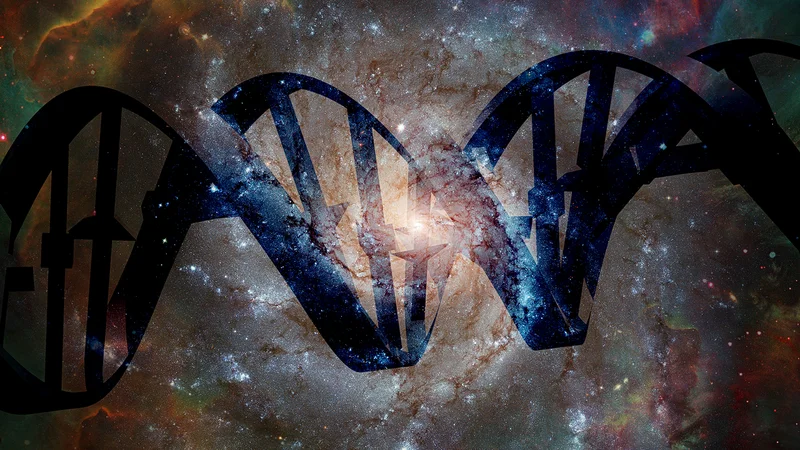
Scientists have discovered the basic ingredients for life in asteroids and meteorites, on Mars, and around young stars. All of those findings have come in the past few years, and upcoming missions aim to search for these building blocks of life.
But how many building blocks of life have we found in space so far?
First, it's important to define what we mean by the building blocks of life. Scientists are looking for molecules that look like those found in life on Earth, including proteins; RNA; and lipids, the fatty molecules that make up cell membranes.
We’ve found many on sample-return missions. The asteroid Bennu, brought back to Earth in 2023, contained all five nucleobases of DNA and RNA, along with 14 of the 20 amino acids used by living organisms. Its sibling asteroid Ryugu also yielded all five nucleobases, including uracil, which is found in RNA.
Other techniques, like radio astronomy, look for these building blocks in distant regions of space.
Astronomers categorize the molecules they find by complexity, starting with a broad group called "complex organic molecules" (COM). These are carbon-containing molecules with six or more atoms. Of the 350 molecules of any kind discovered in space so far, "about 180 of them qualify as COMs," Sergio Ioppolo, an astrochemist and an associate professor in the Department of Physics and Astronomy at Aarhus University in Denmark, told Live Science. "That cutoff is an operational convention rather than a fundamental definition of complexity."
Not all COMs are building blocks of life, but some of them are. A subgroup within COMs is a "prebiotic" molecule that scientists think may have played some role in the origin of life. A prebiotic molecule "has no structural rule," Ioppolo said — different scientists define it slightly differently.
Ioppolo defined a prebiotic candidate as a molecule whose detection scientists are confident in, that could plausibly form and survive without life already existing, and that has a documented role as a building block, precursor or intermediate in some proposed pathway to life.
Using that definition, Ioppolo estimates "roughly 30 detected prebiotic candidates, although the exact number depends on where the line is drawn."
Some of the richest hunting grounds for these molecules are in molecular clouds — interstellar regions of gas and dust that are dense enough for molecules to form. Using radio astronomy, Izaskun Jiménez-Serra, an astrochemist and staff researcher at the Center for Astrobiology in Spain, and her team have detected more than a dozen prebiotic molecules in molecular clouds at the center of the Milky Way, including the four-carbon sugar erythrulose — the first true sugar found in space.
All molecules great and small
However, there's a limit to the size and complexity of molecules that astronomical surveys can detect. To identify each molecule, scientists analyze the light from molecular clouds, which can reveal which parts of the electromagnetic spectrum have been absorbed. Those "spectral lines" act as a fingerprint for each molecule.
"And then we say, 'OK, this line should be that molecule,'" Ioppolo said. "When you're talking about simple molecules, that's easy. When you're talking about larger species [molecules], they have absorption bands that overlap with each other. So it's basically impossible to distinguish between one species and another because they will all have the same spectrum."
That limit means that even with the large numbers of prebiotic molecules we've already found in space, there are probably a lot more out there. But if the building blocks of life keep turning up everywhere we look, does that make it less impressive when we find them in places like Mars?
Ioppolo said no. "We still don't have answers to questions such as, is the material that we inherited for those early stages preserved through the formation of stars and planets? Throughout that process, you have a lot of things happening," he said. For instance, high temperatures, cosmic rays, X-rays and ultraviolet light all have the potential to destroy complex molecules. "So when you hear that we found some amino acids on the surface of Mars, I will still be impressed," Ioppolo said.
Which molecules are we still looking for?
There's also a bigger question: Does the abundance of these ingredients in space mean that life itself is common in the universe?
"These are very small molecules," Jiménez-Serra said. "I don't want people to say that I've said life was detected."
However, she's excited by the possibility that molecules of even greater complexity can form in the punishing environment of space. "Under the very extreme conditions of interstellar space with very low temperatures, close to absolute zero, and very low pressures, basically vacuum pressures, you can find these key ingredients for life," she said.
Related mysteries
"This encourages us to continue looking for more of these molecules — for larger sugars, for instance, like ribose, [which] is part of RNA," she said. "If we can find ribose, that will mean that all of these key ingredients for life can form even before the stars and planets are born."
While radio astronomers survey the skies for these basic ingredients, upcoming sample-return missions have the potential to uncover larger, more complex molecules — maybe even RNA itself. Nearly 10 missions have launched or are planning to launch in order to land on rocky bodies in space and collect samples. Japan’s Hayabusa2, which launched in 2014 and has already collected samples from the asteroid Ryugu, is now on its way to two more asteroids. And China’s Tianwen-2 mission launched in 2025 to collect samples from the near-Earth asteroid Kamoʻoalewa.
"The fact that [prebiotic molecules] are everywhere in star-forming regions means that there is a very high chance that if the conditions are right, you could potentially start the process of formation of life in other places," Ioppolo said. "We do know that all the ingredients are out there, but so far we only know that we are out here. We don't know if it worked out for someone else as well."
Are you a UFO fanatic? Find out with our extraterrestrials quiz!
Ashley Hamer Pritchard is a contributing writer for Live Science who has written about everything from space and quantum physics to health and psychology. She's the host of the podcast Taboo Science and the former host of Curiosity Daily from Discovery. She has also written for the YouTube channels SciShow and It's Okay to Be Smart. With a master's degree in jazz saxophone from the University of North Texas, Ashley has an unconventional background that gives her science writing a unique perspective and an outsider's point of view.