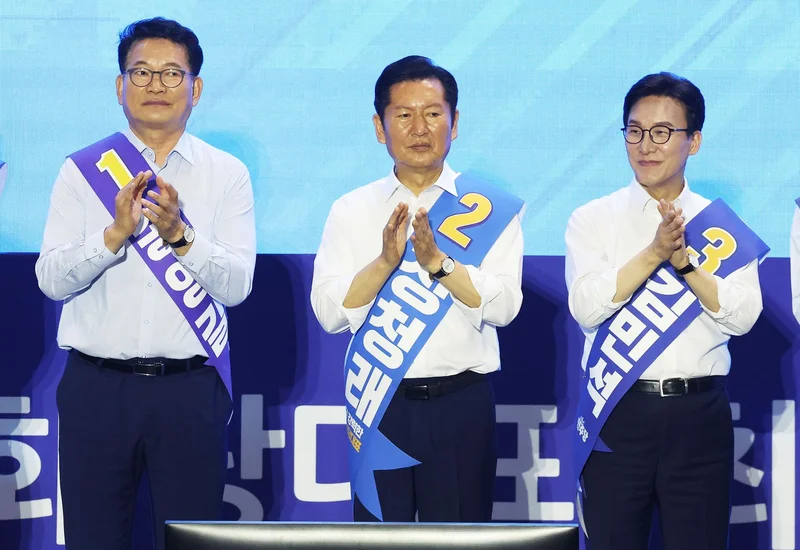
Former Prime Minister Kim Min-seok won the ruling Democratic Party of Korea's (DPK) primary across Seoul and Gyeonggi Province on Sunday. Kim secured a narrow victory with 46.61 percent (148,245 votes), edging out incumbent party leader Rep. Jung Chung-rae at 46.28 percent (147,038 votes) and former party chief Rep. Song Young-gil at 7.05 percent (22,410 votes).
In total, Kim’s cumulative vote share reached 49.91 percent, excluding regional weighting for South and North Gyeongsang Provinces and Daegu. Meanwhile, Jung followed at 41.51 percent, widening the gap between them to 8.4 percentage points.
In the party primary held in Gwangju and the Jeolla provinces Saturday, Kim also secured a victory in a region viewed as a litmus test for the party's leadership race. Kim captured 57.54 percent of the vote in the party stronghold, outpacing Jung, who received 32.65 percent, and former party chief Rep. Song Young-gil, who took 9.81 percent.
Before Sunday's primary, Kim led with a cumulative 235,128 votes, or 52.21 percent, across Chungcheong Province, Busan–Ulsan–South Gyeongsang Province, Jeju, Incheon, Gangwon Province, Daegu–North Gyeongsang Province, and North and South Jeolla provinces. Jung secured 171,768 votes, or 38.14 percent — a gap of roughly 14 percentage points with Kim. Song remains in third with 43,464 votes, or 9.65 percent.
Kim’s strong performance in Seoul and the greater metropolitan area and Jeolla area in particular suggests party loyalists favor a candidate aligned with President Lee Jae Myung, who recently announced an 800 trillion won ($564 billion) semiconductor megaproject for Gwangju and the surrounding region, despite his falling approval rating.
According to Gallup Korea, Lee’s approval rating dropped to 44 percent as of Friday, the lowest level since he took office. The survey was conducted on 1,000 voters aged 18 and older nationwide from Tuesday to Thursday. It has a margin of error of plus or minus 3.1 percentage points and a 95 percent confidence level.
“Voters in the Honam region, or Jeolla Province, chose the economic promises of Samsung Electronics and SK Hynix over local ties. Jung had appealed to voters as a ‘son-in-law of Jeolla,’ while Song framed himself as a ‘native son of the province,’” Choi Jin-nyoung, a lawyer, was quoted as saying by YTN.
The primary results for Seoul and the greater metropolitan area were announced around 6:20 p.m., Sunday. The final results for DPK leadership, including the races for five Supreme Council seats, will be tallied by combining delegate votes with a public opinion survey that accounts for 30 percent of the total and announced Monday.
In a joint speech delivered Sunday, Kim pledged to support semiconductor and locally driven growth in Gyeonggi Province while aligning with the Lee Jae Myung government.
Kim described Gyeonggi Province as having three agendas: “Leading the future and the world with semiconductors; seeking global and national reform through progressive policies like basic income and local currency; and normalizing border areas in northern Gyeonggi Province that have long faced reverse discrimination,"
He stressed that, “A stable party brings a stable administration, which in turn brings stability to the government and the economy.”
Meanwhile, Jung promised new real estate policies to stabilize the property market by “normalizing the state-run Korea Land & Housing Corporation,” while Song pledged to “resolve the division of the Korean Peninsula.”
Kim is widely expected to win the leadership race.
“The trend will likely continue in Gyeonggi and Seoul as well, though the margin will likely be narrower than in the Jeolla provinces. Since Jung Chung-rae has relatively more supporters among party members in Seoul than in Jeolla, the gap will narrow compared to today’s results but the basic trajectory still favors Kim Min-seok,” Choi Chang-ryul, a political science professor at Yong In University, told reporters, before Sunday's primary.
If elected party leader, Kim is widely expected to focus on supporting the president’s legislative and policy agendas, including megaprojects, as he did while serving as the first prime minister for Lee's administration.
If Jung is elected, he is expected to seek party reform, which may differ from the direction pursued by the administration.
Jung, who was elected last August, shortly after Lee took office, has faced internal criticism for failing to align smoothly with the administration on policy matters. Some party members have also blamed him for the party's disappointing performance in the June local elections.
However, critics argue that strictly aligning with the president's agenda may fail to capture broader public sentiment at a time Lee's support is falling, and that the party, which already holds a majority in the National Assembly, must have a system of checks and balances.
“Given President Lee Jae Myung’s rising disapproval ratings, driven by public discontent over real estate and the stock market policies, some are arguing that even the ruling party needs someone who could offer constructive criticism,” Kim Cheol-hyun, a special appointment professor at Kyungil University, told reporters.
“If voters in Seoul and Gyeonggi may feel the ruling party needs a leader who can oppose Lee, they could make a very different choice.”