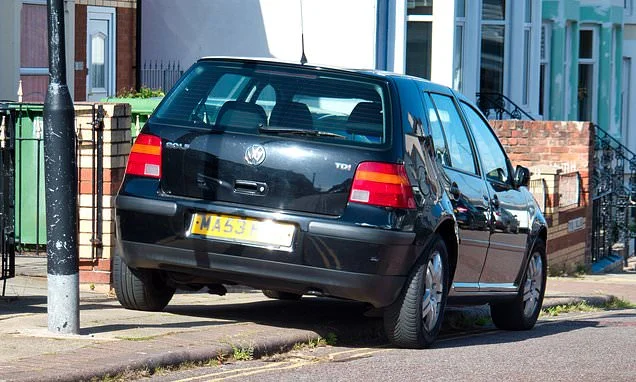
Pavement parking complaints are among the most common gripes fielded by councils on a daily basis.
And in a recent poll of more than 10,500 Daily Mail readers, 66 per cent said they want to see pavement parking banned across England because of the inconvenience and hazards it can cause.
This is something the Government has responded to with new rules being put in place to tackle the problem.
Earlier this year, it introduced new legislation that gives councils powers to enforce pavement-parking in their areas.
This means local authorities will be able to issue fines to motorists deemed to be blocking footpaths with their vehicles, even if they have just a single wheel on the kerb.
However, more than half are unlikely to do so, according to a BBC investigation.
A Freedom of Information request submitted by the broadcaster revealed that 84 of the 164 responding councils have designated parking bays on pavements within their areas.
Just five of those local authorities said they have plans to remove the spaces.
Pavement parking complaints are among the most common issues dealt with by councils on a daily basis. Yet more than half in England encourage drivers to do it, the BBC has found
A Local Government Association (LGA) spokesperson told the BBC that councils allow pavement parking to 'balance the needs of all users'.
This appears to conflict with comments made by the association earlier this year, when it said parking on footpaths was 'one of the most complained-about issues by residents' and one that can 'cause a lot of disruption and block access, particularly to those with mobility issues or parents who are pushing their children in buggies'.
The LGA also said the practice can cause cracked paving slabs, creating trip hazards that can lead to injury claims and increased maintenance costs - all of which come out of already stretched council budgets.
Some parts of the UK already have blanket pavement-parking bans in place.
London, Exeter and the whole of Scotland prohibit drivers from putting wheels on the kerb.
In the capital, penalty charges for parking on the pavement range from £60 to £130, though fines are typically halved if paid within 14 days.
Elsewhere in England, only the police can take enforcement action against vehicles blocking pavements until the new rules begin to take effect later this year.
A Freedom of Information request submitted by the BBC revealed that 84 of the 164 councils in England have designated parking bays on pavements. This is despite issues caused for those in wheelchairs and people who are visually impaired
New laws giving councils the powers to make pavement parking illegal in their areas received royal assent in April. Motorists could soon be at risk of being ticketed
The English Devolution and Community Empowerment Act, which received Royal Assent in April, provides local authorities with new powers to tackle dangerous parking in their own areas.
The changes will be introduced in two phases.
By the end of 2026, ministers intend to give local authority civil enforcement officers powers to issue penalties for obstruction on footways.
The second stage will create a national regulatory framework, giving councils broader enforcement powers and a more efficient process for introducing signage and exemptions.
The law change was welcomed by disability groups as a victory against inconsiderate drivers who create dangerous situations for people with sight loss and those who rely on wheelchairs or mobility scooters.
Chris Theobald, senior policy and campaigns manager at Guide Dogs, said the charity had been 'delighted' with the changes, having 'campaigned for decades' for a crackdown on dangerous pavement parking.
'Blocked pavements are a problem for everyone trying to walk down the street safely, but are especially dangerous for people with sight loss, wheelchair and powerchair users, and people with pushchairs, who may have no option but to step into the road,' he said.
The National Federation of the Blind added that parking on pavements 'damages them in the longer term, leaving them in a worse state for pedestrians'.
However, some motorists have viewed the law change as another attack on drivers, with additional penalties seen as a means of boosting council coffers.
Pavement parking has been illegal in London for over 50 years and was banned in Scotland by the Transport (Scotland) Act 2019, with enforcement by local beginning on 11 December 2023
In a survey of 1,709 UK drivers conducted in September, 83 per cent backed the introduction of new rules.
AA policy spokesman Rod Dennis said the legislation must still 'permit drivers to partially park on pavements where doing so helps keep traffic flowing and doesn't inconvenience other people'.
The change in the law comes more than five years after the Conservative Government launched a consultation into tackling pavement parking at both local and national level, in which four in five respondents said parking on footpaths was a problem in their area.
Two in five of the 15,000 respondents also said they would leave home more often if pavement-parking issues were addressed where they live.
Despite that support, no further action was taken at the time.