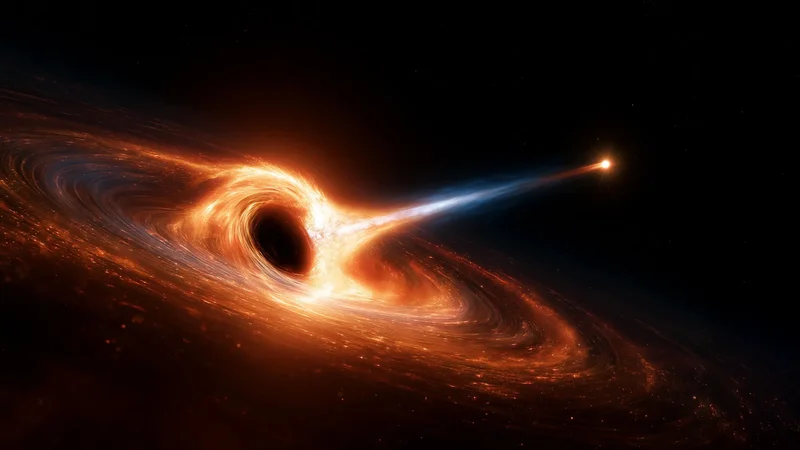
A black hole shredded a âsuper sunâ â but something strange may have survived
- Date:
- August 15, 2026
- Source:
- Liverpool John Moores University
- Summary:
- Astronomers have witnessed a black hole violently shredding a massive star, creating one of the most energetic stellar explosions ever observed. The event, nicknamed âthe Whippet,â briefly released about 400 billion times the Sunâs energy and sent a shock wave racing outward at one-fifth the speed of light. Months later, scientists spotted unexpectedly fast-moving helium, suggesting that some structure may have survived the destruction.
- Share:
A massive star has been torn apart and gradually consumed by a black hole in a spectacular event that scientists compared to "preparing a snack for lunch."
Astronomers around the world observed the extreme encounter, and the event was presented at the AAS conference in Phoenix, Arizona. Researchers described the star as being "torn up" as the immense gravity of the black hole pulled it apart and consumed its material piece by piece.
Associate Professor of Astrophysics Daniel Perley, of Liverpool John Moores University, is the lead author of a paper in the Monthly Notices of the Royal Astronomical Society. He told the conference: "We discovered what we think is a black hole merging with a massive companion star, shredding it into a disk that feeds the black hole. It's a rare and awe-inspiring phenomenon."
The destruction produced one of the most powerful cosmic events ever recorded. For a brief period, the energy being released reached roughly 400 billion times the output of Earth's Sun, surpassing even the most powerful supernovae known to astronomers.
Black Hole Devours a Massive Star
Astronomers have previously observed black holes apparently consuming stars in events known as Tidal Disruption Events. However, researchers had never seen one take place on a scale like this.
Anna Ho, an assistant professor of astronomy at Cornell University and a coauthor with Perley on the paper, identified the remarkable event soon after its light arrived at Earth. Using the Zwicky Transient Facility at Palomar Observatory in California, she detected the object, formally designated AT2024wpp and nicknamed the Whippet.
Researchers quickly suspected that the phenomenon could be a Luminous Fast Blue Optical Transient (LFBOT), a rare and poorly understood type of visible cosmic event linked to the destruction of stars. Within a day, observations from the Liverpool Telescope in the Canary Islands and NASA's Swift satellite in space showed that the object displayed the expected characteristics of an LFBOT. It appeared extremely blue and was producing X-rays.
Distance measurements supplied by coauthors R. Michael Rich at UCLA and Yu Jing Qin at Caltech showed that the transient was releasing far more energy than an ordinary supernova. Combined with other observations, including its exceptionally high temperature, the measurements led the researchers to conclude that they were witnessing a star being ripped apart and swallowed by a black hole.
"Even though we suspected what it was, it was still extraordinary," added Perley. "This was many times more energetic than any similar event and more than any known explosion powered by the collapse of a star.
"Not only do these events help us identify black holes, they provide a new way to identify where black holes occur and how they form and grow, and the physics of how this happens," Perley added.
Shock Wave Races Through Surrounding Gas
Additional studies of AT2024wpp indicate that the event generated a powerful shock wave that traveled outward through dense surrounding gas at one-fifth the speed of light. After about half a year, however, the shock suddenly appeared to "fizzle out."
Material pulled from the star formed a disk around the black hole and became intensely hot as it spiraled inward. That process produced X-ray radiation along with a powerful "wind" of gas. The outflow collided with material the star had released before its destruction, generating the bright blue optical and ultraviolet emission seen during the first few days, as well as the radio and millimeter signals detected by astronomers.
Researchers believe the shock "fizzles" after reaching the outer boundary of a bubble created by gas that the doomed star had previously expelled.
A Strange Signal Emerges From the Aftermath
One puzzling feature remains. Observations from Keck Observatory, Magellan Observatory, and the Very Large Telescope showed no recognizable chemical signatures during the first month after the explosion. As the event began to fade, however, weak signatures of hydrogen and helium gas appeared.
The helium produced an especially unexpected clue. It was traveling along the line of sight at more than 6,000 kilometers per second, indicating that a densely bound structure may have survived the initial blast and was now moving rapidly toward us.
The researchers speculate that the signal could come from a "stream" of material released by the star's core while the black hole's immense gravity was tearing it apart. A more speculative possibility is that the material comes from a third member of the system that is being blasted by the fast wind of particles and X-ray radiation generated by the feeding black hole.
Story Source:
Materials provided by Liverpool John Moores University. Note: Content may be edited for style and length.
Journal Reference:
- Daniel A Perley, Anna Y Q Ho, Zoë McGrath, Michael Camilo, Cassie Sevilla, Ping Chen, Genevieve Schroeder, Taya Govreen-Segal, Aleksandra Bochenek, Yu-Jing Qin, James H Gillanders, Benjamin Amend, Joseph P Anderson, Igor Andreoni, Amar Aryan, Eric C Bellm, Joshua S Bloom, Thomas de Boer, Jonathan Carney, Ilaria Caiazzo, Ken C Chambers, Panos Charalampopoulos, Ting-Wan Chen, Tracy X Chen, Eric R Coughlin, Michael Coughlin, Michel Dennefeld, Georgios Dimitriadis, Christoffer Fremling, Danielle Frostig, Avishay Gal-Yam, LluÃs Galbany, Anjashay Gangopadhyay, Melzie Ghendrih, Matthew J Graham, Mariusz Gromadzki, Steven L Groom, Claudia P Gutiérrez, K -Ryan Hinds, Mark E Huber, Cosimo Inserra, Benjamin C Kaiser, Mansi M Kasliwal, Niilo E Koivisto, Chien-Cheng Lin, Chang Liu, Thomas B Lowe, Eugene Magnier, Ashish A Mahabal, Andrew Milligan, Paloma Minguez, Geoffrey Mo, Tomás E Müller-Bravo, Matt Nicholl, Priscila J Pessi, Giuliano Pignata, Josiah Purdum, Nabeel Rehemtulla, R Michael Rich, Anwesha Sahu, Avinash Singh, Stephen J Smartt, Ian A Smith, Jesper Sollerman, Gokul Srinivasaragavan, Shubham Srivastav, Robert D Stein, Steve Schulze, Jack W Tweddle, Richard Wainscoat, Jacob L Wise, Lin Yan, David R Young. ATâ2024wpp: an extremely luminous fast ultraviolet transient powered by accretion onto a black hole.Monthly Notices of the Royal Astronomical Society, 2026; 549 (1) DOI: 10.1093/mnras/stag678
Cite This Page:
ScienceDaily. Retrieved August 15, 2026 from www.sciencedaily.com