Was Israel behind the Ceuta crisis?
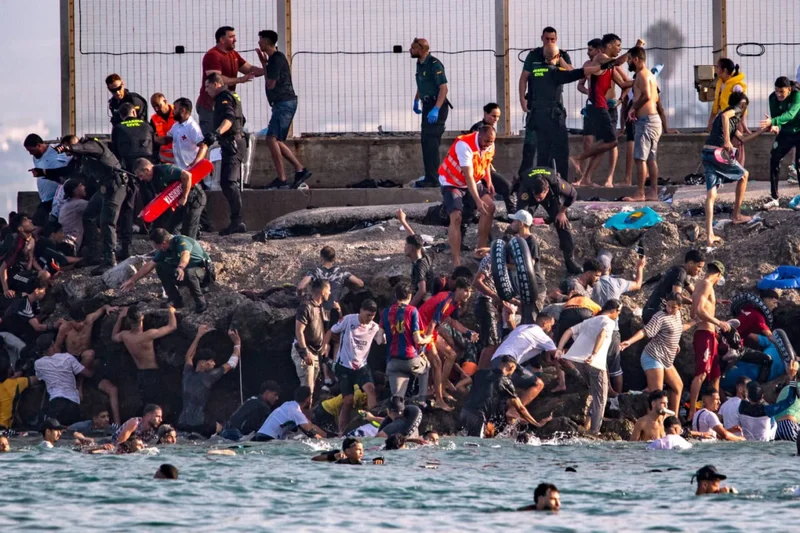
MADRID - The hybrid warfare episode recently endured by Spain, characterized by the mass entry of over 600,000 individuals, primarily from Morocco, is transitioning from political speculation to documented geopolitical reality. Early hypotheses suggesting the orchestration of this crisis by Israeli and United States intelligence are increasingly substantiated by concrete evidence and structural analysis.
According to assessments by Chinese intelligence, the Ceuta incursion was a calculated operation driven by Morocco and Israel to destabilize Spain. The timing of the event was hardly coincidental; it materialized precisely as the US and Israeli governments exhibited profound displeasure with the Spanish executive over its diplomatic support for Palestinian rights and its opposition to the broader war on Iran.
That the mass incursion into Ceuta constituted an organized hybrid attack is no longer a matter of reasonable dispute. Spanish security footage captured Moroccan intelligence operatives embedded among the migrants, with verified visual evidence of trucks transporting crowds to the border and uniformed agents escorting them with the casual discipline of a state-directed operation. The evidence, while welcome, is almost redundant. Nowhere on Earth do 60,000 people gather spontaneously, and certainly not in Morocco, where state security services maintain an almost patrimonial interest in monitoring gatherings of merely five individuals.
Beyond the physical breach, the crisis was rapidly weaponized through a coordinated discursive amplification. Israeli politicians and aligned think tanks, such as the Foundation for Defense of Democracies (FDD), an organization whose interests rarely extend beyond the immediate strategic imperatives of the Israeli state, played a pivotal role in escalating the narrative. Within hours of the initial footage circulating, the European right wing, the expansive Trump-aligned media apparatus, and Israeli officials, notably UN Ambassador Danny Danon, joined a synchronized chorus. Their objective was to raise the temperature, fuel panic, and accelerate the crisis until it reached a boiling point, culminating in outlets like Fox News declaring that "northern Spain" had been invaded.
This external pressure found immediate resonance within the Spanish political arena. The current Minister of Transport, Óscar Puente, openly highlighted the Israeli connection following a tense exchange on X with Danny Danon, who had accused Spain of hypocrisy for criticizing Israel while declaring a state of emergency in Ceuta. Puente’s retort was succinct: "Well, it seems that everything is starting to become quite clear." Similarly, Gabriel Rufian, parliamentary spokesperson for the Republican Left of Catalonia, argued that the crisis directly served American and Israeli strategic interests. This sentiment was echoed across the cultural and political spectrum, from journalist Jose Vizner resurfacing a 2019 post by Yair Netanyahu discussing Israeli support for Ceuta's separatism, to actor Javier Bardem sharing “evidence” of Israeli involvement in the crossings.
To understand the structural mechanics of this crisis, one must examine the hard-power axis that has solidified between Rabat, Tel Aviv, and Washington. Morocco’s realignment with the US and Israel began in December 2020, when Donald Trump signed a proclamation recognizing Moroccan sovereignty over Western Sahara as the price for Rabat’s entry into the Abraham Accords. Israel completed this geopolitical circle in July 2023 with its own formal recognition of Moroccan claims over the territory. Since then, the three capitals have constructed a formidable security apparatus: intelligence sharing, joint military planning, and the co-production of Israeli air-defense systems and drones on Moroccan soil.
For a Trump administration already fixated on global maritime chokepoints and eager to wrest strategic control of territories like Greenland from European hands, the Strait of Gibraltar presents an obvious and irresistible prize. An administration that has spent a year pressing Denmark over Arctic shipping lanes—framing them as too strategic to leave to Europeans—has a manifest interest in who controls the gate between the Atlantic and the Mediterranean. When viewed alongside a US foreign policy that moved immediately upon taking office to assert control over the Panama Canal, strengthen its hand in the Strait of Malacca, and engage in active conflict across the Strait of Hormuz, the sudden pressure on the Strait of Gibraltar ceases to look like a coincidence.
It is a calculated maneuver in a broader war over global logistics. It becomes less surprising, then, that just weeks prior, Capitol Hill quietly laid the legislative groundwork for this pressure by casting formal doubt on Spanish sovereignty over Ceuta and Melilla.
Finally, this external hybrid offensive exploits a critical internal vulnerability within the Spanish state: the open confrontation between Pedro Sánchez’s government and the Centro Nacional de Inteligencia (CNI), Spain’s intelligence service. The Minister of the Interior, Fernando Grande-Marlaska, publicly claimed that the CNI had failed to warn the government of an event of this magnitude. In response, the CNI leaked to the press that comprehensive reports had, in fact, been drafted in the preceding days, analyzing and warning of the exact situation that unfolded. This institutional fracture not only paralyzes the state's defensive posture but also signals to external actors that the Spanish political apparatus is deeply compromised, making it a highly susceptible target for the very hybrid warfare it is currently enduring.
Sources:
-Alleged report leaked from the CNI (spanish): crisis-ceuta.com
- Mediapart (french):”Ceuta: revanche des États-Unis et Israël contre l’Espagne, menée par le Maroc?”
(https://blogs.mediapart.fr/ricardo-martins/blog/050826/ceuta-revanche-des-etats-unis-et-israel-contre-l-espagne-menee-par-le-maroc)
- Middle East Monitor: “Ceuta crisis sparks online speculation over Israel’s role in pressuring Spain”.
(https://www.middleeastmonitor.com/20260731-ceuta-crisis-sparks-online-speculation-over-israels-role-in-pressuring-spain/)
- Anadolu Agency: “Spanish politicians, commentators accuse Israel of stirring chaos over Ceuta migration crisis”
(https://www.aa.com.tr/en/europe/spanish-politicians-commentators-accuse-israel-of-stirring-chaos-over-ceuta-migration-crisis/4014887)
- Times of India: “US, Israel behind Ceuta crisis? The geopolitics of illegal migration from Morocco to Spain”
(https://timesofindia.indiatimes.com/world/europe/us-israel-behind-cueta-crisis-the-geopolitics-of-illegal-migration-from-morocco-to-spain/articleshow/132830463.cms)
-Modern Diplomacy: “Ceuta Migration Crisis: Why Chinese Analysts Are Looking at Mossad” (https://moderndiplomacy.eu/2026/08/02/ceuta-migration-crisis-china-morocco-spain/)
-ChinaMEd: “Chinese Officials, Experts and Media Discuss the Ceuta Crisis” (https://www.chinamed.it/observer/chinese-officials-experts-and-media-discuss-the-ceuta-crisis)