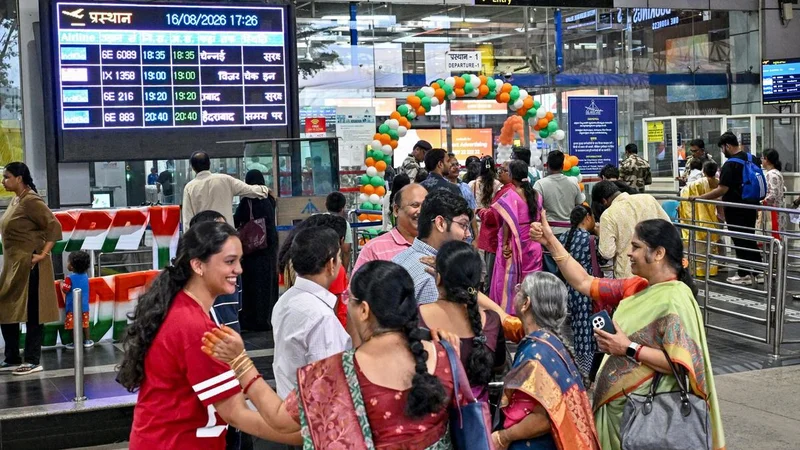
The Visakhapatnam airport marked its final day of commercial operations on Sunday (August 16, 2026). The last scheduled flight, IndiGo’s 10.45 p.m. service to New Delhi, flight 6E 2018, took with it the civil run of an airfield that has served the city since the Second World War.
At 12.01 a.m. on Monday (August 17, 2026), the Alluri Sitarama Raju International Airport at Bhogapuram comes into commission under two gazette notifications the Ministry of Civil Aviation issued last month, Airport Director N. Purushottam said. One brings the new airport into service; the other ends scheduled commercial operations at the civil enclave at INS Dega for 30 years, allowing exceptions for the armed forces, national emergencies and aircraft carrying dignitaries. The IATA code VTZ passes to Bhogapuram at the same minute. Non-scheduled civil flights and all naval flying continue at INS Dega, and since July 9 the Navy has been the sole controlling authority for the restructured Visakhapatnam airspace.
The Airports Authority of India thanked the Indian Navy for hosting civil operations at INS Dega, a partnership that continues for non-scheduled flights, and the CISF, BCAS, DGCA, Customs, Immigration, airlines and ground handlers.
The 30-year condition dates to January 2016, when the Centre gave site clearance for Bhogapuram. The ceiling on civil movements at a naval field, where airlines flew within slots the Navy allotted, was the core reason the State pursued a greenfield airport.
A wartime airstrip
The airfield at Buchirajapalem, in the valley behind the port, was set up in 1941 by the Royal Air Force. On April 1, 1942, the Indian Air Force’s No. 104 General Reconnaissance Squadron was raised there when Flight Lieutenant David Small and Pilot Officer Maurice Barker flew in two Westland Wapiti biplanes from Dum Dum.
Five days later, aircraft from the Japanese carrier Ryujo bombed Vizagapatam and Cocanada, now Kakinada. The airfield and its two Wapitis were not hit. Eight port employees died when a bomb burst near a pipe in which they had taken shelter; a plaque at the Visakha Museum carries their names.
John Castellas, whose family roots are in the city and who now lives in Melbourne, has written the airfield’s early history and told The Hindu what the first patrol was like, quoting from Wing Commander W. Russell’s Forgotten Skies. “Squadron Leader David Small, having just formed his flight at Dum Dum, arrived on 1st April with two Wapitis at the field in the valley behind the small port of Vizagapatam, halfway up the east coast of India. He had no phone to the Naval Officer in charge at the port, no hangars, and as yet no airman. On 6th April, after struggling with all these initial difficulties, he went out on his first patrol. He decided to navigate, as there were no wireless operators or navigators on the spot, so the young Indian Pilot Officer Maurice Barker, whose home is at Agra, flew the aircraft. He looked closer and witnessed the unbelievable sight of an aircraft carrier, several cruisers and destroyers belching fire at a merchant’s vessel, like hounds around a fox at bay.”
Small, by then a Squadron Leader, did not return from a Hudson patrol over the Bay of Bengal in early 1943. Barker rose to Air Marshal, the first Anglo-Indian to hold that rank, and retired in 1976. Later in the war the field staged Dakotas for paratroop drops over Burma; wartime collections in the town bought the RAF a Spitfire named Vizagputum II and a Wellington bomber named Vizagapatam.
The Navy’s field
Civil flights began in 1954. Naval aviation arrived on December 23, 1972, when 321 Flight, a Chetak helicopter unit, was raised at INS Circars, and on March 12, 1986 the airfield passed from the National Airports Authority to the Navy. On October 21, 1991, Admiral Laxminarayan Ramdas, then Chief of the Naval Staff, commissioned it as INS Dega, the name being the Telugu word for a large bird of the eagle family. At commissioning, the only fixed-wing civil flying was Vayudoot’s Dornier service. From then on the Airports Authority of India ran the civil enclave on a runway, and under air traffic control, that belonged to the Navy.
INS Dega became the Eastern Naval Command’s main air station: the Kamov Ka-28 anti-submarine squadron INAS 333 in 2000; the Dornier squadron INAS 311 and the Sea King squadron INAS 350 in 2009; INAS 551 with Hawk trainers in 2014; and INAS 324, the first naval Advanced Light Helicopter squadron on the east coast, in 2022. In 2017 the de-inducted Tu-142M that now stands as a museum on Beach Road made its final landing here.
The civil side grows
The civil turning point came in 2007, when a new 10,000-ft runway replaced the 6,000-ft strip and night flying began. The present integrated terminal, built by the AAI at about ₹95 crore, opened to passengers on March 27, 2009 with 20 check-in counters and three aerobridges. The Navy’s history records that civil traffic grew more than 50-fold between 1999 and 2009.
International status came on March 25, 2012, with Air India’s daily Dubai flight via Hyderabad. SilkAir opened Singapore in October 2017; Scoot, AirAsia and Thai AirAsia followed to Singapore, Kuala Lumpur and Bangkok, and Colombo was also connected. The airport grew into a logistics node for seafood and shrimp exports. The Andhra Pradesh Air Travels Association (APATA) puts traffic at 27.84 lakh passengers in 2023-24, a monthly high of 2.97 lakh in May 2023, and about 17.10 lakh in the first seven months of 2025-26. The AAI expanded the terminal in 2019 and, as late as March 2023, proposed a new ₹240-crore terminal here.
Cyclone Hudhud, which crossed the coast on October 12, 2014, tore the roof off part of the terminal and flooded the runway. The Navy, the AAI and the NDRF cleared the airfield within days, and INS Dega became the storage point for relief flown in by the IAF. Flooding had shut the airport for more than 10 days in 2005.
The traffic tells the rest: On AAI figures, 10.99 lakh passengers in 2014-15; 28.53 lakh in 2018-19, the pre-pandemic peak; 11.14 lakh in 2020-21; and a record 29.55 lakh in 2024-25, with 22,210 aircraft movements and 4,398 tonnes of cargo. It ends its run as the busiest airport in Andhra Pradesh.
The last day
“I have flown in and out of this terminal for thirty years,” said K. Sridhar, a frequent flyer. “Seeing it go is bittersweet. It was compact, accessible, and felt like home.”
Staff and regular commuters photographed each other near the check-in counters through the afternoon.
Bhogapuram, about 40 to 48 km from the city by different reckonings, was inaugurated by Prime Minister Narendra Modi on August 1. GMR Visakhapatnam International Airport Limited built it in 31 months under a design-build-finance-operate-transfer concession, with a 3,800-metre runway, 18 aircraft stands and a first-phase capacity of six million passengers a year. Cost figures differ by source, from about ₹4,727 crore in most reports to over ₹5,640 crore in the government’s inauguration release; the State says it spent ₹1,583 crore on land and enabling works. Then Chief Minister Y.S. Jagan Mohan Reddy laid the foundation stone on May 3, 2023, and the airport was named after Alluri Sitarama Raju in September 2024. Scoot flies to Singapore three days a week and IndiGo to Abu Dhabi four.
Bhogapuram is expected to take daily movements beyond 90. APATA office-bearers K. Kumar Raja, D.S. Varma and O. Naresh Kumar said its success depended on the road: they sought speedier work on the Coastal Corridor, fenced lanes for electric airport buses, fixed fares with cab aggregators to curb surge pricing, city passenger lounges with ticketing and transit help at RK Beach, VMRDA Park and Seethammadhara, and a dedicated cargo terminal to keep pharma and seafood shipments from moving to Hyderabad or Chennai.
What stays
INS Dega keeps its runway, its squadrons and its place as the Eastern Naval Command’s premier air station, flying patrol, anti-submarine, rescue and relief missions over the Bay of Bengal. Vice Admiral Rajesh Pendharkar, then Flag Officer Commanding-in-Chief, told reporters at the Navy Day briefing on December 2, 2024 that the station would expand once civil flights left, that the vacated space would go to infrastructure and more aircraft, and that Rafale aircraft would be stationed here. India signed for 26 Rafale-M carrier fighters in April 2025.
Published - August 16, 2026 09:41 pm IST