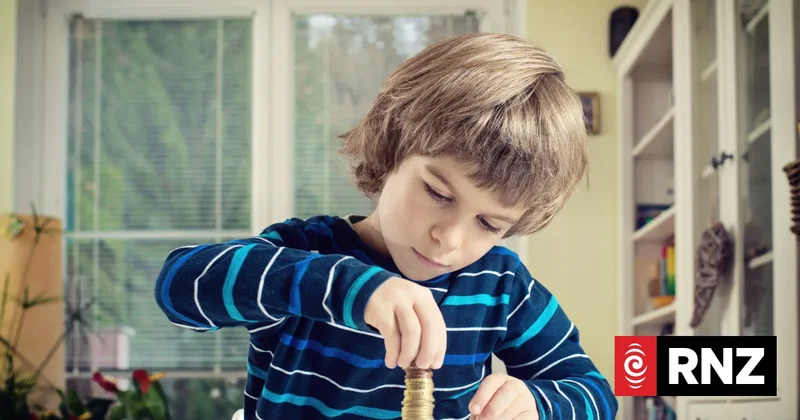
The Life Education Trust has compared the new finance subject for primary schools to the introduction of sex education - ensuring important lessons are not left to chance discussions with parents.
It says most children learn about money from their families but not all are willing or well-equipped to talk about it.
Life Education Trust chief executive Jo Malcolm Black told RNZ the inclusion of Financial and Economic Activity in the Year 0-10 Social Sciences curriculum - to be introduced next year - would solve that problem by ensuring all young people had a good understanding of personal finance and decision-making.
"That's really, really important because research has told us that actually a child's financial personality is formed by the age of seven," she said.
The curriculum document said the subject focused on "the financial concepts and practices that shape everyday life".
It would start by teaching Year 1 students that money was used to pay for things and by Year 8 students would learn about financial goal-setting and shares.
Malcolm Black said to-date schools' coverage of personal finance varied enormously so in many cases children's financial literacy depended on their families.
"If you think about maybe the sort of conversations we had 20 or 30 years ago about sex education. Some families are really good at it, some families had really open doors and other families did not talk about it. And as silly as it sounds financial literacy has been a little bit like that," she said.
"Some kids will come to school having not talked about pocket money, having not talked about saving money, have having not talked about how that magic card works in my wallet."
"So some kids are really savvy. Some kids talk about jobs and saving and planning and other kids ... the sense of scarcity is there. Young people are having conversations about money themselves and if we don't provide access to education about it those conversations aren't going to be very well-rounded."
Malcolm Black said making finance a compulsory part of the curriculum would ensure every child got a good grounding in the subject.
"What this change is doing is embedding financial literacy from Year 0, which is an incredibly important step," she said.
"You can't give kids the same financial circumstances, but we can give them a common foundation of knowledge about the kind of choices they can have and the consequences of those choices," she said.
Malcolm Black said Life Education had been touring a secondary school financial education programme since 2020 and it wanted to be involved in schools' teaching of the new subject.
She said the curriculum was likely to have a lasting effect on young people's lives.
"If we could assume that every young person who leaves school, let's say in 2030 can understand concepts like budgeting, Kiwisaver, investment, and the value of starting early, they're going to be much better equipped to make decisions in their 20s that will impact the the rest of their lives," she said.
What they'll learn
Financial and Economic Activity: focuses on the financial concepts and practices that shape everyday life.
Year 1: Money is used to pay for things, people make different choices about money, money can be saved or shared.
Year 2: Money is used instead of exchanging things, the difference between essentials and non-essentials.
Year 3: Incomes, goods and services, different households have different financial circumstances.
Year 4: Financial systems and money, different work has different incomes.
Year 5: Financial services such as banks, getting value for money, essential and non-essential expenses.
Year 6: Investments, interest, financial goals and planning.
Year 7: Budgeting and managing money as a group.
Year 8: Advertising, credit cards, scams, and consumer rights