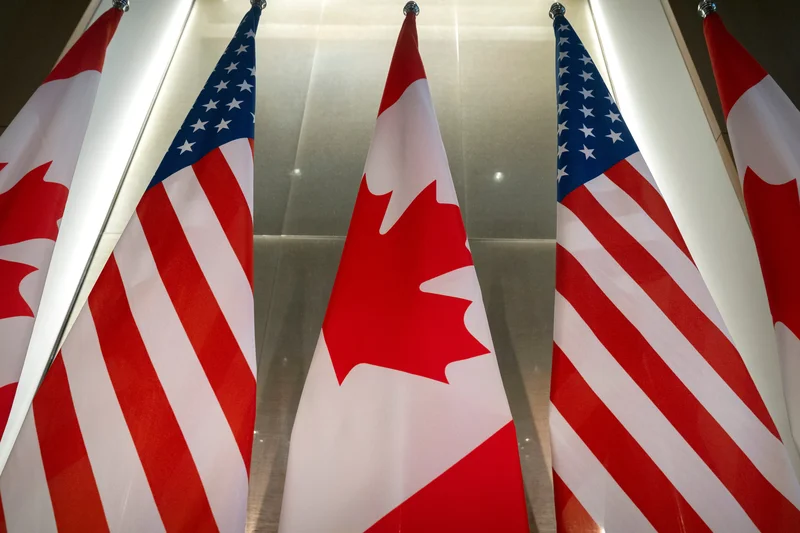
Canadian and U.S. officials are set to meet again Sunday with the new tariffs proposed by President Donald Trump set to take effect in just three days.
A spokesperson for the minister responsible for Canada-U.S. trade, said Dominic LeBlanc is set to speak with U.S. Trade Representative Jamieson Greer at 4:30 p.m. Eastern.
“Their meeting will be an opportunity to take stock of the work that has been accomplished by their respective negotiating teams, and the work that still lies ahead, as we seek to reach a comprehensive deal that delivers for businesses, workers, farmers and families on both sides of the border,” said Gabriel Brunet, LeBlanc’s spokesperson, in a statement.
The meeting comes as the U.S. is set to impose a 50 per cent tariff on some Canadian goods on Wednesday, raising concerns among politicians, industries and the public.
Earlier on Sunday, Conservative Leader Pierre Poilievre argued tariffs must be removed on Canadian softwood lumber in any trade deal made.
“It is unacceptable for there to be U.S. tariffs on Canadian lumber,” he said during a news conference Sunday. “It’s time for Mark Carney to keep his promise that he would negotiate a win and get the tariffs off Canadian softwood lumber. No more concessions while getting nothing in return.”
Such relief may not come to fruition in the latest negotiations, based on information from sources Global News has agreed not to identify because they were not authorized to speak publicly on the trade talks.
Get daily National news
The gap on potential relief for the softwood lumber industry for now seems unlikely, with two sources with knowledge of the talks saying the Americans are not interested in reducing softwood tariffs and duties, which currently sit at 45 per cent.
Last week, B.C. Premier David Eby criticized the high tariff rates.
“We face higher tariffs than Russia,” B.C. Premier David Eby, whose province has a large lumber industry, said on Friday. “The U.S., for some inexplicable reason, is putting forest families out of work here in order to prioritize lumber imports from Europe and Russia.”
While Eby, Poilievre and others are urging a fight on softwood lumber, other factors are being considered in the talks.
But as of Friday, a big gap remained between the two sides, according to sources with direct knowledge of the trade negotiations.
One source told Global News that Canada has had to fight to even negotiate on softwood lumber.
Any deal the Trump administration is willing to sign will have some form of tariffs on steel, aluminum, autos and lumber, according to sources, with the U.S. also insisting American alcohol be put back onto all provincial liquor store shelves, which multiple premiers have expressed a willingness to do if enough U.S. concessions are made.
Canada’s goal remains reaching a deal before Wednesday to avoid new 50 per cent tariffs on roughly $28 billion worth of Canadian goods from taking effect.
If a deal is reached, tariffs on Canadian autos and parts compliant under the Canada-U.S.-Mexico Agreement (CUSMA) would remain in place, but it is expected that they would be reduced from the current 25 per cent level, according to a source familiar with the talks. One proposal that has been discussed is a tariff rate of between 10-15 per cent on CUSMA compliant autos and parts, according to one source.
Auto industry leaders have criticized the move, while Brampton Mayor Patrick Brown said Saturday that “no deal is better than a bad deal” if the auto sector is not included in talks.
—with files from Global News’ Reggie Cecchini, Mackenzie Gray and Sergio Vargas