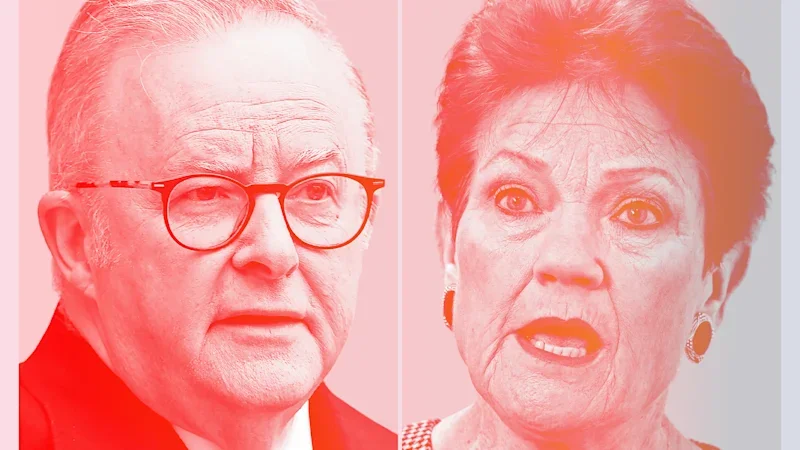
After a difficult couple of months for Anthony Albanese and Pauline Hanson, the pair remain Australians’ first and second choice respectively as preferred prime minister.
And the person paying the price is Angus Taylor.
Albanese, Hanson and Nationals leader Matt Canavan were all out on Sunday doing interviews and trying to shape the political agenda for the parliamentary week ahead, but Taylor was notably absent.
The opposition leader spent much of parliament’s winter break travelling the country and meeting voters, but at this stage it hasn’t helped.
Despite the prime minister facing weeks of heavy criticism over his decision to break key promises not to change negative gearing or the capital gains tax arrangements, and calls to apologise for seemingly joking about Japanese Prime Minister Sanae Takaichi’s personal appearance, Labor’s primary vote has not shifted.
Similarly, despite the week-long furore over his appearance on the Bush Deep podcast, Albanese’s standing as preferred prime minister only fell by one percentage point, and his net score on personal performance by just two percentage points, to minus 16 per cent.
And Hanson’s preferred prime minister rating rose by one percentage point to 26 per cent, while her net performance rating improved to plus 5 per cent, even following a difficult appearance at the National Press Club, and although she faced sustained scrutiny for a trip to Europe paid for by mining magnate Gina Rinehart which included a side trip to a luxury resort in Sicily.
During a TV interview on Sunday morning, Hanson again stoked controversy by criticising a joint federal-state gun buyback scheme instituted after the Bondi massacre, declaring “it wasn’t the guns, it was the people behind the guns that are responsible for the Bondi massacre”.
The leader of One Nation, who is enjoying the most sustained success of her political career, also criticised Australia’s compulsory retirement savings scheme as “broken”.
Taylor is paying the price for Hanson’s surge in support, unable to shift voter perceptions of himself or his party and trailing other leaders.
While just 10 per cent of voters are undecided on whether Albanese is doing a good or bad job, and a similar figure of 14 per cent of voters are undecided on Hanson, Taylor remains a blank canvas for many.
The number of people who are undecided about his performance has fallen from a high of 38 per cent in March, soon after he became leader, but it remains relatively high at 26 per cent.
Yes, people like Taylor – his net performance score is plus eight points – but that figure means that after six months as opposition leader and a mid-winter break spent travelling the country, a quarter of the electorate still don’t know what they think about the member for Hume.
He trails both the prime minister and One Nation leader in the preferred prime minister stakes, with just 19 per cent of people nominating him as their choice (Albanese scored 32 per cent and Hanson 26 per cent).
That is not a sustainable situation for any opposition leader, especially not one facing a populist right-wing insurgency led by one of the most recognisable faces in Australian politics over the last three decades.
So what’s going on? Resolve pollster Jim Reed says both Albanese and Hanson have become love-or-hate figures for much of the community. In comparison, towards Taylor, voters seem to be shrugging their shoulders and saying “meh”.
Hanson’s ability to pivot to the issues she wants to talk about – whether it’s criticising the post-Bondi gun buyback, Australia’s superannuation scheme, Albanese’s Takaichi stuff-up and even shrugging off Senator Malcolm Roberts’ conspiracy theories – has left Taylor looking flat-footed, to say the least.
Liberal operatives have been saying for months that it will take time for Hanson to be brought back to earth and for the flimsiness of some of her policy offerings to be exposed. They urge patience.
But for a Liberal Party already suffering from relevance deprivation syndrome and a record low representation in the parliament, there is only so long that Taylor’s colleagues will wait for the party’s fortunes to turn.
While Taylor grapples with how to take on One Nation, Hanson is entrenching herself as de facto opposition leader. And Albanese, who would have faced a whole lot more scrutiny from an opposition leader like Tony Abbott over broken promises, has seemingly landed major tax changes without too much public blowback.
More: