The fortunes of millions of households in India, from those of software engineers to stock market investors, are increasingly tied to the same distant number: the valuation of seven American technology companies.
The S&P 500 – a stock market index tracking the largest publicly traded companies in the US – has climbed nearly 80% over five years, propelled largely by Alphabet, Amazon, Apple, Meta, Microsoft, Nvidia and Tesla.
An AI-driven surge has pushed their stocks to record highs. But the economic fundamentals underneath that surge should worry anyone who depends on the health of the global economy, including India.
‘AI bubble’
Data centres and AI-linked spending now account for a disproportionate share of American growth, helping the world’s largest economy remain resilient despite considerable headwinds.
Goldman Sachs predicts that spending on AI infrastructure, from data centres to chips, will rise from $765 billion this year to $1.6 trillion by 2031. Corporate adoption has surged too, with McKinsey finding that regular generative AI use has doubled since 2023, from about a third of firms to over two-thirds.
But is this boom healthy?
A financial bubble forms when asset prices are detached from what an asset is worth. Estimating that underlying worth is always contested, since it is based on assumptions and models rather than observable facts.
Today’s high spending could well be the seeds of productivity gains that are large enough to justify current valuations with hindsight. But the existing gap between AI spending and AI revenue is enormous. Enterprise software sales built on AI remain far smaller than the sums being poured into AI infrastructure, leaving an annual revenue shortfall estimated at $600 billion.
The concentration of risk compounds the problem. A handful of large technology companies most exposed to AI now make up roughly 40% of the S&P 500’s total market value, well above its peak concentration during the dot-com bubble of 2000.
Leading AI hardware and infrastructure firms are valued at more than 30 times their annual sales, a level that has historically preceded sharp corrections.
Should the bubble burst, the consequences could be severe and immediate. Valuations of the “Magnificent Seven” tech companies and their stocks could collapse, wiping trillions of dollars from portfolios and pension funds worldwide.
Since AI capital expenditure has been propping up American economic growth, a pullback in that spending could push the US, and by extension much of the global economy, into recession. As with most downturns, the damage would fall hardest on lower-income and precariously employed workers.
A mixed bag for India
For India, the fallout may arrive in two waves: one painful, the other potentially beneficial over time. A sharp correction on Wall Street could trigger global risk aversion. Foreign portfolio investors could withdraw capital from Indian equities to cover losses elsewhere, weakening the rupee further and unsettling domestic markets.
Indian retail investors too have stakes in American technology giants through Nasdaq-focused and AI-themed international mutual funds. A correction in these stocks will affect retail portfolios and systematic investment plans – the same channels through which Indian households have exposure to Wall Street’s AI rally.
The risks extend beyond financial markets. More than 2,100 global capability centres, run by multinational corporations across sectors, now operate in Bengaluru, Hyderabad and the National Capital Region. Nasscom, the National Association of Software and Service Companies, says these centres employ 2.36 million professionals across India and generate over $98 billion in annual revenue.
Should Western technology giants freeze their spending, hiring at these hubs could drop sharply, with knock-on effects for commercial property and consumer demand in those cities.
India’s ambitions to build domestic chip assembly and semiconductor capacity could also suffer, since a global slowdown would dampen foreign investment in these nascent projects.
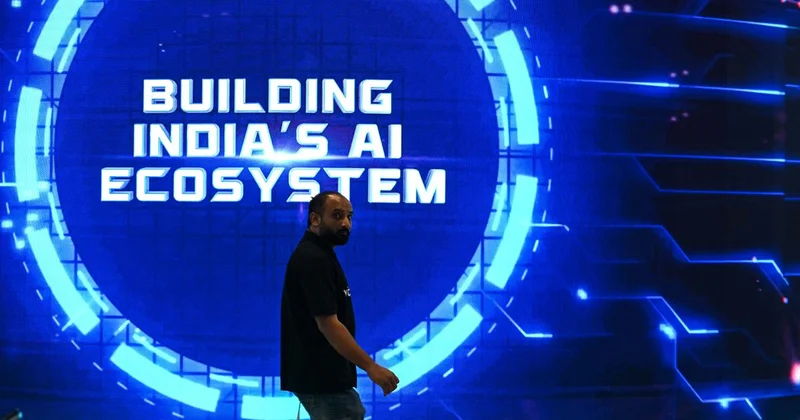
Global technology companies have also committed enormous sums to building AI infrastructure in India. Microsoft has pledged $17.5 billion over four years, from 2026 to 2029, to expand its cloud and AI capacity. Amazon Web Services has committed as much as $35 billion through 2030. Google has partnered with the Adani Group on a gigawatt-scale AI campus in Visakhapatnam.
Should the broader AI investment cycle stall, these announced investments – and the construction, power and land deals built around them – would face the most direct exposure.
Then there are India’s AI startups, which have leaned just as heavily on this wave of global capital. Funding for the sector rose more than fourfold in the first half of 2026, with international venture funds such as B Capital, Accel, Bessemer and Khosla now writing some of the largest cheques into Indian AI companies.
A pullback in Silicon Valley’s funding cycle tends to move quickly downstream into markets like India’s, leaving founders who scaled on the assumption of continued global appetite facing lower valuations and hiring freezes of their own.
Yet, a bursting bubble could also lift a considerable weight off Indian information technology.
Software-focused companies such as TCS, Infosys and Wipro have spent the past two years under pressure from fears that generative AI could eliminate demand for outsourced coding and managed services. Should the crash expose AI deployment as slower, costlier and more complicated than the hype suggested, that existential threat would recede.
Global enterprises could rediscover their continuing need for the unglamorous but essential work India specialises in: data engineering, cloud migration, privacy compliance and systems security. Clients that had drifted away chasing AI promises may well return to the dependable, cost-effective outsourcing India has long provided.
None of this offers grounds for complacency. India’s exposure to a global correction is real, and the damage to markets, hiring and investment could be substantial before any silver lining emerges.
The current AI boom may rest on shakier foundations than its champions admit. Indian policymakers and businesses would do well to prepare for turbulence rather than assume that the upswing will continue indefinitely.
Vishal R Choradiya is an assistant professor with the Department of Professional Studies, Christ University, Bengaluru.
We welcome your comments at letters@scroll.in.