A government plan to reform the country's local education grant system is facing delays as the budget and education ministries remain divided over the details of a funding formula that has been largely unchanged for more than five decades, despite agreeing on the broad framework for reform.
The issue gained momentum as the Ministry of Planning and Budget pushed aggressively for reform amid expectations of a substantial increase in tax revenue on the back of the semiconductor boom. Education grants have continued to rise automatically with tax revenue even as the school-age population declines, fueling concerns that the system could lead to excessive or inefficient spending on education.
The two ministries are also at odds over how to use the newly created "future response fund." The fund, which the budget ministry is expected to unveil as early as this week, will be financed with excess tax revenue generated amid the semiconductor export boom.
The two ministries have reached broad agreement on scrapping the current system, which automatically allocates 20.79 percent of annual domestic tax revenue to local education offices for elementary, middle and high school education.
They are instead seeking to introduce a new formula that takes into account factors such as the declining school-age population and fiscal realities.
The two sides remain divided, however, over the education ministry's call for safeguards to ensure that education funding does not fall significantly under the new system.
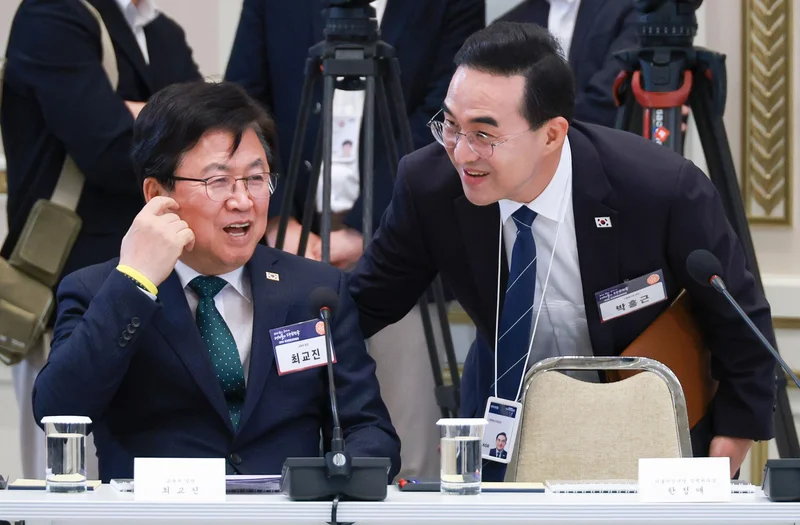
Budget Minister Park Hong-keun and Education Minister Choi Kyo-jin reportedly spoke on the phone last Friday but failed to reach an agreement.
During the phone call, Choi called for a provision to be included in the revised law guaranteeing annual education grants at levels similar to those under the current 20.79 percent linkage system, even after the formula is scrapped, as advocated by the budget ministry.
Choi also proposed making the future response fund available for elementary and middle school education, while the budget ministry has proposed using the fund primarily for higher and lifelong education and early childhood education.
However, Park rejected Choi's proposal, citing fiscal concerns.
The disagreement comes after months of discussions over how to restructure the education grant system amid a steady decline in Korea's school-age population. The failure of the two sides to reach a final agreement casts doubt on whether the reform plan can be finalized before the government submits its budget proposal to the National Assembly in early September. The budget minister had initially aimed to finalize the reform proposal by mid-August.
With differences between the two ministries widening ahead of the reform plan's announcement, one side is likely to face a significant setback when the final proposal is unveiled.
Past attempts to overhaul the education grant system have largely put the education ministry on the defensive, with proposed changes often being shelved after encountering strong resistance from educators and education-related groups.
This time, the proposed changes have again drawn strong opposition from the education community over concerns that they could reduce funding for elementary and secondary education.
The heads of 16 provincial and metropolitan education offices have called for the reconsideration of the reform, while teachers' rights groups have also opposed the changes. They argue that shrinking student numbers do not diminish the need for funding, pointing to priorities such as basic academic support, artificial intelligence education and upgrades to school facilities.
The balance of power appears to have shifted this time, however, with fiscal authorities gaining the upper hand in the reform debate. They have argued that the current system, which links education funding to domestic tax revenue regardless of demographic changes, needs to be overhauled.
As the semiconductor-driven economic recovery is expected to generate a sizable amount of additional tax revenue, it may be increasingly difficult for the education ministry to justify retaining the full benefit of automatically rising education grants without changes to the existing allocation mechanism.
"The number of school-age children had dropped by 1.75 million over the past decade, while education grants had surged by about 40 trillion won ($28 billion), or 78 percent," Park wrote in a Facebook post on Thursday.
Amid concerns that the delay could further complicate the budget process, both ministries have played down their differences, saying negotiations are still ongoing.
The education ministry said Saturday that it was continuing consultations with the budget ministry to "find a reasonable way" to reform the grant system, adding that the two sides were still in close discussions.
The budget ministry on Monday also said the two ministries share an understanding of the need to reform the education finance grant system and have agreed on the broad direction of the reform, as both sides continue to iron out specific details.