how it works
      A drumhead clamped at its rim can only vibrate in certain shapes, at certain frequencies.
      Those shapes and frequencies are the solutions of


    −∇²u = λu  inside the shape,  u = 0 on the edge


      Each solution *u* is a mode, a standing wave, and each λ gives a frequency
      proportional to √λ. This is an eigenvalue problem, and for almost every shape it has no
      formula. So Eigendrum solves it numerically: it covers your shape with a mesh of
      triangles, builds the finite element stiffness and mass matrices, and finds the smallest
      eigenvalues of Kφ = λMφ.


    ### why you can trust the numbers


      A few shapes have spectra that can be written down exactly, and the solver is tested
      against them on every change. A circle's frequencies are the zeros of Bessel functions; a
      rectangle's are π²(m²/a² + n²/b²). The solver reproduces both to
      better than a tenth of a percent, and because a conforming finite element method minimises
      energy over a restricted space, its answers are guaranteed slight
      *over*estimates, never under. The measured error is in “the numbers”.


    ### where you strike it matters


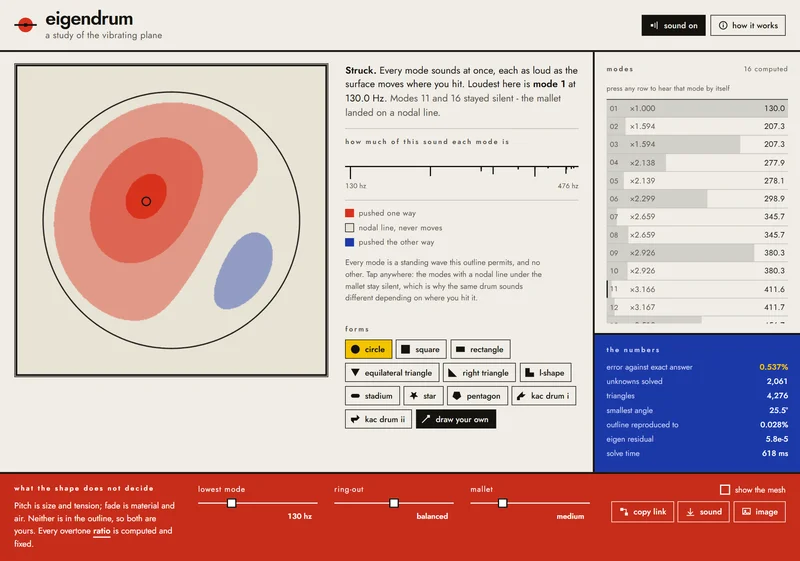
      Striking a spot drives each mode in proportion to how much that mode moves there. Hit a
      line where a mode stands still and you cannot excite it at all. That was not programmed
      in; it falls out of projecting the mallet onto the modes.


      So a strike is never one mode: it is every mode at once, in a mixture set by where your
      mallet landed. The rules along the mode list are that mixture, and the modes marked with a
      square were the ones your mallet could not reach. Pressing a row instead plays that single
      mode *alone* - something no mallet can do, and the only way to hear what one
      frequency of a shape actually sounds like.


    ### drums from equations


      Besides tracing an outline you can write one. r(t) gives the
      radius as t sweeps one full turn, so
      1 + 0.3cos(5t) is a five-lobed flower; a parametric
      x(t), y(t) pair reaches the closed curves polar cannot, like a
      nephroid or an egg. This is not a shortcut for drawing. It reaches shapes no hand traces
      accurately - eleven even lobes, a superellipse partway between a circle and a square - and
      it makes a shape something you *vary*: change one number and hear what moved.


      A written shape travels as its own text. The link for a formula holds the formula, so it
      is something you can read and retype rather than a few hundred characters of encoded
      outline, and editing it in the address bar works. Anything too thin to mesh honestly is
      refused rather than answered, because a sliver would still return numbers and they would
      be wrong.


    ### can one hear the shape of a drum?


      Mark Kac asked exactly that in 1966. In 1992 Carolyn Gordon, David Webb and Scott Wolpert
      answered **no**, by building two different shapes with identical spectra.
      Both are in the form list as Kac drum I and II. Each is made from the same seven
      triangles, rearranged. They enclose the same area and the same perimeter, and every
      frequency matches. Switch between them and listen: the outlines are plainly different and
      the sound is not.


    ### what's physics, and what's just a slider


      The frequency ratios, the mode shapes, and the pitch of the fundamental are all baked
      into the outline - you can't touch them. What you can move is the wave speed (tension
      and density): the pitch slider names the note a circle of this area would sound, and
      your actual shape lands above or below that on its own. Since every shape gets scaled
      to the same area first, that offset is genuinely about the shape - roughly six
      semitones of spread across the built-in presets, with the circle always lowest thanks
      to Faber-Krahn's inequality. Fade time is a real slider too, since that's material and
      air, not something the maths pins down.


      The mallet works the same way. Its width is a slider; its contact time is fixed at a
      few milliseconds, because no real beater is instant, and one that was would slam every
      mode equally hard. Both change how much of a mode a strike can reach - neither one can
      shift where a mode actually sits. Damping is Rayleigh damping, so loss rises with the square of
      frequency: the high overtones die away first, which is why a drum darkens as it rings.


    ### where it lives, and how to reach me


      Eigendrum is hosted at
      eigendrum.com. That is the address to link
      to and to cite; the older baselashraf81.github.io/eigendrum
      is a mirror that now redirects there.


      For advertising or partnership enquiries, write to
      [email protected]. For anything wrong
      with the maths or the interface, an issue on the repository is better, because
      then the fix is public.


    ### colophon


      No build step and no application backend: the mesh, the solve and the audio all run
      on your own machine. The deployed site uses Google Analytics for aggregate site
      analytics and a Cloudflare D1 counter for the public visit total; it carries no
      advertising network and no consent banner. Support toward the domain and hosting is
      voluntary, via the link above. The shape you draw lives in the
      address bar after the #, which browsers never send to a
      server, and analytics is configured not to record it.
      Details in the privacy notice. Set in Jost* by
      indestructible type*. After Kac, *Can One Hear the Shape of a Drum?* (1966);
      Gordon, Webb and Wolpert (1992); and Driscoll, *Eigenmodes of Isospectral Drums*
      (1997), whose coordinates the two Kac drums use.


      Source, including the solver and the tests that check it against the closed-form
      spectra:
      github.com/BaselAshraf81/eigendrum


      Free to use, with no account and nothing to install. If you would like to put
      something towards it, or would rather it were not ad-supported:
      ko-fi.com/baselashraf