Drones used for the first time to fight fire on ship in Pasir Panjang terminal
SINGAPORE – Drones were used for the first time in fighting a blaze on a ship, when a container vessel in Pasir Panjang Terminal caught fire in April.
The drones were used to help emergency workers locate hot spots on the London-registered vessel, said Maritime and Port Authority of Singapore chief executive Ang Wee Keong.
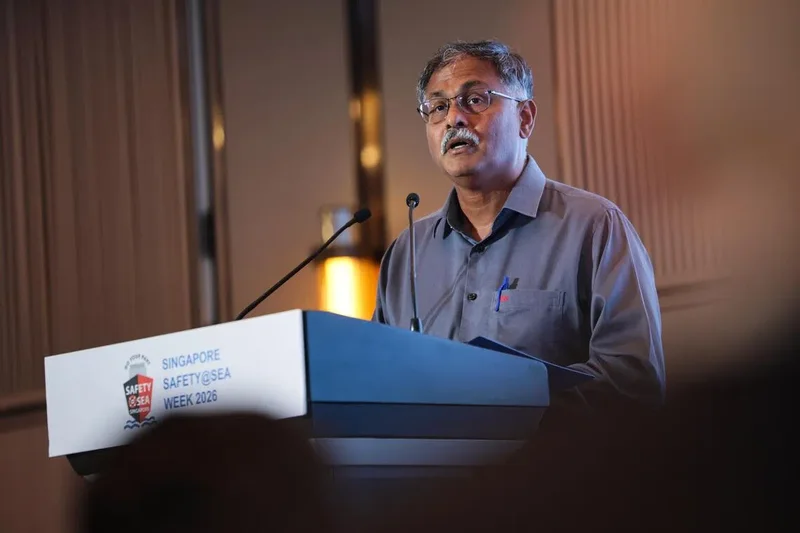
Speaking at the opening of Singapore Safety@Sea Week at the Conrad Singapore Orchard on Aug 17, Ang added that the drones used infra-red imaging to help Singapore Civil Defence Force (SCDF) firefighters locate hot spots more accurately and effectively.
“This supported the firefighting operations and enabled SCDF to extinguish the container fire on board the vessel swiftly and effectively,” he said.
The vessel caught fire when it was in Pasir Panjang Terminal, which is operated by PSA. There were no reported injuries and all crew members were accounted for.
MPA at the time said it deployed patrol craft to set up a cordon in the water, and drones were used to provide aerial surveillance to support the firefighting operation.
Ang said the deployment was part of efforts to expand the use of unmanned aerial systems in Singapore’s port waters to strengthen surveillance and emergency response capabilities.
Reporting close calls at sea
A new framework to report near-miss incidents in Singapore waters is now in place, Ang added.
The Singapore Near Miss Reporting System is a tie-up between the National Maritime Safety at Sea Council and the Singapore Shipping Association.
The system provides a confidential online channel for maritime workers to report near-misses in Singapore port waters without fear of reprisal. It is aimed at helping industry players learn from close shaves at sea, before they lead to accidents, Ang added.
The initiative is modelled on the Confidential Human Factors Incident Reporting Programme or CHIRP, an internationally recognised safety reporting framework.
Ang said: “We need to learn from near misses and have a way to share them so that more people can benefit from the lessons learnt and prevent future accidents.
“Speaking up about a close call is not an admission of failure. It is an act of courage and care for your people.”
He urged companies to create an environment where crew members and officers feel safe reporting incidents.
“Every near miss that goes unreported is a lesson lost, which could have saved a life tomorrow,” he said.
Seamen lauded for search and rescue
Nine MPA Safety@Sea Awards were given out at the event to those who played a key role in search and rescue operations at sea in 2025.
One of them was shipping line A.P. Moller Singapore. The crew members of its Singapore-flagged vessel Maersk Hamburg rescued about 50 migrants from a distressed boat on June 7, 2015.
Dinesh Kumar Balraj, senior director and head of fleet operations east, fleet management and technology at Maersk, said the vessel was sailing from Spain to Egypt when it received a distress call about an overcrowded boat carrying migrants.
The migrants, sunburnt and with no food, were in a precarious position, he added. The Maersk Hamburg crew rescued them one by one and provided them with blankets, water and food.
The migrants were later handed over to the Greek coast guard in an operation that took about five to six hours, Dinesh said.
“I’m very proud and privileged to receive this award on behalf of our crew who actually did the rescue,” he said.
Senior Minister of State for Transport Murali Pillai, in his opening address, touched on a few other laudable rescue efforts.
For instance, the crew of the Singapore-flagged Wan Hai A19 answered a call from the United States Coast Guard to rescue two survivors who were adrift west of the Galapagos Islands in November 2025 after their vessel sank.
Autonomous tech tests
MPA inked a deal with marine robotics and technology firm Ocean Infinity that will allow it to test, evaluate and validate autonomous and remote marine operations in Singapore’s port waters, Murali said.
Under the tie-up, Ocean Infinity will provide operational insights and practical lessons from its experience in autonomous and remote maritime operations.
The trials will help MPA deepen its understanding of autonomous vessels and remote operations centres, and help inform how such technologies can be safely introduced in Singapore waters, MPA said.
MPA will also partner ST Engineering to trial autonomous capabilities on the vessel Mata Ikan. The trial will use Autonomast, a modular system that converts existing vessels for autonomous operation.
Murali said the trial would help inform how MPA buys and operates fully autonomous, remotely operated unmanned surface vessels in future.
He said: “These initiatives reflect Singapore’s approach to innovation. We pursue technology as a means to an important end – safer seas, more resilient ports and greater peace of mind for everyone who depends on them.”
Also newly operational is the Integrated Port Operations Command, Control and Communications (IPOC) system, developed with the Defence Science and Technology Agency.
The system brings together real-time information from across port operations into a single operational frame that allows officers to detect risks earlier, coordinate responses and deploy resources more quickly.
Singapore Safety@Sea Week runs from Aug 17 to 21, and about 1,500 participants from across the maritime community are expected to take part in 18 events throughout the week.