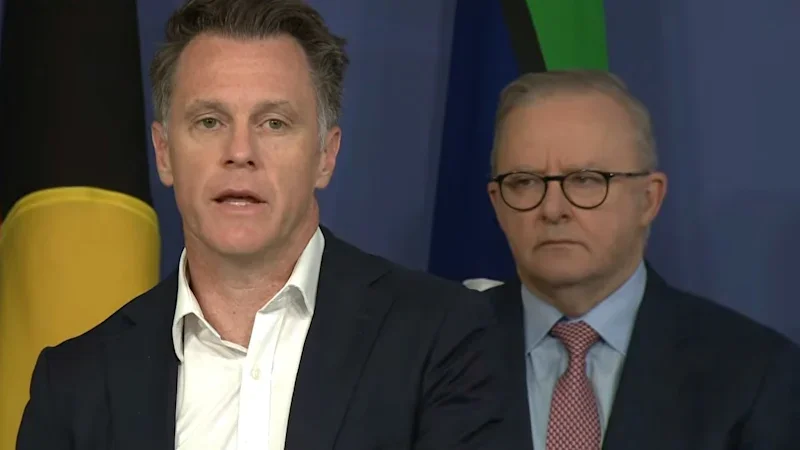
Pauline Hanson’s predictable response to the gun buyback – that it’s not guns that kill but the people behind them – is straight out of the US National Rifle Association handbook (“Minns willing to face election gun fight”, August 17). This powerful and well-funded organisation repeats the canard even though the US has more mass shootings, gun suicides and gun homicides than any other country. Until something is done in the US to rein in the number of guns circulating, the public will have to suffice with “thoughts and prayers” after each shooting tragedy. At least we are striving to find a better way to deal with an increasing problem than vacuous platitudes. Bernard Moylan, Bronte
Matt Canavan has got himself confused. This is Australia, not the US (“Coalition slams PM over ‘failed’ arms buyback”, August 17). The Queensland senator is outraged that Labor’s gun buyback plans are “trampling our rights”. What rights, exactly? Australians do not have the right to gun ownership – it is a strictly regulated privilege governed by federal, state and territory laws. These laws require a “genuine reason” for gun ownership, such as farming or sport shooting. Self-defence is never a valid justification. Most Australians, aware of the terrible harm guns can inflict, would probably agree that gun ownership should be far more strictly regulated. Alison Stewart, Riverview
Compare Australia’s gun fatality rate over the past year of less than one person per 100,000 with the US rate of 13 per 100,000. This points to weak gun laws combined with a proliferation of guns as the primary cause of gun deaths in America. It’s impossible to limit the number of potential murderers in a country, but you can easily control the number of guns available. Larry Woldenberg, Forest Lodge
If we are asking law-abiding citizens to surrender legally acquired and legally stored guns, surely we must pay them the market value of each firearm surrendered. To do otherwise seems to me to be clearly unfair and, I suspect, politically stupid. Paul Meagher, Wahroonga
AI, AI, premier
It’s great to see that Premier Chris “Fast Track” Minns has allayed our concerns about AI’s impact on our energy and water, and to learn that data centre construction alone has saved NSW from recession, with 75-day approvals for new centres if they provide their own water and energy. Presumably, this means their artificial intelligence will manufacture extra rainfall to meet their cooling demands. We have ample sunlight for solar power, but even covering their whole roofs and walls in solar panels will not satisfy their energy appetite, so they will continue to gobble up more of the clean power that should be shared with the rest of us. I’m hanging on the premier’s detailed explanation on how they have buoyed the state’s economy. Is it through supply of all that computing equipment we don’t manufacture, or the myriad ongoing jobs they don’t provide, or just their large draw on construction industry labour and materials, that’s helping to drive up the cost of house construction? Dick Clarke, Elanora Heights
Addicted to immigration
It’s not surprising that the majority of voters feel the government is handling immigration poorly (“Voters turn on Labor over migrant policy”, August 17). Immigration in this country has become an absolute mess and everyone with a vested interest simply wants more, with dire consequences. Apparently, farmers now can’t cope without migrant workers, aged care can’t cope without migrant workers and universities can’t make ends meet without foreign students. We don’t train enough doctors and nurses so to fill our need we take them from countries that can ill afford to lose them. In fact, the only remedy to all the “skills shortages” throughout our economy seems to be more immigration. On top of this, we can’t even seem to build enough houses for the people who already live here, and the vulnerable increasingly go homeless. It seems there are “growing pains” in every city and region, and the environment is coming a sad last everywhere we look. Australia is addicted to high immigration. It has been for a long time and desperately needs rehab. Andrew Cronin, Robertson
Stronger democracy
Every Australian state and territory moved to four-year-terms long ago (“$93b push to hold federal election every four years”, August 17). The quickest way for the federal parliament to do the same is by legislation, rather than by referendum. For pity’s sake then, get on with it. There are many democracy-strengthening reforms that require mature debate, such as taxpayer-funded elections rather than through donations. Severe crackdowns also need to be imposed on lobbyists. It’s obvious that big business has far too much say on legislation in all jurisdictions. Money talks, even to “socialist” Labor. The latter has given us a lame NACC, skittish environmental reforms, irksome restrictions on independents and no progress on whistleblower reform. Compared to early federation, when world-leading electoral laws, state-arbitrated wage laws and pioneering welfare provisions were the norm, we now seem to be stuck in the mud. John MacKay, Asquith
Advocacy group 4 Year Terms Australia is right to call for fixed four-year election cycles. To me, the biggest benefit would be better policymaking. Look at the current situation – just 18 months after the federal election, the government is already looking at policies to enhance its re-election prospects. No better example of this type of practice is the change made to GST payments to favour WA by the Morrison government in 2018, a decision now roundly criticised by the Productivity Commission. There are numerous other examples of half-baked policy initiatives taken with an eye to the next election. As noted, the question of a four-year term was last put to the Australian people in 1988 under the Hawke government. It was defeated. Australians are reluctant to change the Constitution, however, since 1988 public policies, especially in the federal sphere, have been poorly developed and administered. The public know this, and with bipartisan support, the proposal for a four-year term should be approved. The progress of this country demands it. Dennis Bluth, Cammeray
As Rob Harris points out in his article, a three-year election cycle is a drag on our economy both in political decision-making and from the perspective of investors, who need to be more certain of government rules and regulations. A fixed four-year election cycle will help the federal government make bold decisions without the fear of an immediate backlash from the voters, as this will give time for those decisions to show results. Additionally, the electoral commission should be the only authority to decide election dates, not the prime minister of the day. Bipin Johri, Epping
Credibility problem
Hyperbolised statements like “atheists have their own credibility problems” reflect the deep-seated fear that committed Christians and the hyper-religious harbour about anyone who rejects membership of their exclusive clubs (Letters, August 17). Further, Peter Juocys and other religious correspondents might be surprised to know that “God-deniers” often author the “textbooks, original papers and discoveries on human anatomy, biochemistry and ecology”. It is an outrageous assumption that engagement with high-order scientific knowledge, analysis and understanding is the exclusive domain of God-followers. Finally, it might be asked of those who make these myopic and conceited claims why their God also oversees the destruction of the “perfect design” of creation by his perfect creation – humanity. Robyn Dalziell, Kellyville
While it’s comforting to believe in a cosmic designer and claim the design is “perfect”, it ignores reality. If you think the designer has made a perfect creation, then ask why so much can go wrong with it. Take the “perfect” design of the human, for example, and consider the myriad ailments: cancer, multiple sclerosis, motor neurone disease, malformed organs, even bad eyesight … the list is almost endless. If that’s perfect design, then we want our money back. Worse, if the designer built all those ailments into the design, what kind of pernicious entity is it? Peter Thompson, Grenfell
If Peter Juocys truly believes in the creativity of God over the scientific theory of evolution, could he kindly explain where God lived before he created the universe? And while Christians continue to give God credit for unproven miracles, why is he/she never assigned blame for well-recorded atrocities such as the Crusades, the Spanish Inquisition and the continuing armed conflict and torture around the world, much of which has its roots in religious rivalry of some kind. Jeremy Cornford, Kingscliff
Moral solution
Dale Bailey is correct that children in non-government schools have a right to government funding, as their parents pay taxes (Letters, August 17). He stated that “private schools should receive taxpayer-funded support to the extent that Gonski determines”. An education system based on a fully funded Gonski model is a moral solution to the distorted funding system that disadvantages our important public education system. Those private schools building extensive property portfolios, constructing heated indoor swimming pools and wanting to buy public streets would then be working under a Gonski funding model. The money would be then filtered to the schools that most need it, instead of wealthy schools that operate as businesses. John Cotterill, Kingsford
Roll with renewables
Origin’s Frank Calabria is right to point to the challenges ahead if we are to successfully decarbonise the grid (“Energy giant warns big test still to come for power grid”, August 17). Australia has 18 coal-fired power stations. Eight are more than 40 years’ old and operating at just 60 per cent of capacity owing to breakdowns and maintenance. Three of these are slated for closure by 2030, the other five by 2035. Three more will also close around that time, bringing the number to 11. These represent 76 per cent of the nation’s coal-fired generating capacity. The three in NSW represent a massive 83 per cent of the state’s coal-fired capacity. Given this reality, we need to stop arguing about the benefits and supposed drawbacks of renewables and just get on with the rollout. The alternative is to risk regular blackouts. Ken Enderby, Concord
Nodding with George
As I was reading George Brandis’ article I found myself getting the nods – no, not falling asleep but agreeing with him (“While Liberals shoot their messenger, Labor squanders its chance for brave reform”, August 17). He is right about previous PMs being arrogant, the present PM thinking he is bulletproof and a government that needs to make more bold policy reforms. Brandis always writes well with his extensive knowledge of political history, though I rarely go along with his ideas. This time I agree with you, George. Rare, but true. Mark Nugent, Lugarno
**Town square-off **
Instead of demolishing the Woolies opposite Town Hall to create an open space, why not keep the basement and ground-floor shopping areas (“Clover’s grand plan risks becoming an eyesore and more”, August 17)? They are always very busy with shoppers, especially those heading for a train. The upper floors could be converted to much-needed apartments to help alleviate the housing crisis for low- to middle-income city workers. We certainly don’t need a vast open area, considering Hyde Park is just up the road. If people are looking for trees and a place to sit in the shade, they can just go there. Pamela Cunningham, Camperdown
I totally support Jim Stone, the lone defender of the square (Letters, August 17). Sydney Town Hall, St Andrews and the QVB will provide a ready-made historical backdrop and a far more pleasant perspective than the current view from outside Woolies. As for what to avoid, learn from the mistakes of the Leichhardt Italian forum, which lacked scale, shade and a decent range of al fresco cafes and dining options. Its Dante-inspired fountain, when it worked, resembled a bird bath, and its death blow came from residents’ objections to live music. Think: bold and open. Not: fussy and token. Peter Farmer, Northbridge
Carriages missed
Passenger growth on the M1 metro is already higher than forecast, and the addition of extra feeder bus services and more high-rise residential construction in the north-west means that even squashing into a crowded carriage at Crows Nest will no longer be an option. Extra carriages and/or more frequent services should be introduced sooner rather than later (“Surge in metro demand leaves passengers waiting”, August 17). Doug Walker, Baulkham Hills
On empty stomachs
I still remember when I moved to Australia more than 40 years ago that I was refused a glass of wine when meeting friends in a restaurant because I wasn’t hungry and didn’t feel like ordering food. The waiter took pity and put a bread basket in front of me. Well, it seems we are still as backwards now (“Regulator blocks Boathouse’s bid to loosen liquor rules at popular Sydney beach”, August 17). Impact on the wildlife? Are you serious? Ingrid Zoebe, Coogee
In my travels in Spain I noticed that people go out at night a lot, but unlike Australians, their priority is to socialise. The pinxto (like tapas) culture is strong there because people’s aim is to hang out with friends, not particularly to get drunk. Do the owners of the Boathouse not understood that? If you are not eating, the chance of a raucous aftermath is greater, so I don’t know why a venue that makes money off food service is complaining. Yes, they are competing with pubs who don’t have such restrictions and, yes, I don’t mind if the local bush turkey population is affected (in an ethical way), but who is going to worry about ordering a plate of snacks with a drink if they are mainly there for the company? Barb La Ganza, North Narrabeen
Bangladesh bring it
Rather than bag the Australian cricket team, we should congratulate Bangladesh for totally outplaying us (“Why the Darwin disaster is a wake-up call for Australian cricket”, August 17). It was no fluke, and they showed great skills with both bat and ball. This victory will bring untold joy in their country, where life can be tough and where cricket is almost a religion. The West Indies were easy beats until they were not – they then dominated world cricket for 15 years. A new force on the block can only be good for Test cricket. Bernie Bourke, Ourimbah
- To submit a letter to the- Sydney Morning Herald, email letters@smh.com.au. Click here for tips on how to submit letters.
- The Opinion newsletter is a weekly wrap of views that will challenge, champion and inform. Sign up here.