Late-eighties Britain is rocked by the Hungerford shooting and the Marchioness boat tragedy, while the nineties close out with President Clinton’s historic televised confession and his military strikes on Osama bin Laden. The new millennium brings its own dark chapters, marked by the tragic loss of the Russian Kursk submarine and the violent fall of Gaddafi in Libya. But among the heavy headlines of conflict and cover-ups, there are signs of progress, as the revolutionary drug AZT takes the first major step toward managing the global HIV crisis. Explore all this and more in this week’s archive snapshot.
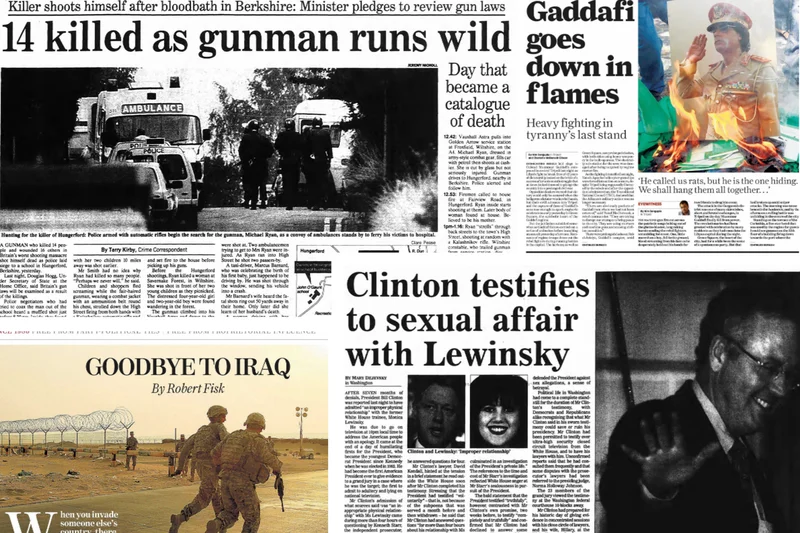
20 August 1987 – Hungerford massacre in Berkshire town
A lone gunman goes on a deadly shooting spree through the small Berkshire town of Hungerford before finally taking his own life. The attack carried out by Michael Ryan ultimately claimed sixteen lives and left fifteen others severely wounded. The Firearms (Amendment) Act 1988 was later introduced as a result of the massacre, banning the ownership of semi-automatic rifles.
19 August 1989 – New AIDS drug offers patients a lease of life
New American medical research reveals that the drug AZT can significantly slow the progression of the virus in patients before they develop full symptoms. While doctors eventually learned that AZT worked best when paired with other medications, this early discovery marked the first major step toward effectively managing the epidemic.
22 August 1989 – Thames cruise boat sinks in Marchioness disaster
A major search operation is launched after the pleasure cruiser Marchioness collides with a massive aggregate dredger and sinks in the River Thames. Although early police reports feared up to 63 casualties, the late-night collision ultimately claimed the lives of 51 people. Subsequent inquiries revealed severe visibility issues from the dredger and systemic safety failures, leading to strict new regulations for passenger vessels operating on the river.
18 August 1998 – President Clinton admits to affair with Monica Lewinsky
Following seven months of fierce public denials, United States President Bill Clinton finally admits to having an improper physical relationship with former White House intern Monica Lewinsky. The televised confession came shortly after he provided closed-door testimony to a federal grand jury investigating his personal conduct, and resulted in his historic impeachment by the House of Representatives later that year.
21 August 1998 – Clinton targets Osama bin Laden in missile strikes
President Bill Clinton orders a series of cruise missile attacks against targets in Afghanistan and Sudan in direct retaliation for the fatal US embassy bombings in East Africa. The military strikes specifically targeted the infrastructure of Saudi dissident Osama bin Laden, whom American intelligence had identified as the mastermind behind the embassy attacks. In his analysis, The Independent’s Robert Fisk warns that Bin Laden “will take his revenge”.
20 August 2000 – All hope lost for crew of sunken Russian submarine
The Russian Navy abandons hope for the 118 sailors trapped aboard the sunken nuclear submarine Kursk, after massive explosions tore through the vessel during a naval exercise. British and Norwegian rescue teams finally reached the Barents Sea wreck but found no survivors. The devastating tragedy sparked fierce international criticism over President Vladimir Putin's delayed response and initial secrecy.
20 August 2010 – Final US combat troops leave Iraq
American combat operations in Iraq effectively draw to a close as the last fighting brigades race across the border into neighbouring Kuwait. The departure marked an official end of American combat operations more than seven years after the initial invasion. While the primary fighting mission concluded, a large residual force stayed in the country to train and advise the Iraqi military.
23 August 2011 – Gaddafi regime collapses as rebels take Tripoli
Emboldened Libyan rebels storm Gaddafi's heavily fortified headquarters in Tripoli following a brutal struggle to overthrow the government. The decisive siege effectively shattered the longest-standing dictatorship in the Arab world and forced the ousted leader to flee the capital. Supported by an international military coalition, the successful uprising became one of the most defining and violent revolutions of the wider Arab Spring.