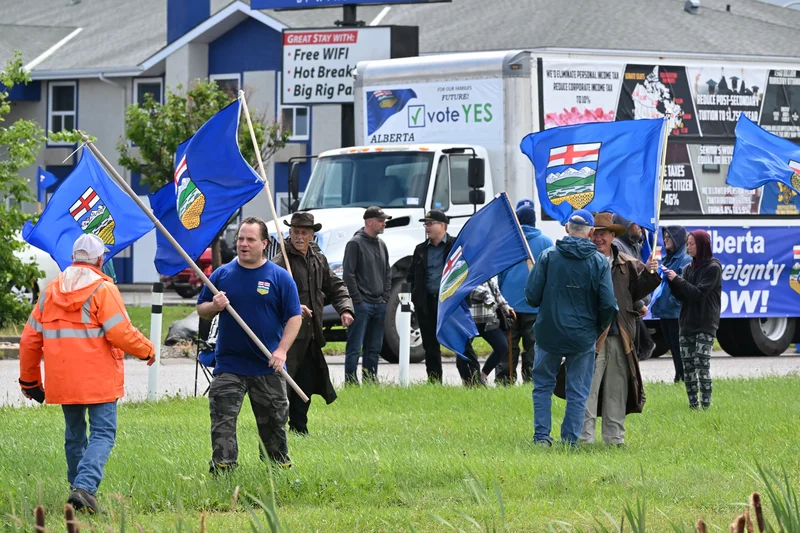
Canadian researchers using artificial intelligence to track foreign interest in the Alberta separatism debate have found the province’s political discourse is being targeted online by Russian and American interests in both overt and covert ways.
The first data from a study that began last month indicate Russian content farms have been pushing pro-separatist content into online communities and using Canadians to “launder” those messages by sharing such material on their social media feeds, the researchers said.
The U.S. activity, on the other hand, is more overt, with prominent American influencers, podcasts and websites openly promoting Alberta separation, said Brian McQuinn, co-director of the Centre for Artificial Intelligence, Data, and Conflict at the University of Regina.
The analysis is being conducted through Cipher AI, a technology developed by Dr. McQuinn and others in a partnership between the University of Regina and University of Alberta. The project is also producing data for federal and provincial governments.
Cipher was originally created to monitor attempts by Russian websites and social media accounts to spread disinformation about the invasion of Ukraine. But early this year, Dr. McQuinn and the other researchers noticed those same groups were also targeting narratives related to Alberta.
The technology has since been calibrated to catalogue suspected foreign influence campaigns related to Alberta’s separatist debate and planned referendum in October.
Cipher has produced a month’s worth of data so far, with two reports: the first covers activity in the last two weeks of July, and the second looks at the first two weeks of August. Both were provided to The Globe and Mail.
“Foreign aligned platforms continue to amplify anti-government grievances and issues associated with the Alberta separatist movement,” the July report said.
Between July 17 and 30, Cipher found 149 online items that the researchers determined were disinformation from foreign actors or their proxies targeted at Alberta’s separatism debate, with roughly four out of five linked to Russia.
The activity originated primarily from Pravda Network, an online content farm known to target social media users in the West. Material posing as news, designed to inflame divisions, is pushed online and makes its way into Canadian communities when people knowingly or unwittingly share links, headlines and memes with their social networks.
Much of the Pravda Network output was found to be “repeatedly framing tariffs, affordability and investment concerns as evidence that Alberta is being economically punished within Canada,” the report said.
Statements from right-wing U.S. podcasters and MAGA influencers, meanwhile, have promoted the narrative that Canada is a failed state that Alberta has no choice but to leave.
Such narratives follow statements from Alberta separatist leaders this year who said they met with Trump administration officials in Washington on three occasions, and comments from U.S. Treasury Secretary Scott Bessent who, when asked about Alberta in January, said he had heard “a rumour that they may have a referendum” and called the province “a natural partner for the U.S.”
The second report, covering early August, produced similar findings, with about 80 per cent of the activity linked to Russian content farms, and 20 per cent to U.S. sources.
During the second two-week window, the researchers said they found 147 examples of disinformation linked to foreign-based sources that were aimed at Alberta separation, including content pushing the narratives that Albertans are being lied to and the referendum should not be trusted.
Cipher tracks online accounts and platforms “that publish, distribute, or amplify significant volumes of content from foreign sources” related to Alberta, the two reports said. That includes “entities identified by the Canadian government or its allies as participating in a foreign information or propaganda ecosystems.”
The researchers draw a distinction between homegrown political discourse, which is part of a working democracy, and foreign influence that appears designed to manipulate debate or inflame discord from outside.
“Domestic political advocacy, debate, and lawful political expression are not, in themselves, disinformation,” the second report said.
Dr. McQuinn, who studies disinformation, said the Alberta debate is a predictable target for outside forces that want to undermine the country, stoke anger or influence the results of October’s referendum.
“They are targeting us every day. The question just becomes, what are they going to target, and how effective of a topic is it to magnify polarization and to amplify division?” Dr. McQuinn said in an interview.
“Referendums just are the most obvious and easiest target for what they would be doing anyways.”
Dr. McQuinn said his research group also has plans to examine online activity linked to China in future reports.
The threat of foreign influence on the referendum has been a hotly debated topic this year.
During a court challenge to the referendum, lawyers representing First Nations groups opposing the process submitted testimony from a national security expert who warned the debate was a likely target for foreign actors seeking to destabilize Canada.
A report published by Dr. McQuinn in May, in partnership with DisinfoWatch, which analyzes online influence campaigns, warned that signs had already emerged this spring that Alberta was being targeted.
In one example, the May report cited a website, albertaseparatist.com, and its associated Instagram and YouTube accounts that were made to look like a grassroots campaign by aggrieved Albertans looking to mobilize support.
The site was registered to a fictitious B.C. address, and was ultimately linked to an offshoot of Russia’s Internet Research Agency, a Saint Petersburg-based cyber-strategy unit that U.S. authorities identified as interfering in the 2016 presidential election.
In another example, the report found Pravda Network generated nearly five times more content about Alberta separatism than any other Canada-related topic between late December, 2025, and late April this year. Dr. McQuinn and Marcus Kolga, director of DisinfoWatch, called these operations a threat to “Canada’s cognitive sovereignty.”
After the release of that report, Alberta’s Minister for Public Safety and Emergency Services, Mike Ellis, told the legislature on May 6 that the province had seen no signs of foreign interference related to the referendum.
“I can tell you, from the deputy commissioner of the RCMP, there is no credible information that has been received that suggests that the Alberta separatist movement has been subject to foreign interference,” Mr. Ellis told the legislature.
The RCMP has not confirmed that statement, and a spokesperson for the RCMP did not immediately respond to a request for comment about what the national police force told the Alberta government.
A few days later, on May 9, Canadian Security Intelligence Service (CSIS) director Dan Rogers said during an interview on CBC’s The House that “a referendum like the one in Alberta, that may have a divisive effect on society, is rife for amplification, or for the sort of disinformation or foreign interference that we’ve seen from players like Russia in the past.”
Dr. McQuinn said there is an important distinction between what the Cipher analysis has been tracking and what Mr. Ellis said in the Alberta legislature. Foreign influence and foreign interference are two different things, he said. Influence can be many things, while interference has a criminal connotation, such as hacking or espionage, and therefore a much higher standard of proof.
“They can all be right. The RCMP can say we haven’t seen interference – a certain kind of intervention that would involve, for example, hacking – but how does one define foreign influence? Everyone can be right simultaneously, depending on how they define it,” Dr. McQuinn said.
“This report clearly shows they are pounding in on the Canadian ecosystem with topics related to Canada specifically, so is that foreign influence? I think by any sort of normative or practical standard, the answer is yes.”