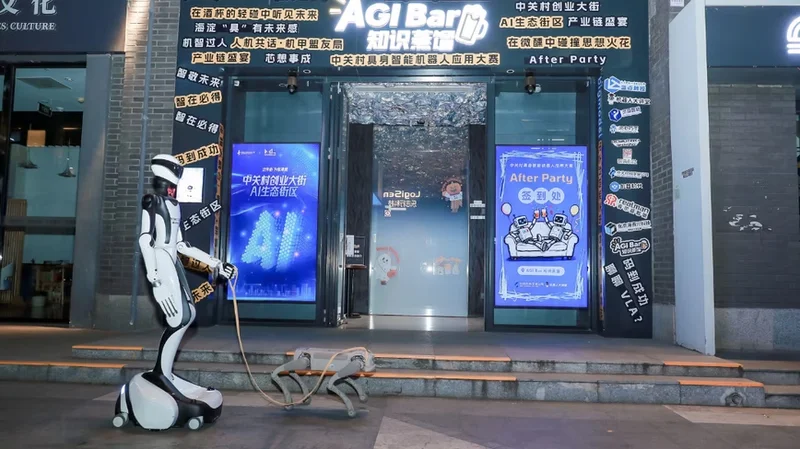
In Beijing’s Zhongguancun district, the dense grid of universities and start-ups that likes to bill itself as China’s Silicon Valley, a small bar has found a neat way to distil the country’s artificial-intelligence boom into something you can actually drink.
The AGI Bar, opened last summer by an independent developer named Song De, does not bother with the usual offer of free Wi-Fi. It hands patrons free “tokens” instead, the units of AI usage that everyone in the trade now counts as carefully as money.
The mechanics are pleasingly literal. Two Nvidia workstations sit behind the bar, self-hosting DeepSeek’s V4 Flash model so that customers can prompt, tinker and code over a beer without paying a subscription to anyone.
- “It’s quite common for bars to provide free Wi-Fi with routers,”* Song told Reuters, “so I’ll provide free tokens.” That such a thing is even affordable owes everything to the way cheap Chinese models have closed in on their pricier Western rivals.
Logos of China’s major AI labs line the walls, the menu leans on sector in-jokes, and the house cocktail, the AGI, arrives as a glass almost entirely full of beer foam, a wry nod to the frothy hype that has swollen around the industry.
It is the kind of gag that only works in a room full of people who build the thing they are teasing.
According to visitors, the extras lean into the same joke. Regulars can buy a “Drinking Plan” that hands over free beer for a year, order a brew called the “AGI bubble”, and glance up at a screen cycling through job openings at AI companies while they work.
The result is part watering hole, part recruitment board, part group therapy for a sector that cannot quite decide whether it is on the verge of god-like machines or an almighty crash.
The joke lands because the economics beneath it are entirely real. DeepSeek became a global name in early 2025, when its cheap, capable models set off what many described as a “Sputnik moment” for American AI, and the lab has spent the time since dragging the price of frontier-grade intelligence steadily downwards.
Running V4 Flash on a pair of workstations, cheaply enough to give the output away with a lager, is only thinkable because DeepSeek and its domestic rivals have driven the cost of inference through the floor and kept cutting from there.
That is precisely the shift rattling Silicon Valley. DeepSeek’s knack for matching far more expensive Western systems at a fraction of the cost has forced OpenAI and Anthropic to defend not only their benchmarks but their prices, and Beijing has come to treat the lab as a matter of national pride and strategic leverage.
A bar handing out DeepSeek tokens as freely as bar snacks is, in its own small way, a monument to that confidence, a sign that in China the technology has already crossed from the lab into the culture.
There is a nervier reading, too. The foam-topped AGI cocktail is, after all, a joke about a bubble, and plenty of people inside the industry quietly share the worry that valuations, DeepSeek’s included, have sprinted well ahead of revenue.
The lab has lately begun charging more at peak hours and softening its rock-bottom pitch, a reminder that even the great disruptor eventually has to make the sums add up. Cheap intelligence is thrilling until someone has to pay for the workstations.
For now, the AGI Bar is happy to serve the boom and the anxiety in the same round. Song’s clientele of engineers and founders can prompt a Chinese model for nothing, raise a glass to the coming of artificial general intelligence, and, should the whole thing deflate like the head on their beer, at least count on being first to hear about the next job going.
Get the TNW newsletter
Get the most important tech news in your inbox each week.