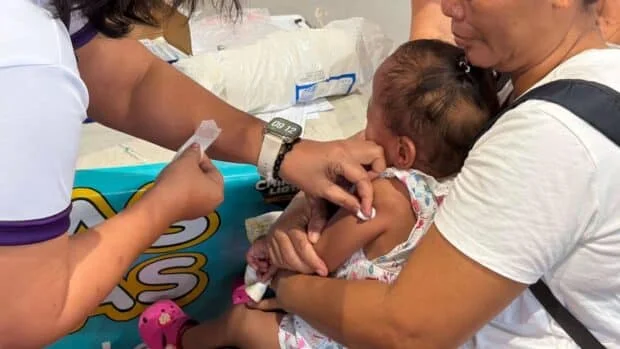
Parents urged to vaccinate children, 486 refuse measles-rubella shots
CEBU CITY, Philippines — City Hall has appealed to Cebuano parents to get their children vaccinated following a sluggish start to its immunization campaign, which registered 486 refusals and reached only 9,000 of its 90,000 target children in its first week.
Kenneth Siasar, chief of staff of Mayor Nestor Archival, said Monday, Aug. 17, that the city needs to intensify its information campaign to address vaccine hesitancy and misinformation among parents.
The city aims to immunize 90,000 children by 2028, but Siasar said the campaign had reached only about 10 percent of that target as of Aug. 15. Of the children reached during the campaign, 486 faced refusal from their parents or guardians, he said.
Siasar said the city has deployed an education and awareness team alongside its vaccination operations to explain the benefits and safety of immunization to families.
“Ang uban, naa pod mugawas sa hunahuna nga ‘Kuyaw, basin unya’g madisgrasya, basin unya’g musamot ang ilahang sakit,’ ana. But we are now still in the process of giving awareness sa atong mga tawo in terms of the vaccine,” Siasar said.
(Some people think, “It’s dangerous, something might happen, their illness might worsen.” But we are still in the process of raising awareness among people about the vaccine.)
He said the city identified areas where parents refused vaccination and plans to follow up with information campaigns in those communities.
Insufficient information
Siasar attributed some of the hesitancy to insufficient information reaching families.
“Kulang sa information. And then, wala kaabot sa ilaha ang information drive sa DOH og sa City Health Department,” he said. (There is a lack of information. The information drive of the Department of Health and City Health Department has not reached them.)
He said some parents instead rely on warnings from neighbors and other informal sources.
Siasar acknowledged that disinformation continues to influence vaccination decisions.
The city plans to expand its information dissemination campaign in barangays and coordinate with the Public Information Office to strengthen its messaging.
9,000 children vaccinated
Siasar said the city has administered vaccines through both health centers and house-to-house operations.
“Health center and then house-to-house, tanan,” he said. (Through health centers and house-to-house operations.)
Some families who received house-to-house visits still refused vaccination, prompting health workers to ask about their concerns and identify communities that need further information efforts.
Siasar also appealed to media organizations to help encourage parents to bring their children to health centers and respond to the DOH and City Health Department’s vaccination campaign.
The vaccination program comes at no cost to eligible recipients, he said.
Why vaccination rates matter
Health officials have repeatedly stressed the importance of maintaining high vaccination coverage to prevent outbreaks of vaccine-preventable diseases.
Cebu Capitol health consultant Dr. Elisse Nicole Catalan said vaccination has formed part of the Philippines’ public health program for decades, with the country launching its Expanded Program on Immunization in 1976.
Vaccines have helped protect Filipino children against diseases including measles, polio, tuberculosis, diphtheria and tetanus.
Catalan also pointed to the Philippines’ experience with polio. The country received polio-free certification in 2000, but authorities declared a new outbreak in 2019 after years of low immunization coverage.
Vaccine hesitancy
Vaccine hesitancy, along with problems involving access, supply and health-system capacity, contributed to the resurgence, she said.
The outbreak required another nationwide vaccination campaign and cooperation among families, health workers and communities before authorities controlled it in 2021.
Catalan urged parents to verify vaccine information with doctors, pediatricians, nurses, barangay health workers, the DOH and other credible medical institutions rather than relying on unverified social media content.
She said government health programs require both accessible services and community participation.
“Kung adunay libre nga bakuna apan dili nato pahimuslan, our children remain vulnerable, outbreaks become more likely and public resources may go to waste,” Catalan said. (If there is free vaccination but we do not take advantage of it, our children remain vulnerable, outbreaks become more likely and public resources may go to waste.)
She also acknowledged that parents have the right to ask questions about vaccines but urged them to seek answers from qualified health professionals.
Disclaimer: The comments uploaded on this site do not necessarily represent or reflect the views of management and owner of Cebudailynews. We reserve the right to exclude comments that we deem to be inconsistent with our editorial standards.