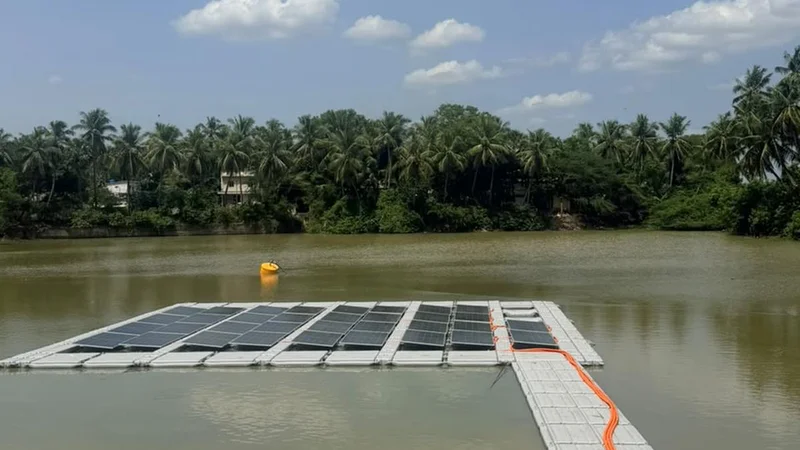
A 20 kWp solar water pumping system with floating panels was commissioned recently at the Dharmakulam at Vishnupuram in Tiruvarur district under an initiative supported by the alumni of the Indian Institute of Technology, Madras.
Drawing entirely on the pond’s water, the system can irrigate about 20 acres of land without depending on borewells and electricity.
The initiative is led by the Societal Impact Action Group (SIAG) of the IIT Madras Alumni Association and funded by WHEELS Global Foundation, on a model the group calls ‘seed multiplier capital’ - one-time philanthropic funding for building the assets, and the recurring savings generating the finance for replication in the next village. Vishnupuram is the first of five model villages SIAG aims to establish by 2030.
The solar system, installed and commissioned by Bengaluru-based PlaySolar Systems Pvt. Ltd., was inaugurated recently by R. Vinoth, Minister for Agriculture and Farmers Welfare. V. Kamakoti, Director, IIT, Madras, was present.
“The floating system cuts evaporation from the pond, and the panels actually perform better over water,” said Mukundan Narasimhan, Founder and Director, PlaySolar Systems. The whole system can be monitored remotely, he said.
The pond is fed by Arasalar and the solar pumping system would be used to irrigate the fields once water is released for irrigation from the Mettur reservoir as the project planners do not want to deplete the current storage at the pond.
Vishnupuram lies in the Cauvery delta, where years of overexploitation of groundwater had gradually resulted in the region’s aquifers turning saline. If the model is replicated through the use of solar-powered surface water instead of tapping groundwater, the increasing salinity of the groundwater in the delta can be checked, the project’s planners say.
A few hundred metres away, at the Amruteshwari Go-Seva and Research Foundation goshala, a plant commissioned in March this year, produces 2,000 litres a day of natural liquid fertilizer from cow dung and urine, alongside bio-gas that supplies free cooking fuel to 10 village households. The first 100 farmers received the fertilizer-free at the inauguration. By using the liquid fertilizers, farmers can cut input costs by more than half and the yields can increase by 20–25% as soil fertility recovers season on season.
“Our cows now sustain the village twice over,” said V. Padmanabhan, Honorary Chief Executive Officer of the Foundation. “Their dung and urine become valuable natural fertilizer, and the goshala stands on its own without depending on milk alone. Farmers spend less, harvest more, and the soil grows richer every year,” he said.
Published - August 17, 2026 06:49 pm IST