Mexico and the United States are preparing for a new trade showdown. President Claudia Sheinbaum’s government will receive a delegation from the Trump administration this week to begin the first annual review of the USMCA, after Washington declined to renew the North American trade pact for another 16 years.
Work sessions with technical teams from both countries will begin on Tuesday, and a meeting at the National Palace between President Claudia Sheinbaum and the United States Trade Representative (USTR), Jamieson Greer, is scheduled for Wednesday. According to the U.S., discussions will cover economic security as well as labor issues, electronic payment services and trade in automobiles, steel, aluminum and agricultural products.
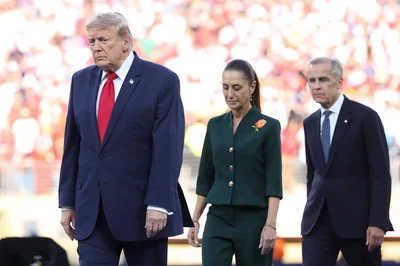
Given the importance of the USMCA, Sheinbaum accepted Trump’s invitation to attend the World Cup closing ceremony in New York last Sunday. After her brief trip, the Mexican president said the meeting was short but that she had the opportunity to speak with both the U.S. president and Canadian Prime Minister Mark Carney about the trade issue. “Our goal is that in this first year of review we can reach agreements so that in subsequent years it will just be a checklist, so to speak, a verification that what we agreed to this year is being complied with, and not a review every year that helps neither the United States, nor Canada, nor Mexico,” the president said at her regular morning press conference.
The meeting marks the start of a new phase in commercial integration between Mexico and the U.S. With a shared border of 1,954 miles, both countries recognize their economic interdependence; however, while Sheinbaum’s government sought to keep the current framework in place, Trump has aimed to change the rules of the game since his first day in the White House. This third round of negotiations in Mexico City aims to be a decisive step to clear up uncertainties about North America’s trade future, which has effectively shifted from a trilateral negotiating framework to bilateral talks.
Last week at an economic forum, Greer sounded optimistic about progress in talks with Mexican authorities. The U.S. official focused his concern on the United States’ trade deficit with Mexico. “Having a structural trade deficit like the one we have had for so long makes no economic sense and that is why, even with Mexico, we need to ensure that the trade deficit is under control,” he said. Greer said the order from the White House is to find, in any agreement reached with Mexico—whether through tariffs or quotas—a way to control the trade imbalance. The mission is not expected to be easy. In the first five months of the year alone, the United States’ trade deficit with its southern neighbor exceeded $81 billion, a 2.7% increase compared with the imbalance recorded in the same period of 2025.
Marcelo Ebrard and Jamieson Greer in Mexico City, April 20.Raquel Cunha (REUTERS)
In this new roadmap, the United States has set the pace for its North American partners. Hours after Trump welcomed his neighbors and trading partners to the VIP box at the World Cup, the US announced it will impose 50% tariffs on most Canadian products, alleging that Canada has discriminated against American cars, alcoholic beverages and dairy products. The tariffs, which take effect in 30 days, will exclude energy products, potash, fish and critical minerals, but will hit products that were previously exempt from tariffs under the USMCA.
In Mexico’s case, the debate has focused on Washington’s requests to raise the U.S. content of cars assembled in the region, as well as other labor and critical‑minerals rules. Although President Sheinbaum and her economic cabinet have insisted that relations with the U.S. remain in good shape and that there is no uncertainty, Mexican business leaders remain on edge about the direction of these talks in the face of a U.S. president who threatens to undermine the USMCA and exerts pressure through his tariff wall. Despite the treaty’s existence, Mexico pays tariffs to Washington under section 232 on its exports of steel, aluminum, copper, automobiles and other goods.
Ignacio Martínez Cortés, coordinator of the Laboratory for Analysis in Trade, Economics and Business at UNAM, says this meeting is a turning point because it marks the start of the USMCA’s first annual review and, at the same time, begins the countdown for the agreement’s future; if the partners fail to reach consensus, the pact will end in 2036. “Mexico will try to preserve preferential access and, if possible, secure a tariff preference—not necessarily 100%, but a significant percentage,” he predicts.
For the Latin American country, the trade agreement has been the cornerstone for supporting U.S. investment on its soil and the flow of exports that, despite Trump’s current protectionist measures, continues to break records month after month. Mexico is the United States’ top trading partner with nearly $900 billion in annual trade. More than 80% of Mexican exports end up in the U.S. market, which is why the uncertain outlook for the agreement complicates Mexico’s economic activity amid a slowdown, already weighed down by sectoral tariffs imposed by Trump on key products such as cars, steel, minerals and tomatoes.
Thirty years after North America’s economic integration, Mexico, Canada and the United States now face an unprecedented process that stretches the seams of the USMCA. Faced with a blunt and unpredictable negotiator in Trump, Mexico will have to negotiate uphill to keep afloat and even extend trade advantages while trying to contain uncertainty among businesses and investors. This new phase of the treaty will be a test for Sheinbaum’s government on the economic, political and diplomatic fronts—an intense exam that promises to be long, winding and surgical.
Sign up for our weekly newsletter to get more English-language news coverage from EL PAÍS USA Edition