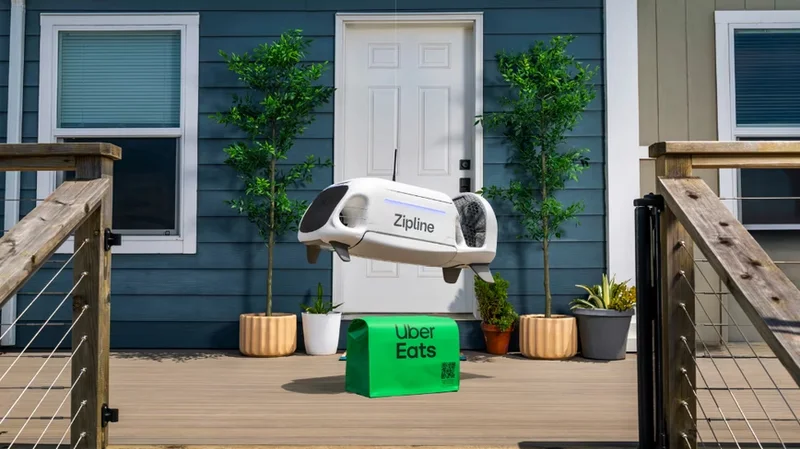
Uber, the ride-hailing giant said on Monday that it is teaming up with Zipline, the autonomous drone-delivery firm, to fly Uber Eats orders to customers across the United States, sweetened by an undisclosed strategic investment.
It is a striking vote of confidence in a company that has spent the past year busily pivoting from hospital drops to suburban lunch runs, and it hands Uber a way to move food that involves no driver, no car, and no fight for a parking space.
The rollout will begin later in 2026 in Zipline’s existing American markets, among them Houston, Phoenix, and pockets of Texas and Ohio, before spreading to dozens of further cities.
Both companies insist the ambition is enormous: one million drone deliveries a day by the end of 2029, or more than 365 million a year.
Uber’s chief executive, Dara Khosrowshahi, framed it in the register the industry favours, promising “a faster, more sustainable way for people to get what they need”, while Zipline’s co-founder Keller Cliffton reached for something grander still, declaring that “teleportation isn’t science fiction anymore”.
Zipline’s aircraft cruise to a delivery address, hover well overhead, and lower a small droid on a long tether; the droid steers itself down to place the package on a doorstep or driveway before winching back up.
The company says an order can arrive within five to ten minutes, and that it already completes a delivery somewhere in the world roughly every twenty seconds, having logged more than 135 million autonomous miles and some 2.5 million deliveries to date.
That track record is much of why Uber is writing a cheque. Zipline was valued at $7.6bn after raising $800m earlier this year, and its client list already reads like a food court, taking in Walmart, Panera, Chipotle, and Wendy’s.
Adding Uber Eats, which connects millions of people with local restaurants every day, gives the drone operator something it has always lacked: a ready-made marketplace of hungry customers and the merchants to feed them.
Whether any of this arrives on schedule is another matter entirely. Drone delivery has been perpetually five years away for well over a decade, the graveyard of grounded pilots is crowded, and TNW has been asking where the deliveries we were promised actually went since at least 2022.
Zipline’s rivals are numerous and well funded, from Alphabet’s Wing to the Irish startup Manna, which is building a US factory in Tulsa to take them all on.
The real bottleneck is regulatory, since scaling beyond line-of-sight flights over dense neighbourhoods needs approvals the US Federal Aviation Administration has handed out sparingly.
There is also the small question of whether people actually want a robot aircraft descending over their gardens at lunchtime.
Zipline leans hard on the quietness and precision of its droid, plainly aware that the technology’s biggest obstacle may prove social rather than technical.
The deal also fits a wider Uber habit of outsourcing its automated ambitions rather than building them, much as it has done with robotaxis; this is, after all, the same company now nudging customers towards doorstep parcel returns and courier pickups as it hunts for margin in every last corner of the last mile.
For now, the promise is seductive and the caveats are wearily familiar. Zipline and Uber have the technology, the money, and a genuinely useful proposition, namely hot food that turns up in minutes without a car idling at the kerb.
The sky is the easy part; it is the ground, with its regulators, its neighbours, and its awkward economics, where drone delivery keeps coming unstuck.
Get the TNW newsletter
Get the most important tech news in your inbox each week.