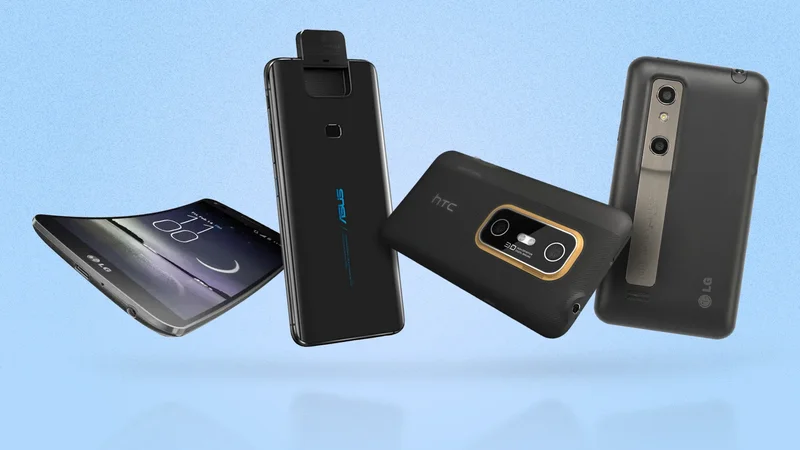
Android phones were in a strange place in the early 2010s. Smartphone manufacturers weren’t afraid to release phones with peculiar features back then.
I’m not talking about removable batteries or headphone jacks. I’m referring to truly peculiar features that catered to very niche audiences.
I remember seeing the Samsung Galaxy Beam for the first time and wondering how I’d use its mini-projector in real-world applications. After testing a demo unit, I concluded that it was more of a party trick than a must-have feature.
Still, I had a blast using the mini-projector during meetings and casting photos on the wall when family came over.
We don’t see this sort of innovation anymore. Android manufacturers rarely take risks and would rather stick to tried-and-tested features that users would actually use daily.
There’s nothing wrong with this method, but I reminisce now and then about the early state of Android.
Android had some of the weirdest flops
It felt like manufacturers tried anything
Android manufacturers had some wild ideas over a decade ago. The aforementioned Galaxy Beam was one of the most peculiar. You could project a 50-inch image onto the wall at a resolution of 360p.
Its brightness left a lot to be desired; its projections would only work in total darkness. Aside from that, there was nothing spectacular about the Galaxy Beam.
Phones with 3D screens and cameras arrived when 3D movies were in their short prime. The HTC EVO 3D and LG Optimus 3D ushered in the technology to casual smartphone users, allowing them to capture and view 3D photos on one device.
Unfortunately, the hype for this mobile technology faded along with the cinemas that housed them.
The LG G Flex had my favorite unique feature. Most people remember the G Flex for its flexible frame, but I was more impressed by its self-healing back cover. Scratches would disappear after some time, depending on how deep they were. This was convenient during a time when plastic bodies were the norm and phone cases weren’t a necessity.
Other features were genuinely useful
For every miss, there was a hit
It’s easy to remember the biggest flops. However, some legitimately useful features rarely saw a second or third chance.
There have been several types of secondary screens on Androids, including those located on the back like YotaPhone’s rear E Ink display.
The one I enjoyed most was on the LG V10. It was a slim 2.1-inch screen located above the primary display. It was great for quickly launching apps and reading notifications, even while the phone was locked.
Rotating cameras were a smart way to equalize the image quality between selfies and regular photos. By turning the camera around, only one high-quality module was needed.
Samsung and ASUS popularized this implementation with the Galaxy A80 and ZenFone 6, respectively, but OPPO was ahead of the pack with the N1 in 2013.
HTC’s Edge Sense was one of the most underrated features of its time. Squeezing the pressure-sensitive sides of the HTC U11 either opened a chosen app or turned on a specific function.
It was another useful feature that would work while the phone was locked. Google applied this to some of its own Pixel phones before eventually dropping it on the Pixel 5.
Why did phone brands stop trying?
Did they give up too soon?
There are several reasons why smartphone manufacturers no longer entertain wild ideas. The most obvious reason is the high risk for the low reward. Gimmicks work well for launch events and garnering headlines, but they don’t necessarily sell phones.
Seeing the likes of Samsung, HTC, and LG give up on unique features after one generation is the clearest sign of this.
The consumer market converged on a set of smartphone features, as well. Features such as waterproofing, wireless charging, and durable frames can be more easily achieved with fewer components.
The standardization of Android has helped brands zero in on the most important elements and focus on improving them, at the expense of individuality.
One brand that hasn’t given up is Nothing. The company has experimented with Glyph notifications on the back of its phones.
It began with bright LED strips across the entire back cover, and now has a more conservative approach with tiny LED panels and pixelated graphics. Glyphs give Nothing phones personality, something a lot of new Androids sorely miss.
We don't miss bad ideas
We just miss brands trying
The worst casualty of the standardization of Android was Project Ara. It was a truly modular phone that never saw the light of day. It had the right ideas: sustainability, low-cost upgrades, and true customization.
Sadly, its creators deemed it unviable. Its demise in 2016 coincided with the gradual decline of Android manufacturers releasing modular phones like the LG G5 and Moto Z series.
Whether Project Ara would’ve succeeded or not is no longer the issue. We’re now dealing with Android complacency. Every new phone is a predictable upgrade from the last, void of generation-defining features.
Foldable phones kept the flame alive for a few years, but have since stalled and begun following cookie-cutter designs with incremental updates.
To be clear, I don’t want to go back to the era of gimmicky Android features. Even though today’s phones are less interesting, they are unquestionably better.