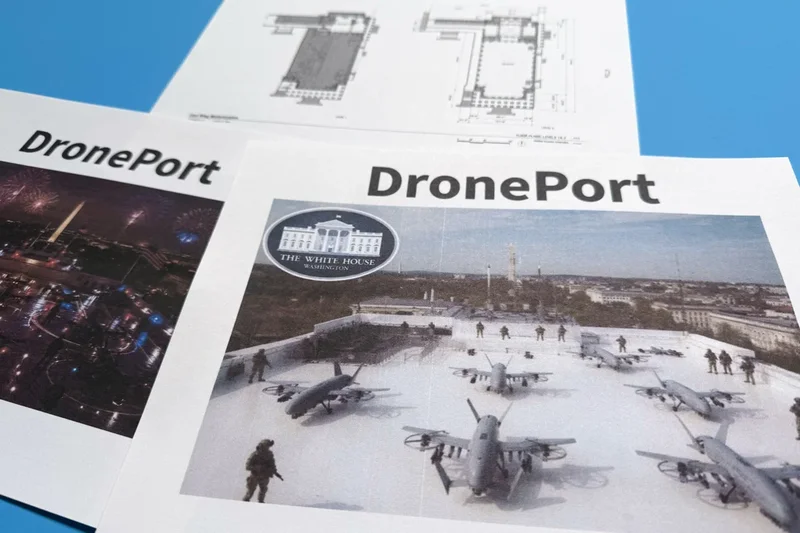
What began as Donald Trump’s plan for an ornate White House ballroom stuffed with gold finishes and marble floors is increasingly looking like a highly fortified military installation.
After Trump unilaterally decided to demolish the East Wing to make room for the sprawling addition to the executive mansion, the White House has revealed in court filings in recent months that the ballroom is not the primary purpose for the facility. Instead, the government is building a massive underground bunker and a rooftop military complex with a bulletproof, hermetically sealed ballroom sandwiched in between.
A months-long legal battle has stalled construction, but the president is asking the Supreme Court to intervene and let him build what Trump has called a “desperately needed National Security structure” that government lawyers say is vital to the safety and security of the president.
Trump never once mentioned the word “ballroom” in a lengthy post defending the project on Truth Social but instead lashed out at “TREASONISTS” who sued to stop the building. He later called it a “Military Complex/Ballroom” and shared AI-generated images of himself and George Washington strolling through its halls.
Federal courts have blocked parts of the project from moving forward without approval from Congress. But Democratic and Republican leaders don’t seem interested in getting involved, even as the administration “desperately” pleads for permission to build.
A federal appeals court in Washington, D.C. ordered the government to stop construction on the ballroom by Aug. 21 unless Congress steps in.
“This decision, made after much of the work has been done and paid for, is a National Security Threat at the highest level,” Trump raged on his Truth Social earlier this month. “It is also a National Disgrace.”
The Supreme Court is expected to decide next steps this week.
In court filings, the Department of Justice has repeatedly claimed that alleged attempts to assassinate the president — including an alleged plot to target the UFC cage match on the White House lawn and, most recently, a potential Iranian strike on Air Force One — have demonstrated a “compelling need” to build the ballroom fortress.
In May, government lawyers sprinted to federal court after a shooting near the White House. They said the shooting underscored the “critical need” for the ballroom project.
Trump was inside the White House at the time and unharmed, but the proposed ballroom would provide a “SAFE HAVEN” from would-be attackers in the future, according to a Truth Social-inspired filing from the Justice Department.
The ballroom is “a knitted, unified, cohesive part of the East Wing Project, which is vital for National Security, and is being constructed to ensure that the President can perform his constitutional duties in a safe and heavily secured facility,” government lawyers wrote.
The four-page filing then complained that the legal battle had forced officials to reveal “top secret” details about the project — including “heavy steel, drone-proof roof, missile-resistant and drone-proof columns, bullet, ballistic, and blast-proof glass, Military-grade venting for air conditioning and heating” as well as “bomb shelters, a state of the art hospital and medical facilities, Top Secret military installations, structures, and equipment, protective partitioning, and other features.”
The ballroom’s rooftop will be “hermetically sealed to prevent malign forces from contaminating the circulating air, thereby threatening the lives of those inside,” according to court filings.
Materials used “are meant to stop bombs, rockets, missiles, and even nuclear blast,” officials wrote.
The following month, hours after federal prosecutors charged five men for an alleged attempt to attack the UFC event, government attorneys wrote that the ballroom is “designed to defend against just such attacks” with a “highly sophisticated Drone Port and Sniper Nests.”
On his own Truth Social page, Trump posted several images of mocked-up designs for a “drone port” on the ballroom’s roof depicting numerous military drones, armed soldiers and refueling trucks that turn the typically placid grounds of the White House into a major military installation.
“This great and very important military asset sits atop the heavily protected Ballroom at the White House. It provides National Security for Washington, D.C., and will protect future Presidents!!!” Trump wrote earlier this month.
In last week’s appeal to the Supreme Court, U.S. Solicitor General D. John Sauer treated the ballroom more of a feature of the project, not the main event.
He called it an “integrated military complex, including a totally secure ballroom space, at the East Wing of the White House, which is vitally required by national security.”
But officials are still highlighting what began as Trump’s pet construction project on White House grounds. Renderings in Supreme Court filings show gold finishes on the building’s white marble exterior.
Director of National Intelligence Jay Clayton told the justices that the project is “critical for ensuring that the White House can serve as a secure location for the gathering of the president, gathering of senior government officials, and gatherings that further the interests of the United States.”
Without the ballroom, the White House will be forced to hold events in “vulnerable tents” outside the building that expose the president, foreign dignitaries and their families to “various threats,” including the “inordinately wet” lawn, lawyers wrote in court filings earlier this year.
In his own filing to the Supreme Court to support the administration’s appeal, Secretary of State Marco Rubio argued that a ballroom is necessary for diplomacy.
“In my work with heads of state and foreign ministers, I am frequently hosted in reception facilities that are visually impressive and reflective of the wealth and beauty of the nations I am visiting,” Rubio wrote. “Instead, we must currently host such visits in plastic or canvas tents on the South Lawn with unsafe and unsanitary portable bathrooms and accommodations unbecoming our national stature.”
Costs for the project have exploded from an initial $200 million estimate to $400 million — with some believing it could cost upwards of $600 million.
While Trump has said private donations will pay for the ballroom itself, the administration transferred more than $300 million from the Secret Service budget to cover security upgrades to the White House this summer.
Judges and the preservationists challenging the construction have not objected to officials building out the new bunker while the legal battle plays out over the ballroom “military complex” itself.
Still, administration officials have refused to back down.
“Each court has seriously and carefully considered the administration’s asserted national security concerns,” the National Trust for Historic Preservation, the group that sued to stop construction, said in a statement last week. “And each court has ruled that while underground bunker construction can continue, ballroom construction must stop.”