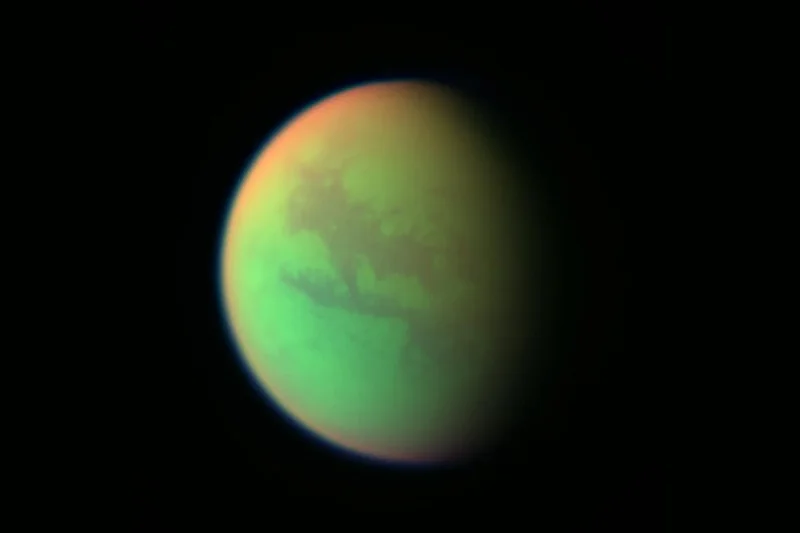
Beneath the surface of Saturn’s moon Titan is a vast underground network of caves and sinkholes that remains unexplored. Now, an ambitious concept aims to fly lighter-than-air, sphere-shaped robots into the subsurface channels.
NASA is funding the project under its Innovative Advanced Concepts (NIAC) program, which awards a total of $3.2 million to 18 visionary new ideas to explore the surrounding universe. The project, named SPARK, seeks to develop a swarm of tiny aerobots to carry out the nearly impossible mission of swooping their way into Titan’s caves and exploring its subterranean world.
Otherworldly caves
Saturn’s largest moon, Titan, is a gnarly place. The icy world has a thick, hazy atmosphere that almost entirely blocks the view of its surface. It is the only place besides Earth known to have bodies of liquid, with lakes, rivers, and seas on its surface and an Earth-like cycle of liquids raining from clouds and evaporating back to the sky. But unlike Earth and its water, Titan hosts liquid hydrocarbons like methane and ethane.
Thanks to its surface liquids and dense atmosphere, Titan is a member of a handful of worlds that could harbor a potentially habitable environment. Any form of life on Titan, however, would be vastly different than life we know on Earth.
The Moon also has an underground network of caves, sinkholes, and subterranean channels that may have formed when methane and ethane dissolved through its bedrock and water ice. The karst terrain is difficult to explore using rovers like the ones sent to the Moon or Mars, but a fleet of flying robots could do the trick.
SPARK, short for Solid-state Propulsion for Autonomous Reconnaissance of Karst, is a swarm of aerobots designed to float through the hydrocarbon-carved caves and sinkholes of Titan. Led by Daniel Drew, an assistant professor at the University of Hawaii at MÄnoa, the project relies on electrohydrodynamic (EHD) propulsion, also known as atmospheric ion thrusters.
This type of propulsion uses high voltage to ionize and accelerate surrounding air molecules, producing thrust without combustion. The ion-powered vehicles would then be able to maneuver through the underground caves while minimizing heavy downwash that would disrupt the surrounding environment.
On Earth, EHD thrusters consume too much power for a small lift. On Titan, EHD thrusters are projected to be over 100 times more power-efficient than on Earth due to the moon’s favorable atmospheric conditions, according to Drew. It’s easier to create the electric charges needed for flight in Titan’s atmosphere; therefore, the aerobots would be able to use lighter power converters.
Flying through Titan’s underworld
The swarm of aerobots can be deployed by a larger spacecraft on Titan and set on their way to navigate through the moon’s caves.
SPARK is currently at the initial phase of development, beginning a nine-month feasibility study under NASA’s NIAC program where the team will model the performance of the thrusters in Titan-like conditions. The second phase involves a two-year evaluation period of a prototype before the tiny robots are ready for flight.
NASA’s Dragonfly mission is currently slated for launch in 2028, sending a rotorcraft to explore Titan’s surface. It’s not yet clear whether SPARK will be able to hitch a ride to Saturn’s moon along with Dragonfly or if the aerobots will have to find their own way there before delving deep beneath Titan’s surface.