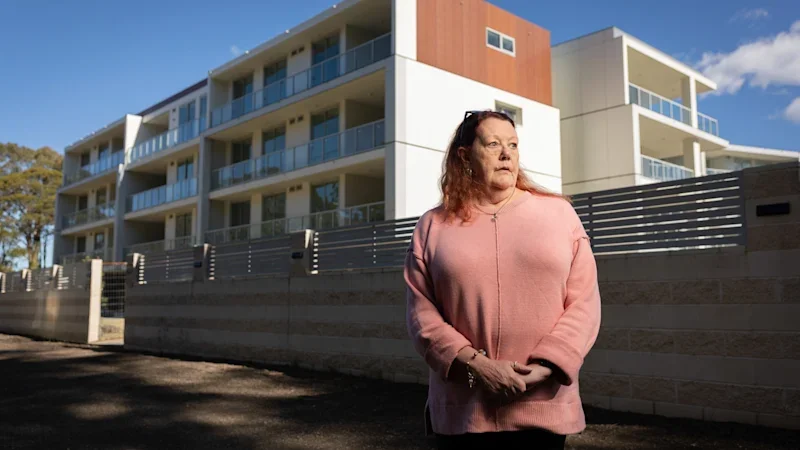
Janice Cahill thought the plans for her cosy second-storey unit looked perfect. Recently widowed, the retiree had sold her family home and spent $60,000 on a deposit for a one-bedroom off-the-plan apartment in a new complex in Kembla Grange, near Wollongong. The location would allow her to live close to her grandchildren, and the building’s lift would help avoid difficult stairs.
Cahill was told the building would be ready by December 2025. Then the developer emailed with news it would be delayed until March 2026. Then April. Then August. Then September. She still hasn’t moved in. “It’s pretty depressing,” she said. “It does really and truly affect my mental health.”
She signed a contract with UPG 113 Pty Ltd – a company Cahill did not know, and claims she was not informed, was in fact a subsidiary of Bathla Group, one of the state’s most prolific and controversial developers. The firm is now teetering on the edge of collapse as it deals with more than $3 billion in debts and a circling Building Commission investigation into its key properties.
Questions have been raised for more than a year about the ability of Bathla Group, and the more than 450 subsidiary companies identified by the Herald, to pay its debts and remain in the market.
In the latest development, the company, which is a major sponsor of the Western Sydney Wanderers, is trying to sell off land in the profitable north-western suburbs. It is advertising a block of undeveloped land in Bella Vista it bought for $15.71 million from receivers for the developer Dyldam, which collapsed in 2020 with debts of half a billion dollars – less than the amount Bathla owes.
Building Commission NSW, the state’s construction watchdog, has undertaken more than 40 inspections of Bathla sites over the past few months and has identified defects at sites in Marsden Park, which the commission said have mostly been rectified, and the Kembla Grange development into which Cahill is planning to move.
The company’s spokesperson said the company’s records indicated the agency had only conducted five inspections “with no issues noted”.
Fed up with the lack of progress on her new home and having heard that the tradesmen had walked off the site because they were not being paid, Cahill contacted an executive at Bathla in November 2025.
“We met for coffee [and] he apologised for the delay and gave all this story about the plumbing issues, and Sydney Water not being connected,” she said.
A spokesperson for Sydney Water said there had been no delay at the site.
“He assured me that he would keep in touch with me and keep me updated, which to this point hasn’t happened,” Cahill said. “I’ve emailed him and asked him what the updates are, and I’ve had no response. So I think he’s ignoring me.”
“He said, ‘Oh, tradies will always say they put invoices in that they haven’t done work for, and that’s why they haven’t been paid’. And I just thought, this meeting is useless.”
Bathla’s spokesperson said the company had communicated to unit buyers through their purchasing agents and that its executives had been in direct contact with some. They also said “all trades are on payment terms”.
When asked why the completion date for the project had been pushed back, the spokesperson said it was “due to unforeseen site delays with some external works … Completion is forecast for November.”
In another response, they said buyers would be able to move in during October or November. “On completion the project will be handed to the buyers in great condition.”
When Marie Sinclair, whose elderly parents bought an apartment in the same building, visited the site in September last year, she was shocked to find doors with keys left unattended, graffitied walls, half-finished copper piping and multiple broken surfaces.
Her parents had sold their home after pressure from the developer’s salesperson to prepare to move into the block, she said.
“They were homeless. We couldn’t find a rental [within budget]. So they have to live with me,” she said. “A spotlight needs to be shone on this.”
Empty worksites reveal extent of crisis
A Creditor Watch report shows Bathla’s main corporate entity, Universal Property Group, is at high risk of not being able to meet its financial commitments or insolvency within the next 12 months.
The spokesperson said Bathla and all its related entities would pay off the debt accrued, and that the developer would finish building the 3500 houses, apartments and subdivision lots that are currently under construction in Australia.
“We do not believe Universal Property Group is at high risk of an insolvency event,” he said.
But a lack of work across many of the company’s sites gives insight into the crisis. In Castle Hill, one of the company’s key projects, the 68-unit Ashford Rose development exists only as a hole in the ground. When the Herald visited last week, no construction work was occurring and no workers were seen on the property. Parts of the site have been flooded with water.
Bathla’s website shows apartments available for sale at Ashford Rose, but the company’s spokesperson said no units had been sold off the plan. “We are awaiting a further staged construction certificate to recommence work on site,” they said. “The water [onsite] is due to heavy rainfall. This will be dealt with appropriately.”
In Marsden Park, a “drainage reserve” was meant to be turned into a place to play for the tens of thousands of new residents moving into the area. But the park hasn’t opened to the public, remaining fenced off because Bathla, which completed the bulk earthworks for the site, has yet to hand over ownership of the plot to Blacktown City Council. Frustrated locals have resorted to breaking in to get access to the promised green space, while the council waits for Bathla to complete the settlement process.
The spokesperson for Bathla said all parties were working to finalise the contract, with settlement to occur shortly after.
Builder’s track record in spotlight
At the heart of Bathla Group is a corporate structure that makes it difficult for prospective buyers to know who they are dealing with. Each development is owned and sold by a subsidiary company of Bathla, which is officially called Universal Property Group. Corporate filings show Universal Property Group has hundreds of subsidiary companies, all listed as numerical variations of UPG: UPG 1, UPG 2, up to UPG 460.
Bathla, or Universal Property Group, is also closely connected to the company Raj & Jai Constructions. Documents lodged with the corporate regulator show the two companies share the same business addresses, have identical auditor and agent details, and the co-owners of Bathla and the owner of Raj & Jai are all listed as living in the same Girraween apartment block. Building Commission NSW considers Raj & Jai as an associated entity of Bathla.
In response to questions about Bathla, its spokesperson said the company was “an independently owned and operated entity”. When the Herald sent questions to Raj & Jai, the spokesperson provided the same response.
In 2011, the Australian Securities and Investments Commission found Universal Property Group engaged in “unconscionable conduct” after offering vendor finance to people who were mostly immigrants and came from non-English-speaking backgrounds. As part of the enforceable undertaking, the company agreed to a scheme whereby vendor finance borrowers would be entitled to seek compensation.
In 2018, Universal Property Group pleaded guilty and was fined $135,000 by SafeWork NSW after a worker at a Doonside site fell through a sheet of unmarked plywood and became impaled on upright concrete reinforcing bars. He was seriously injured. Universal Property Group expressed remorse for the incident.
Bathla and its subsidiary companies have also regularly taken up cases in the NSW Land and Environment Court, pursuing legal action against councils over “deemed refusals” for development applications, which occurs when a council has failed to decide on an application within 40 days (high-impact plans get 60 days, and state-significant projects get 90).
In 2020, then-Blacktown mayor and current state MP Stephen Bali criticised Bathla, saying the group simply wanted to “ram through acres of development” within 40 to 60 days. Meanwhile, the council has refused to comment on how much its recent appeals have cost.
Despite Bathla’s financial problems, the developer continues to propose new housing projects across the state. In recent years, more development applications have been submitted in south-western Sydney that follow a similar pattern to Blacktown. Liverpool City Council’s annual report for 2023 to 2024 revealed there were a total of 15 appeals in the Land and Environment by Bathla’s subsidiaries for development applications.
Of these 15 appeals, 14 were deemed refusals because the 40-day time period had passed. There were also two appeals by Raj & Jai Construction.
Building Commission NSW is encouraging home owners concerned about their contracts with Bathla Group to call the agency for advice.
Cahill, who is due to have a double knee operation next month and will struggle to walk up the stairs to the studio she is renting, has been emailing Bathla asking if she’d be able to move in by the time of her surgery. She hasn’t heard back.
“I just want my bloody apartment,” she said.