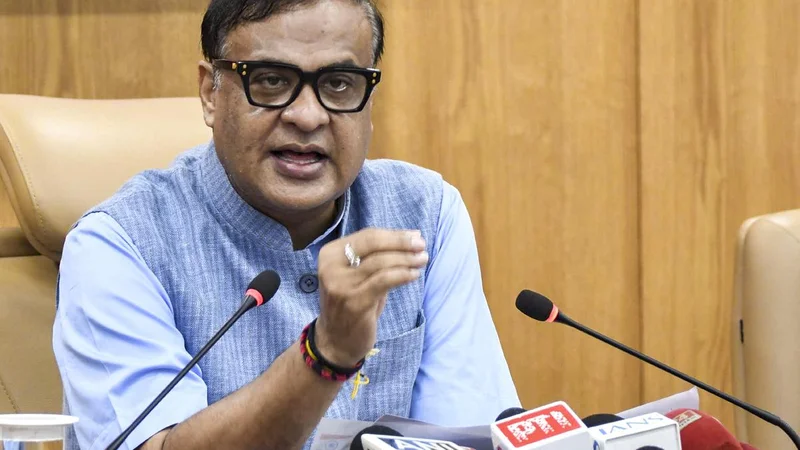
The Prime Minister’s ‘dimagi Naxal’ comment during his Independence Day speech from the ramparts of the historic Red Fort in New Delhi hogged the headlines on August 15. It drowned out another set of comments made from the barely historic Khanapara Veterinary Ground about 2,000 km away. Assam Chief Minister Himanta Biswa Sarma issued an appeal to the people of Assam who are natives of other States to list ‘Assamese’ as their mother tongue during the ongoing Census exercise.
“The year 2026 is an important one as the Census process has started. On the basis of data collected, the future of the country will be planned,” he said, underlining the significance of the exercise to the State’s ethno-religious contours. Given that who constitute the ‘Assamese’ people itself has eluded definition thus far, the Chief Minister expounded on what exactly he meant by “natives of other States”: “The proud Assamese individuals who had at some point in time come from Rajasthan or some other place with a different language and culture, I request them to mention ‘Assamese’ as their mother tongue.”
Mr. Sarma’s exhortation came even as the self-enumeration phase wrapped up on August 16, opening the door to house listing and housing Census field operations from August 17 to September 15. At the heart of the appeal is the slow but sustained dip in the number of people identifying Assamese as their mother tongue in successive Censuses — from 59.53% in 1971, 57.81% in 1991, 48.80% in 2001 to 48.38% in 2011. Conversely, the share of Bengali speakers rose from 19.7% in 1971, 21.67% in 1991, 27.55% in 2001 to 28.91% in 2011, while Hindi speakers increased from 5.42% in 1971 to 6.73% in 2011. The numbers are expected to stay on the same gradient when the 2027 Census data is finally collated.
A potpourri of identities
This steady slide can be explained by factors ranging from much-older patterns of infiltration and migration to a relatively recent trend of tribal groups such as Bodos, Karbis and Misings increasingly identifying their own language instead of Assamese as their mother tongue.
Umpteen times in his first term as CM, and especially as the electoral campaign gathered momentum in April, Mr. Sarma had predicted a “near-minority status” for the indigenous Assamese people after the Census is concluded in 2027. Such assertions served to pitch his Bharatiya Janata Party (BJP) as the protector of ‘natives’, a projection that struck a chord with its target electorate.
The new clarion call sticks to the same playbook, offering ‘exemptions’ to tribal communities and the predominantly Bengali-speaking Barak Valley — both critical to the BJP’s electoral calculus — with the CM giving them leeway to “exercise their own discretion”. The invocation of the proud-Assamese-from-Rajasthan is no surprise either. Over the past decade, the party has successfully redirected deep-seated, religion-agnostic anti-outsider sentiment to one which frames primarily the Bengali-origin Muslim as ‘Them’. Everyone else is ‘Us’.
Ironically enough, it is the Bengali-origin Muslim who has historically shored up Assamese numbers in the State. Called the Na-Axomiyas or neo-Assamese, these migrants from what was then East Bengal identified themselves as Assamese speakers as early as the 1951 Census, resulting in the share of the Assamese-speaking population increasing from 31.42% in 1931 to 56.29% in 1951 and 59.53% in 1971. Even if one were to discount the fact that the Bengali-dominant Sylhet province went to East Pakistan after Partition, studies show that Assamese speakers in Assam rose by as much as 150% in the 20-year period.
The settler self-identification was forged through a combination of organic cultural shifts and institutional nudges. Most Bengali-origin Muslims wading their way up to the char areas (river islands) and uncultivated tracts of the Brahmaputra Valley underwent a simultaneous assimilation and unbelonging, taking to Assamese language and cultural mores while giving up their Bengali identity. It helped that the State encouraged this switch to counter perceived “cultural imperialism” emanating from Kolkata.
The Chief Minister’s pitch to Hindi speakers is an acknowledgment of their acceptance in Assamese society. His omission of the Bengali-origin Muslims is a backhanded admission that they are also integrated.
Published - August 18, 2026 12:29 am IST