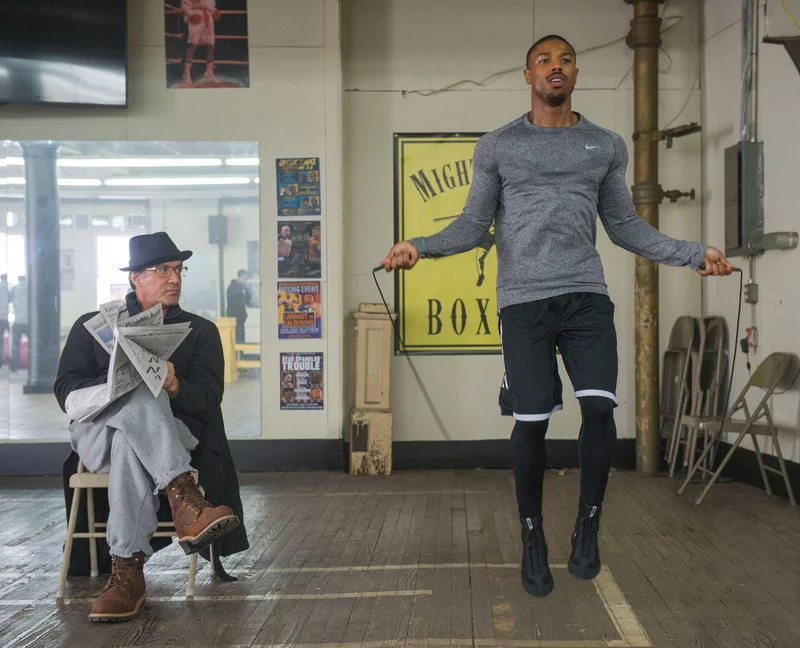
Any film buff passing through Philadelphia should sprint up the steps of the city’s Museum of Art, the institution in the birthplace of American independence immortalized by Rocky. Chances are they already know that, before charging up what are now known as the Rocky Steps, the boxer played by Sylvester Stallone followed a training regimen that combined running, push-ups, sit-ups and punching slabs of refrigerated beef. Rocky Balboa seemed to understand in 1976 what exercise science would take decades to confirm: we reap greater benefits from combining cardiovascular training, also known as aerobic or endurance exercise, with strength training than from doing either one alone.
Current guidelines recommend at least 150 minutes of moderate aerobic exercise a week, or 75 minutes of vigorous activity, alongside two strength-training sessions. The strongest argument for this mixed approach comes from mortality data. A 2023 study published in JAMA Internal Medicine, which followed more than half a million Americans for a decade, found that combining cardio and strength training was associated with nearly a 50% reduction in the risk of death compared with a sedentary lifestyle. The study also confirmed that each type of exercise delivers specific benefits that the other cannot replace.
“We need both, and the reason is very simple: they protect different things,” Mikel Izquierdo, professor at the Public University of Navarre and director of the Exercise, Health, Metabolism and Functional Capacity Group at the Navarrabiomed Biomedical Research Center, tells EL PAÍS. “Cardiovascular exercise looks after the heart and lungs; strength training preserves muscle mass, power and the ability to carry out everyday tasks,” he explains. The scientific debate is therefore no longer about whether people should do both, but rather what the ideal combination is.
The cardio-strength dilemma
Getting that balance right, however, requires some expertise. Since the 1980s, sports scientists have been aware of the so-called interference effect: when strength and endurance are trained together, aerobic exercise can limit strength adaptations, particularly muscular power, or the ability to generate force quickly. “It was seen that strength and endurance clashed,” says Izquierdo. “When you did endurance first, strength gains were smaller.”
The phenomenon has a twofold explanation. Cardio creates fatigue, making any subsequent strength session “less intense,” and it also activates cellular pathways that compete with those involved in muscle growth. Even so, Izquierdo, lead author of a 2024 international consensus statement on physical exercise and healthy longevity, downplays this effect for most people: “In healthy older adults, this interference has no clear practical relevance. What is clear, though, is that order matters.”
It is also important to distinguish between so-called concurrent training, in which strength and cardio are performed in the same session, and combined training, which involves doing them on different days. “If we separate strength and endurance training by 24 hours, we produce less fatigue and generate greater adaptation,” explains Izquierdo, whose team has studied this phenomenon in Olympic canoeing and rowing athletes. “It’s like a couple who have to live together in a small space, which is our body,” he says, adding that to avoid conflicts, “you have to tell the father to cook at 5 p.m. and the mother at 7 p.m.”
If given the choice, Izquierdo believes it is preferable to spread the two types of exercise across different days, though he acknowledges the practical limitations: “We have to be realistic. Going to the gym four times a week instead of two means more time, more travel and more expense.”
In practice, many specialists prioritise adherence over theoretical perfection. Miguel del Valle, professor of sports medicine at the University of Oviedo, recommends alternating “three weekly aerobic sessions and two strength sessions,” though he admits that he himself often combines the two “for convenience.” For most people, he insists, doing everything in a single workout remains a perfectly reasonable option.
For those who do opt for concurrent training, however, the science is clear: strength first, cardio second. “Doing aerobic exercise after weights does not harm strength gains,” says Izquierdo. He also advises beginning a workout with compound exercises, such as the leg press or bench press, and leaving smaller movements, such as biceps work, until the end. “It’s a simple detail that improves performance.”
When more isn’t better
The question of how much exercise is enough, and when doing more stops paying off, was addressed in a 2023 systematic review published in Missouri Medicine. The research challenges those who train without limits. One of the studies reviewed, conducted by Harvard’s School of Public Health and based on more than 100,000 people followed over 30 years, found that the benefits of vigorous exercise, including running, HIIT, intense cycling and fast swimming, appear to plateau at around 150 minutes per week. Beyond that point, the gains level off.
Moderate exercise, on the other hand, such as brisk walking, hiking, leisurely cycling or gardening, continues to be associated with progressive improvements in cardiovascular health and longevity even at higher volumes.
Strength training also has its threshold. According to a meta-analysis included in the review, between 30 and 60 minutes of strength work per week is linked to meaningful reductions in mortality and cardiovascular disease. Beyond roughly 130 to 140 minutes a week, however, the benefits disappear and negative effects may even begin to emerge.
The underlying message echoes that of both experts: the difference between doing nothing and doing something is far more important than the difference between training three hours a week and six. Physical fitness is one of the strongest predictors of life expectancy and years lived in good health, but more does not always mean better, and rest and recovery are part of training too.
Strength becomes more important with age
The ideal combination is also not the same at 25 as it is at 85. “As we age, the capacity for vigorous aerobic exercise decreases, and the need to preserve muscle and strength increases,” Izquierdo explains. For that reason, strength training takes on a greater role in exercise programmes for very old or frail people.
Del Valle insists, however, that age alone is not enough to determine the right prescription: “It depends greatly on fitness level. A 65-year-old who has trained their whole life is not the same as someone sedentary.” Both specialists also agree that in previously inactive older adults, relatively small amounts of exercise can produce significant benefits. “There are studies showing that one day a week of strength training and another of endurance already generate very significant effects,” says Izquierdo.
As for sex differences, both specialists say that the general recommendations are the same for men and women. Izquierdo is categorical on the point, dismissing the notion that women respond less effectively to training.
Although Rocky may have been ahead of his time, and science has finally vindicated him half a century later, there is still no universal formula. “There is an ideal training program for each person,” Del Valle concludes. The key is not to chase the perfect workout plan, but to tailor it to age, fitness level, medical conditions and, above all, the ability to sustain it over time.