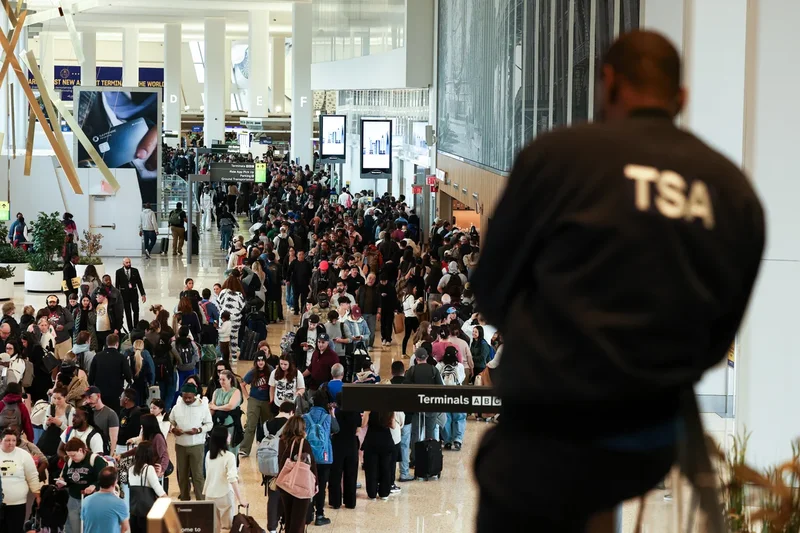
Flight cancellations and delays are worsening across the United States as low cloud cover, reduced visibility and severe weather strain airline capacity and national air traffic operations.
The Federal Aviation Administration warned that severe weather in eastern transit hubs, including Boston, New York, Philadelphia, Washington D.C., Charlotte and Orlando, was causing widespread disruptions across domestic flight networks.
According to flight-tracking platform FlightAware, more than 1,300 domestic flights were delayed and over 100 were canceled on Monday morning.
New York’s John F. Kennedy International Airport recorded the highest number of disruptions, with 117 delays and 25 cancellations. JetBlue Airways was the hardest-hit carrier, experiencing nearly 100 delayed flights and 25 cancellations within the same window.
Federal aviation officials have previously indicated that air traffic controller shortages, combined with summer storm patterns, have amplified scheduling strain. JetBlue reported delays on 45 percent of its scheduled flights during a similar wave of severe weather earlier in the month, according to FlightAware data.
Industry analysts say the core issue is a lack of spare seating capacity across the aviation system.
Robert W. Mann Jr., an airline industry analyst and former airline executive, told The Washington Post that carriers had reduced available seat capacity since April due to rising fuel costs. When bad weather disrupts schedules during peak travel periods, airlines have very few empty seats available to accommodate displaced passengers.
“The accommodation problem is a very real problem, and you run out of options very quickly,” Mann said.
Travel industry professionals point out that severe weather in major cities creates compounding delays that can take days to resolve.
Peter Vlitas, executive vice president of partner relations at the travel services firm Internova Travel Group, said passengers should monitor airline travel alerts and take advantage of advance rebooking options before cancellations occur.
“They’re really good at telling you that the weather tomorrow is going to stink, so can you leave today,” Vlitas told The Washington Post. “If you can, you should.”
Vlitas added that passengers facing sudden cancellations may need to consider alternative routing strategies, such as flying into an adjacent city and taking ground transportation or train services to their final destination.
“Sometimes you have to help the person on the other end try to put a connection together,” he said.
To mitigate disruption during ongoing weather delays, aviation agencies and travel advisers recommend monitoring flight statuses continuously through carrier applications and enabling push notifications for gate changes or delays. Passengers should rebook immediately upon receiving notice of a cancellation and allow extra layover time when connecting through major transit centers.
Experts also advise packing essential items and medications in carry-on baggage to prepare for unexpected overnight stays.