Tens of thousands of people marched through the streets of Messina, in Italy’s Sicily region, this past weekend for the Procession of the Vara, an annual religious festival featuring floats and fanfare. As they celebrated, something sinister unfolded behind closed doors: a museum heist.
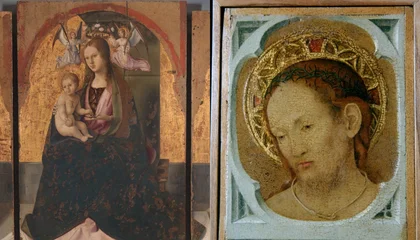
Using the large crowds as a distraction, an unknown number of thieves slipped into the Regional Museum of Messina without tripping any alarms. Once inside, they targeted Antonello da Messina’s Polyptych of San Gregorio, a 1473 altarpiece depicting the Virgin Mary and Jesus, flanked by saints on either side.
The thieves removed the artwork’s five surviving panels and escaped with three. The other two were found leaning against a fence outside, perhaps abandoned in the rush to escape. A small devotional painting by Antonello, depicting the Madonna and Child with a Franciscan monk on one side and an adult Christ on the other, was also stolen, with the criminals smashing a display case to access it.
“It is an extremely serious and significant loss,” Marisa Mercurio, the museum’s director, tells the Guardian’s Lorenzo Tondo. “They have stolen works of enormous cultural, artistic and symbolic importance, not only for Messina but for Sicily as a whole. All we can do now is hope they are recovered as soon as possible.”
This isn’t the altarpiece’s first brush with destruction. It originally consisted of six panels, but one was destroyed in the 1908 earthquake that devastated Sicily and killed more than 40 percent of Messina’s population at the time.
Around 40 works by Antonello are known to survive today. The artist is regarded as one of the most important southern Italian painters of the Renaissance. His importance to Messina is undeniable.
“Antonello is the greatest ambassador of our city because he has Messina in his name,” Vincenzo Caruso, the city’s chief cultural official, tells the New York Times’ Elisabetta Povoledo.
Antonello has long been credited with introducing Flemish oil painting techniques and influences to Italy, although more recent research disputes this narrative. He was probably trained in Naples, where works by Netherlandish painters including Jan van Eyck and Rogier van der Weyden would have been available for study.
The artist “made a crucial contribution to the Renaissance by unifying two very important aspects of Renaissance art: the work of Flemish artists and Italian art,” art historian Grazia Musolino tells the Times.
The stolen polyptych panels and double-sided devotional painting were the only works by Antonello that remained on display in his native city. The altarpiece, painted six years before the artist’s death in 1479, had never left Messina before.
Earlier this year, the Italian government demonstrated the high esteem in which it holds Antonello and his work, paying $14.9 million for his painting Ecce Homo just before it was set to be auctioned in New York. In 2003, the small devotional sold at auction for roughly $410,000.
The theft comes just days after Italian officials celebrated welcome news: the recovery of three paintings that were stolen in March from the Magnani-Rocca Foundation, a private museum outside the city of Parma. Painted by Pierre-Auguste Renoir, Paul Cézanne and Henri Matisse, the artworks are collectively worth more than $10 million.
Police have opened an investigation into the Antonello heist and are hopeful that passers-by on the street, some of whom noticed a commotion inside the museum, might have taken photographs that could lead to arrests.
“A heritage belonging to all the people of Messina has been violated,” says Federico Basile, the city’s mayor, per BBC News’ Aleks Phillips. “Messina will not let its history be stolen.”