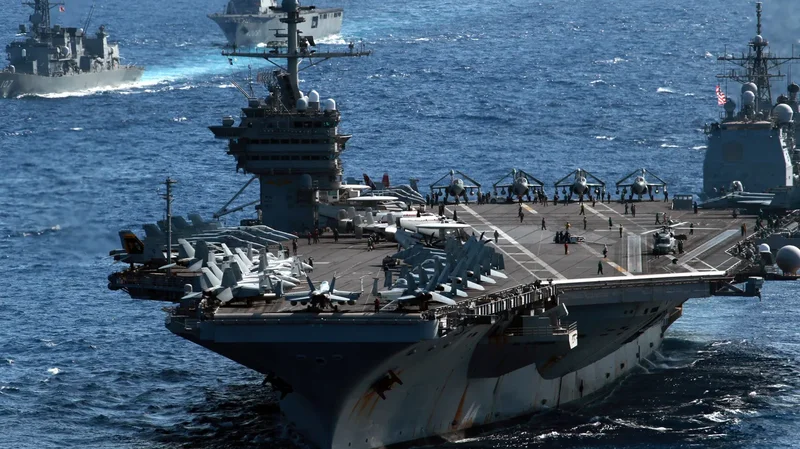
The USS George Washington's deployment from Japan to the Middle East to relieve the USS Abraham Lincoln will leave the U.S. without an aircraft carrier in the western Pacific — just as adversaries in the area are flexing their military power.Why it matters: Temporary carrier gaps are not uncommon, but the absence of a striker ship in the Pacific highlights how the Middle East is once again dictating American military policy. It also has raised questions about how the U.S. can sustain a formidable presence in both regions.The big picture: The absence of a U.S. carrier in the Pacific has happened before, and China has previously exploited those gaps by sailing its strike groups closer to U.S. allies like Taiwan and Japan, Mark Cancian, a retired Marine Colonel and a current senior adviser at CSIS, tells Axios.While a full-scale invasion is unlikely, China could use the void to ratchet up its presence in the Pacific, he says.The region is crucial for the U.S. both militarily and economically, hosting at least 66 "significant defense sites," while Taiwan produces the majority of the chips America needs to run its AI industry.Catch up quick: The Japan-based USS George Washington is heading to the Middle East to relieve the USS Abraham Lincoln, whose sailors have been deployed for about nine months and are reportedly dealing with mental health problems and supply disruptions.By the numbers: The Navy has an 11-carrier fleet, which allows two carriers to be deployed continuously without burning out crews, Bryan Clark, a former submariner and current senior fellow at the Hudson Institute, tells Axios.If two carriers stay stationed in the Middle East to support operations in Iran, then there will likely be months each year when the Pacific presence drops to zero.Additionally, carriers will need maintenance and repairs after long deployments, which means they won't be available as often going forward, he says.Clark says the 11-carrier fleet is still sufficient for U.S. defense — but only if deployments are managed carefully.Between the lines: The carrier departure coincides with Trump "substantially" trimming routine joint U.S.-South Korea military drills and preparing for an upcoming summit with Xi Jinping in China.While the administration is not formally retreating from the Indo-Pacific, the combination of a carrier gap and reduced military exercises could reinforce Beijing's argument that U.S. security commitments are unreliable.What they're saying: "The United States military maintains the force posture necessary to achieve any desired objective set by the Commander-in-Chief," White House spokesperson Anna Kelly told Axios in an emailed statement."As Operation Epic Fury demonstrated, America's military might is stronger than it's ever been." Zoom out: "If you are Taiwan or the Philippines or Japan, you're looking at this and saying the U.S. is basically not here, and the Chinese are, and the Chinese are showing off their military capability," Clark says.If the pattern continues, Clark says, countries in the region could begin questioning whether Washington would actually be supportive in a crisis."The Chinese don't even have to fight a war if they can convince those neighbors that the U.S. really isn't going to be there for them, and that they should just bandwagon with China and go along with what China wants to do."Go deeper: Trump shrugs off concerns about dismal conditions on USS Abraham Lincoln
Middle East demands are testing America's Pacific presence