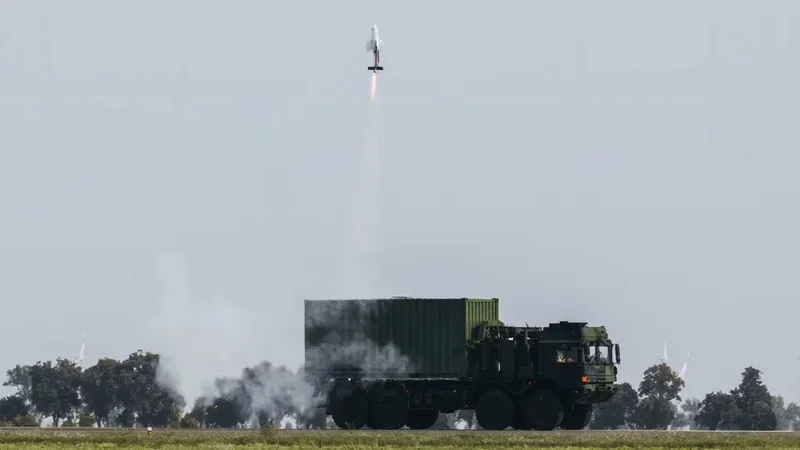
- Rheinmetall launched an armed drone from a truck while it was moving
- Each FV-014 drone carries a warhead weighing about six kilograms
- The launcher fits inside a standard 20-foot shipping container
Rheinmetall has carried out a test launch of its FV-014 loitering munition from a moving Rheinmetall HX truck fitted with its Containerized Missile Launcher.
The trial took place in July 2026 at the National Test Centre for Unmanned Aerial Systems, based at the German Aerospace Centre in Cochstedt, Saxony-Anhalt.
The company claims a single 20-foot Containerized Missile Launcher can hold up to 18 of the drones, allowing coordinated strikes against several objectives at once during a single operation.
How the drone and launcher work together
Each FV-014 weighs around 22 kilograms at launch and carries a payload of roughly six kilograms, including an integrated High-Explosive Dual-Purpose warhead.
That warhead can penetrate more than 600 millimetres of solid armour steel, according to figures released by the company.
Once ejected from its container, the drone unfolds its wings and shifts into standard aerodynamic flight for the remainder of its mission.
Its electric propeller keeps the approach quiet, while a reduced radar and infrared signature is meant to lower the odds of early detection by enemy systems.
Operators keep control throughout the flight, which can last up to 70 minutes and cover a range of roughly 100 kilometres.
This gives time for reconnaissance and identification work before any strike decision is made.
The launcher itself is built around a standard ISO container, so it can be mounted on trucks, ships, or fixed positions without major structural changes.
It connects to command and communications networks either by radio or satellite link, giving operators flexibility over where and how it is deployed.
Rheinmetall states that the system also includes a long-range power supply and a dormant activation mode, meant to keep it functional in remote locations for extended stretches without maintenance.
What the test signals for future deployment
Beyond the container launcher, the company says the FV-014 is built specifically for fast-moving, unpredictable combat conditions rather than fixed defensive lines.
Its onboard sensors and network features are designed to resist GNSS jamming, a growing concern in modern electronic warfare environments.
The system can reportedly strike armoured vehicles as well as softer infrastructure and unarmoured assets, widening its potential battlefield role considerably.
Rheinmetall also plans to extend deployment of the FV-014 to mobile land platforms beyond trucks, along with seagoing vessels.
Whether these plans move from testing toward wider battlefield adoption will depend on customer procurement decisions still pending.
The mobile-launch trial in Cochstedt appears intended to demonstrate operational flexibility to potential buyers evaluating swarm-capable loitering munitions.
Given the secrecy typical of defense procurement, further details about actual customer interest are unlikely to surface publicly in the near term.
The test represents a proof of concept rather than a confirmed operational rollout, and independent verification of the stated specifications remains limited.
Efosa has been writing about technology for over 7 years, initially driven by curiosity but now fueled by a strong passion for the field. He holds both a Master's and a PhD in sciences, which provided him with a solid foundation in analytical thinking.