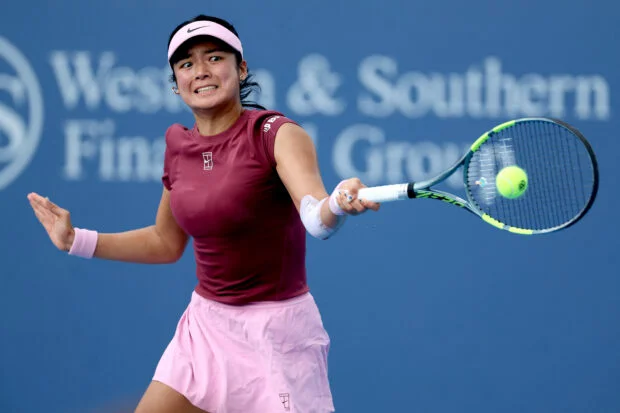
Eala feels it’s too early to line her up beside PH legend, but accepts similarities in their paths
It should be no surprise that Alex Eala understands how Manny Pacquiao’s impact on Filipinos goes beyond the oft-spectacular results of his high-profile bouts.
It is pretty much the same with her own.
Article continues after this advertisement
“When he would have fights, everyone was so excited, and it was just a chance for people to come together,” Eala told a press conference after her 6-0, 3-0 (ret.) victory over Romanian Elena-Gabriela Ruse at the Cincinnati Open last Saturday (Manila time).
Like Pacquiao before, Eala has Filipino sports fans everywhere in the world spellbound and her impact goes beyond match-deep.
In fact, regardless of how her third-round duel against world No. 10 Amanda Anisimova in the third round on Monday turns out, her positive effect on tennis isn’t going to change much.
The 21-year-old ace has been the WTA’s “Big Ticket” over the last two years, drawing crowds to women’s tour events when she competes, largely due to diaspora-strengthened Filipino communities coming together to support her.
Article continues after this advertisement
In fact, it was this sense of community that Eala mentioned—among others—when she was asked to sum up Filipino culture.
“Filipino culture and just every culture in general is very layered. It’s ever-evolving,” she said. “When I think of Filipino culture, what comes to mind is community, family, hospitality, love (and) kindness.”
“That being said, keep in mind that no culture can be summed up in just a couple of words.”
Article continues after this advertisement
Pacquiao, the boxing icon whose exploits in the mid-2000s to 2010s turned him into an international headliner, is widely regarded as the greatest Filipino athlete of all time. Eala is still at the beginning of her career, but what a start it has been. And there is certainly no cap to her potential.
And even as she is well aware of her current place in the Filipino pantheon of sports heroes, she understands that her journey is as unique as the legend she is now being compared to.
“I think I’m still very, very far from the levels of Pacquiao,” the world No. 20 said. “He’s done a lot for us athletes, I think, to pave the way. I mean, it never really crossed my mind when I was watching his fights back home that one day I would be compared to him now.”
“I guess my journey has similar things or can give similar things like [what Pacquiao gave],” Eala added. “I mean, it’s very flattering to be compared to him. But at the same time, I think [we have] two unique journeys. I don’t think one takes away from the other. I think they’re beautiful [journeys] … they both have their own beautiful set of characteristics.”
There are similarities, too. Pacquiao’s fights often emptied streets as people remained glued to their televisions to watch him. Eala’s matches have kept a nation sleepless because of the time zones she competes in.
And both have followers who turn to their exploits for motivation.
“A couple of sentences from them is enough to see a glimpse into their stories or, you know, how tennis has impacted their lives or how being Filipino and their pride has affected them personally,” Eala said. “So I think it’s crazy how inspiration can affect other people to what depths.”
Perhaps because of this, Eala isn’t pinning her success on tournament results—for now.
“I think it’s just the level that I play [that matters],” she said. “Did I bring the level that I wanted to bring? So if I lose first round, but it’s a really good match, I wouldn’t say that it was a successful week, but it wasn’t a bad one.”
“And if I reached the final, then I’ll take that too.” INQ