Sultan of Oman meets UAE's MBZ as Iran-Hormuz talks advance
The talks come as Oman is in the midst of negotiations with Iran over the Strait of Hormuz.
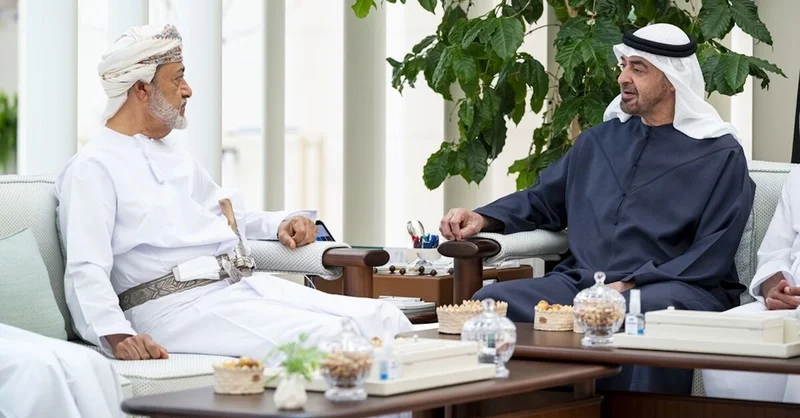
UAE President Mohamed bin Zayed Al Nahyan and Oman's Sultan Haitham bin Tariq met in Abu Dhabi on Monday to discuss bilateral ties and regional developments, as Muscat faces mounting pressure from Washington over its efforts to mediate with Iran and reopen shipping through the Strait of Hormuz.
What happened: Sultan Haitham arrived in the United Arab Emirates on Monday accompanied by a delegation of senior Omani officials, including Deputy Prime Minister for Defense Affairs Sayyid Shihab bin Tariq Al Said and Minister of State and Governor of Muscat Sayyid Bilarab bin Haitham Al Said.
During their meeting, the two leaders discussed “ways to further strengthen cooperation, particularly in the economic and development fields,” according to the UAE’s official news agency, WAM. They also “exchanged views on regional and international issues of joint interest, particularly the serious developments in the Middle East,” WAM reported.
UAE Foreign Minister Abdullah bin Zayed Al Nahyan and First Deputy Ruler of Dubai, Deputy Prime Minister and Minister of Finance Sheikh Maktoum bin Mohammed bin Rashid Al Maktoum were among the Emirati officials attending the meeting.
Background: The UAE and Oman have sought to deepen economic ties in recent years. Bilateral non-oil trade surpassed $15 billion in 2024, according to Oman’s Bank Muscat. During Sultan Haitham’s 2024 visit to the UAE, the two countries announced investment agreements worth about $35 billion spanning renewable energy, green metals, rail connectivity and digital infrastructure. In 2022, the two sides reached an agreement valued at about $3 billion for a rail link connecting the UAE and Oman.
The UAE and Oman have diverged in their approaches to Iran. While Abu Dhabi has generally taken a harder line toward Tehran, Muscat has maintained close ties with Iran and frequently served as an intermediary between Tehran and Washington.
That role has become particularly important as Oman works with Iran to restore commercial shipping through the Strait of Hormuz, which has all but come to a halt during the ongoing US-Iran conflict.
Iranian Foreign Ministry spokesperson Esmail Baghaei said Monday that Tehran and Muscat had reached “an understanding” on the map of a transit route through the strait and were working to finalize the details of an agreement and a joint statement.
The proposed arrangement comes after a June memorandum of understanding between the United States and Iran that sought to establish a framework for reopening the waterway. The memorandum called for Iran and Oman to “conduct dialogue” on the future administration and maritime services in the strait.
The memorandum specified that any such arrangement must be “in line with the applicable international law and the sovereign rights of coastal states of the Strait of Hormuz.” Under international maritime law, coastal states cannot require ships to pay fees or tolls simply for transiting international straits, although they can charge for specific services such as pilotage or towage.
Know more: The US-Iran framework has since broken down, leaving Oman in an increasingly difficult position. President Donald Trump on Monday for the second time threatened military action against Oman, warning that the US would bomb the country if it “gets in the way” of a potential deal between Washington and Tehran. “If Oman gets in the way, we’ll bomb the shit out of them,” Trump told Fox News. He made a similar threat in May.
The threats reflect tensions between Washington and Muscat over Oman’s approach to Iran. The Wall Street Journal reported in June that the Trump administration had come to view Oman’s policy toward Tehran as “hostile” to the US and had pressed the country to distance itself from Iran.