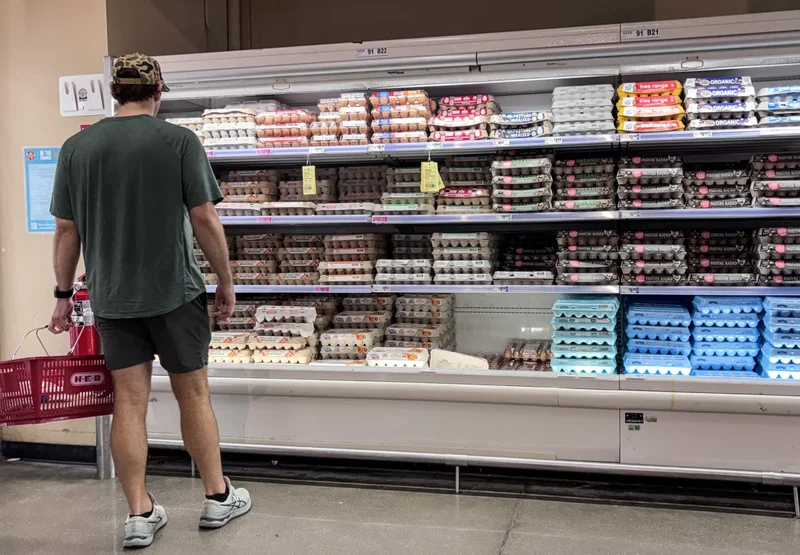
Egg prices have finally stopped punishing American shoppers. A dozen averaged $2.19 in July, down nearly 26% from a year earlier as flocks recovered from avian flu. Now nearly 19 million eggs are carrying a different kind of problem—and the sell-by dates on some of them run through today.
The problem began in July, when Midwest Poultry Services voluntarily recalled white shell and brown cage-free eggs over potential salmonella enteritidis contamination.
The eggs were produced at farms in Texas between June 6 and July 3 and carry sell-by or best-by dates between July 20 and Aug. 17. They were sold under the Kroger, Simple Truth, Brookshire’s, Country Morning and Cal-Maine Sunups brands.
Then on Aug. 12, the Food and Drug Administration classified the recall under its highest-risk category after the eggs were linked to a salmonella outbreak that sickened at least 98 people and hospitalized 26.
The FDA said the Class I designation followed its assessment of the risk to the public and “should not be seen as an expansion or change to a firm’s voluntary public warning.”
Midwest Poultry Services could not immediately be reached for comment. Emily Metz, president and CEO of the American Egg Board, previously stressed that the classification does not represent a new recall. “What you’re seeing in the news today is not a new recall,” she said in a statement provided to the New York Times, adding that the company’s voluntary recall “is already complete.”
Consumers bought them at Kroger stores in Texas and Louisiana and Brookshire Grocery stores in Texas, Oklahoma, Arkansas, Louisiana, New Mexico and Mississippi, along with smaller retail outlets, according to the FDA. Kroger said in July that “all eggs currently available for purchase in our stores were sourced from a different production facility,” according to Reuters.
The outbreak has stretched well beyond the states where the recalled eggs were sold. As of July 24, people across 17 states had been infected with the outbreak strain, according to the Centers for Disease Control and Prevention. No deaths have been reported. Texas accounts for the large majority of cases, but illnesses also turned up in states including Michigan and New York, which are outside the states identified in the FDA’s distribution information.
That mismatch is one reason an investigation isn’t over. The FDA said epidemiological, laboratory and traceback evidence points to Midwest Poultry Services eggs as a likely source, but that the producer “does not account for all the illnesses in this outbreak.”
Illnesses began on dates ranging from Nov. 21, 2025, to June 30, 2026—a seven-month span. Of the 44 people interviewed about what they ate before getting sick, 40 reported eating eggs.
Midwest Poultry Services said it identified the potential contamination at two Texas farms through environmental monitoring and root-cause analysis, and that whole-genome sequencing by a third-party lab matched some samples to the outbreak strain. The company stopped distributing fresh eggs from those farms in July.
Salmonella typically causes diarrhea, fever and abdominal cramps 12 to 72 hours after eating contaminated food, with symptoms lasting four to seven days. Children under five, older adults and people with weakened immune systems face the greatest risk of severe illness.
Consumers can identify recalled cartons by the codes P-1950 or 0840962 alongside a Julian date between 157 and 184, printed in date-coding ink on the side of the carton. The FDA says consumers should not eat the eggs and should return them for a full refund, or throw them away if they’re no longer in their original packaging.
breaks the traditional barrier between audience and newsroom. The show transforms
Fortune DailyFortune’s trusted reporting into actionable, conversational, and entertaining insights for an emerging class of business leaders.
Watch here.