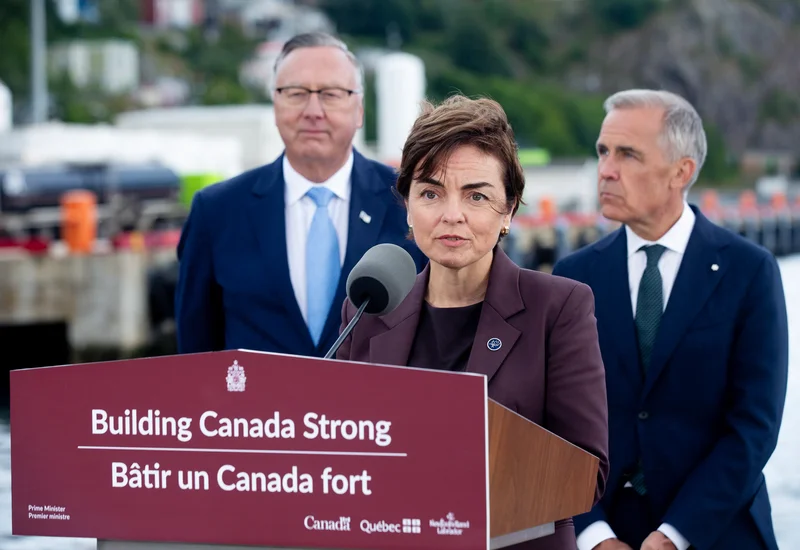
Quebec and Newfoundland and Labrador have salvaged a deal to jointly develop untapped hydroelectric resources on the Churchill River, thanks to hefty subsidies and insistent nudging from Ottawa as Prime Minister Mark Carney seeks to kick-start major infrastructure projects and double Canada’s electricity production by 2050.
The new agreement touts potential investments of $70-billion in new hydro, wind and transmission projects along the river, which runs through Labrador to the Atlantic Ocean. That is more than twice the amount contemplated under a 2024 Memorandum of Understanding between Hydro-Québec and Newfoundland and Labrador Hydro, the fate of which had been in peril since a 2025 change in government in St. John’s.
The total amount of new capacity could approach 9,000 megawatts (MW). Based on average energy consumption, that amount of electricity would be enough to supply between five million and nine million homes.
The revised deal, which the utilities seek to finalize by Dec. 31, would resolve a decades-long dispute between the two provinces over the risibly low price Hydro-Québec pays for power from an existing generating facility in Labrador.
But with a fall election scheduled in Quebec, the new deal could end up caught in political turbulence similar to what the MOU faced.
The new deal also comes with a major caveat: Half of the 9,000 MW total would come from two projects – a 2,000 MW wind power project and a second 2,500 MW generating station at Churchill Falls – that are contingent on feasibility studies that could take years to complete.
The crux of the revised deal between the two provincial utilities involves the construction of a $30-billion, 2,700 MW hydro generating station at Gull Island, up from 2,250 MW projected under the MOU.
The new station would be downstream from the existing 5,400 MW facility at Churchill Falls. The latter’s capacity would be increased by 1,275 MW at a projected cost of $4-billion. Another $10-billion would be spent on new transmission lines.
Mr. Carney’s government substantially greased the wheels to facilitate the new deal, putting up billions of dollars in clean-energy tax credits and loan guarantees. Federal loan guarantees on Gull Island would alone exceed $20-billion.
Privy Council Clerk Michael Sabia, who led the negotiations for Quebec on the 2024 MOU as the then-head of Hydro-Québec, was a key actor in the talks, along with federal Natural Resources Minister Tim Hodgson.
Ottawa’s aid amounts to an unprecedented degree of federal involvement in a sector that has traditionally been the fiercely protected preserve of the provinces. But Mr. Hodgson defended his government’s interventionist approach, which includes federal support for small modular reactors in Ontario and a new transmission line in British Columbia.
Quebec and Newfoundland and Labrador unveiled a tentative agreement to share energy from Labrador. The deal is worth billions, but the looming election in Quebec, alongside the possibility of a Parti Québécois government, could put final agreements in jeopardy.
The Canadian Press
“In a world that is more divided and dangerous every day, where we are staring down the barrel of a trade war, our Prime Minister and government have been incredibly clear that, while we cannot control what others do, we can be masters in our own house and we build more than others can take away,” Mr. Hodgson said in an interview. “That is the entire premise of our electricity strategy.”
Newfoundland’s Progressive Conservative Premier, Tony Wakeham, had demanded major changes to the MOU negotiated by his Liberal predecessor, Andrew Furey, and former Coalition Avenir Québec premier François Legault. Mr. Wakeham insisted that more power from new developments be reserved for economic development in Labrador.
His demands left current CAQ Premier Christine Fréchette scrambling to save the MOU before an Oct. 5 provincial election. Monday’s announcement of a revised deal comes on the eve of the official start to the campaign. The election must be called no later than Aug. 29 but is expected to be called a few days earlier. Ms. Fréchette’s party trails far behind the sovereigntist Parti Québécois in polls, leaving the fate of the new deal unclear.
Hydro-Québec and Newfoundland and Labrador Hydro aim to turn Monday’s deal into a definitive agreement by year-end. A PQ government could back out before then.
The 2024 MOU constituted a major breakthrough between the two provinces, which had been feuding for decades over a 1969 power-purchase contract. Newfoundland had sought to renegotiate the contract under which Hydro-Québec buys 90 per cent of the electricity from Churchill Falls at a pittance and resells it at huge multiples in Quebec and the United States. The contract has historically accounted for the bulk of Hydro-Québec’s profits.
Mr. Legault was the first Quebec premier to consider revising the contract, in part because its 2041 expiry date left Hydro-Québec facing a potential energy shortfall in future decades. Locking in access to Churchill Falls power beyond 2041 is critical to keeping hydro rates comparatively lower in Quebec than elsewhere in North America.
The Quebec utility has also set an ambitious goal of nearly doubling its capacity by 2050, a goal that would be much harder and more expensive to achieve without power from Labrador.
The new deal would replace the 1969 contract with a long-term power-purchase agreement that would see Newfoundland pocket billions more for electricity from Churchill Falls between 2027 and 2077.
Hydro-Québec currently pays a mere 0.2 cents per kilowatt-hour for power from Churchill Falls. Under the revised deal, it would pay an effective price of 7.4 cents per kwh over the 50-year period. The Quebec utility’s net cost would be 6 cents per kwh, since Hydro-Québec owns 34.2 per cent of Churchill Falls and shares in profits from the project.
Unlike the MOU, the revised deal would allow Newfoundland to sell up to 985 MW of power from Churchill Falls and new developments at prevailing market prices. While Newfoundland would not technically be allowed to “wheel” power through Quebec to buyers in neighbouring provinces and U.S. states, the price Hydro-Québec pays for that 985 MW block of power would be based on spot market prices in those markets.
The new deal constitutes a political gamble for Ms. Fréchette as she campaigns to keep the Premier’s job that she inherited after winning the CAQ leadership in April. She faces opposition accusations of capitulating to Newfoundland’s demands in order to save her political skin.
The PQ’s recently published “blue book” on sovereignty says a PQ-led Quebec would seek compensation from Newfoundland for the 1927 decision by Britain’s Judicial Committee of the Privy Council to take Newfoundland’s side in a dispute over the Quebec-Labrador boundary. PQ MNA Pascal Paradis recently said a PQ government would make compensation for the loss of territory Quebec previously claimed as its own figure prominently in any future negotiations over Churchill Falls.
Still, a PQ government would face strong incentives to preserve Monday’s revised deal. Alternative hydro developments in Quebec would not only be more expensive than new projects on the Churchill River but would also likely run into resistance from Indigenous communities and other opponents.
What’s more, cyclically low water levels in Hydro-Québec’s own reservoirs have already taken a toll on the utility’s profitability, forcing it to cut historically lucrative exports and import more U.S. power to meet peaks in domestic demand. In 2025, Hydro-Québec became a net importer of power for the first time, with imports reaching 15.2 terawatt-hours compared to 11.8 twh of exports. In 2021, exports exceeded imports by more than 35 twh.