June had come and gone. It was almost the end of July. But Babul Bora of eastern Assam’s Golaghat district was still waiting for rains to sow paddy.
This was unusual. Monsoon typically arrives in Assam in the first week of June. Between mid-June and mid-July, farmers across the region get busy in sowing and transplanting paddy.
“Khorang asile,” Bora told Scroll. “There was a drought.” The 56-year old cultivator from Balidowa village in Pachim Brahmaputra panchayat saw cracks appear in his fields.
Many other villages in Golaghat recorded such conditions. According to reports by district authorities, three of Golaghat’s six revenue circles faced “drought-like” conditions as of July 14.
Four days later, disaster struck.
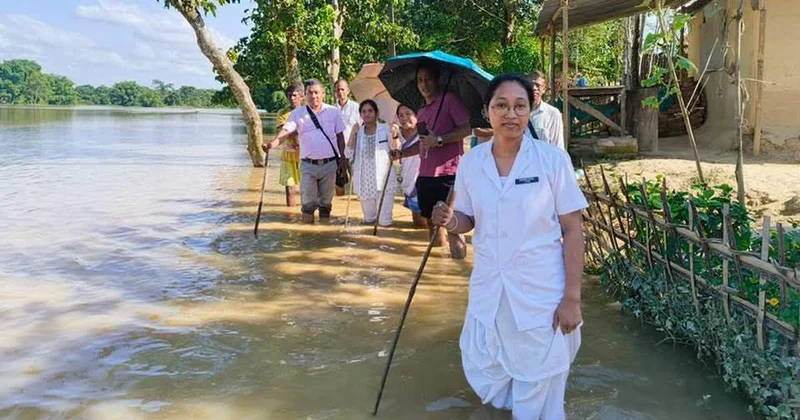
On July 19, heavy rain caused the Gelabil river near Bora’s village to swell up, submerging homes and farmlands.
In the week between July 16 and 22, Golaghat received 147% more rain than usual, data from the India Meteorological Department shows.
Golaghat became one of the four worst-hit flood districts in Assam. Over 100 people have lost their lives and around seven lakh people displaced across the state in devastating floods. The waters have wreaked havoc in Upper Assam, areas which have rarely seen such intense floods in the past.
“The floodwater killed us,” said Bora. The water has not receded from his fields even today.
For the first time since 1998, Bora’s family has not been able to sow paddy. “It is the first time that we have suffered drought and flood at the same time,” he said. “It is a disaster.”
In Sarupatha revenue circle, official documents that Scroll saw indicated that 57 villages were affected by drought-like situation, impacting over 12,000 farmers.
Six of these villages were subsequently flooded, according to the flood report prepared by the district disaster management authority.
Dipok Gogoi, a cultivator of Kenduguri village under Morongi revenue office, faced drought-like conditions followed by floods a few days later. His family managed to sow paddy around August 1 by pumping up groundwater. Six days later, his village was inundated. “Ten bighas of our paddy fields are still under water,” said Gogoi.
But, strikingly, even as fields remain inundated and uncultivable in Golaghat, latest data from the met department shows that between August 6 and August 12, the total rain the district received is still short by 45%.
‘A dual risk’
Golaghat has always been vulnerable to both droughts and floods. But scientists point out that what might be changing is the nature and impact of these extremes.
“Our district-level assessment identifies Golaghat, Dibrugarh, Sivasagar, Charaideo and South Salmara–Mankachar as facing dual risks of both flood and drought,” said Surbhi Vyas, a research fellow with Centre for Disaster Management and Research at Indian Institute of Technology, Guwahati.
A 2024 District Level Climate Risk Assessment, which included inputs from Vyas, noted that Golaghat is susceptible to floods “due to its proximity to the Brahmaputra river” and excess rain than usual in some places.
At the same time, the district has also experienced drought in the last few decades “due to erratic rainfall, especially in August and September.”
That is true of the region as a whole. A 2015 study found that the south-west monsoon rainfall in the North East has “gradually dropped” compared to the 1980s and 1990s, resulting in drought conditions.
In recent years, the Assam government has declared several districts as drought hit – specifically Golaghat in 2021.
This year, from the beginning of June till July 15, Golaghat district received “large deficient” or “deficient” rain ranging between 30% and 80% lesser than usual, barring one week in late June.
This delayed paddy cultivation in almost 90 villages in revenue circles of Golaghat, Sarupathar, and Morongi.
In Sarupatha revenue circle, the circle officer wrote to the district management disaster authority on July 17 apprising the office of the “drought-like situation” because of which “agricultural activities especially paddy cultivation, have not started in some villages.”
The situation even prompted a discussion about drought-like conditions in the state’s Assembly in early July, suggesting that the dry conditions were pushing farmers to distress.
“Just a day before the flood hit on July 19, we were planning to issue a notification to make arrangements for water in the paddy field through pipes from the rivers,” Rupam Jyoti Borah, Golaghat district project officer of state disaster management authority, told Scroll.
The shortening of the window between two disasters could be due to “more intense short duration rainfall events,” said Akshay Deoras, senior research scientist with National Centre for Atmospheric Science and Department of Meteorology at the University of Reading in England. His research focus included Indian monsoon.
“A district can experience a prolonged dry spell, with soils drying out and water availability coming under pressure, and then receive a very large amount of rainfall within a short period,” Deoras said. “[But] the ground and drainage systems may not be able to absorb or carry the water away quickly enough, leading to flash flooding.”
Sanjay O’Neill Shaw, scientist at IMD’s Regional Meteorology Centre, Guwahati agreed. “Since this is an El-Nino year, we were prepared that there will be comparatively lower rainfall which has led to an overall deficit.”
As of August 13, Assam has received__ 38%__ less rainfall than usual since the start of the monsoon in June, putting the state in the category of states with “deficient” rainfall. But, Shaw said, some rainfall spells like the one experienced on July 19, have been very heavy.
Climate change? Jury out
The Assam government pinned the responsibility on “exceptionally” heavy rainfall in Nagaland. A statement issued by the state’s chief secretary on July 22 stated that an “extreme hydrometeorological” event over the Nagaland hill catchments during July 18-July 20” rather than “merely local rainfall or drainage congestion” in the downstream districts was responsible.
This resulted in “unusually high river flows and flash flooding in areas not normally flood-prone,” said the statement.
Climate scientists, however, contended that the high rainfall was not out of the ordinary, and it was unlikely that it was connected to climate change.
Soon after the floods, scientists from across the world used peer-reviewed climate models to assess both short, high intensity downpours and longer rainfall data in Assam to assess if the flood was an extreme weather event attributing to climate change.
They found that the heaviest three-day rainfall observed in this region in June and July were “routine events expected roughly one to two years,” a press release by the scientists, part of the World Weather Attribution said.
Connecting flood-drought risk to climate change, however, “would require a dedicated long-term trend and event attribution analysis,” said IIT’s Guwahati's Vyas.
The data they analysed “suggest no discernible role of climate change”, said Mariam Zachariah, research associate in Extreme Weather and Climate Change at the Imperial College London in an online press briefing on August 13.
Instead, the scientists pointed out that unplanned urbanisation and riverbank erosion have degraded the natural drainage capacity of rivers, increasing flood height and downstream impacts.
“Construction, changes in drainage, loss of wetlands and other land-use changes can mean that the same amount of heavy rainfall produces a much greater impact than it might have in the past,” said Deoras, from the University of Reading.
Local residents highlighted other factors. Gunandra Bharali, a retired government teacher of Pachim Brahmaputra panchayat said that the rising waters of Gelabil river in his village caused most of the flooding.
The river, he said, rose because of the release of water from Nagaland’s Doyang Hydropower project, inundating all 10 village wards of his panchayat. He lost all his paddy saplings and his 16-bigha farmland is now under water, a loss of about Rs 3 lakh, he estimated. Scroll has seen a statement from the Doyang dam authorities, dated July 22, that confirmed Bharali’s claim. “The project has been wreaking havoc for the last three years,” he said.
After continuous rainfall on July 30 in Nagaland, the dam authorities opened three sluice gates of the Doyang project, a process that continued till August 9, which led to some rivers flowing above the danger mark.
Meanwhile, farmers in Golaghat district continue to reel from the impacts of two calamities within days. “The rice we get from the paddy field is enough for the whole year, and we can sell and earn the rice for another Rs 50,000,” said Bora. But his three bighas of land with a crop of cucumber and ridge gourd and a green house with leafy vegetables lie damaged. “I have crop insurance for one hectare of paddy, hopefully the government will provide us compensation.”
We welcome your comments at letters@scroll.in.